<?xml version="1.0" encoding="UTF-8"?><rss version="2.0"
	xmlns:content="http://purl.org/rss/1.0/modules/content/"
	xmlns:dc="http://purl.org/dc/elements/1.1/"
	xmlns:atom="http://www.w3.org/2005/Atom"
	xmlns:sy="http://purl.org/rss/1.0/modules/syndication/"
	xmlns:itunes="http://www.itunes.com/dtds/podcast-1.0.dtd"
	>
<channel>
	<title>Comments on: Orthodox Chanting</title>
	<atom:link href="http://www.pbs.org/wnet/religionandethics/episodes/april-10-2009/orthodox-chanting/2625/feed/" rel="self" type="application/rss+xml" />
	<link>http://www.pbs.org/wnet/religionandethics/episodes/april-10-2009/orthodox-chanting/2625/</link>
	<description>An online companion to the weekly television news program</description>
	<lastBuildDate>Wed, 09 Dec 2009 20:18:44 -0500</lastBuildDate>
	<generator>http://wordpress.org/?v=2.8.4</generator>
	<sy:updatePeriod>hourly</sy:updatePeriod>
	<sy:updateFrequency>1</sy:updateFrequency>
		<item>
		<title>By: Rdr Mo</title>
		<link>http://www.pbs.org/wnet/religionandethics/episodes/april-10-2009/orthodox-chanting/2625/comment-page-1/#comment-2217</link>
		<dc:creator>Rdr Mo</dc:creator>
		<pubDate>Thu, 20 Aug 2009 00:08:22 +0000</pubDate>
		<guid isPermaLink="false">http://www.pbs.org/wnet/religionandethics/?p=2625#comment-2217</guid>
		<description>I agree entirely with what Fr. Michael has said above. In addition to being a wise Priest (and excellent chanter himself), Fr. Michael is one of only 2 or 3 people in the whole nation who can hold an ison without going flat.</description>
		<content:encoded><![CDATA[<p>I agree entirely with what Fr. Michael has said above. In addition to being a wise Priest (and excellent chanter himself), Fr. Michael is one of only 2 or 3 people in the whole nation who can hold an ison without going flat.</p>
]]></content:encoded>
	</item>
	<item>
		<title>By: Fr. Michael Shanbour</title>
		<link>http://www.pbs.org/wnet/religionandethics/episodes/april-10-2009/orthodox-chanting/2625/comment-page-1/#comment-2210</link>
		<dc:creator>Fr. Michael Shanbour</dc:creator>
		<pubDate>Tue, 18 Aug 2009 20:19:37 +0000</pubDate>
		<guid isPermaLink="false">http://www.pbs.org/wnet/religionandethics/?p=2625#comment-2210</guid>
		<description>Hi ya&#039;ll!  Yes, a beautiful interview and most non-Orthodox will not notice any imprecisions in explanation.

However, for us Orthodox, I think we need to be more precise in our understanding of our musical tradition since it relates to the very essence of Orthodoxy.

I&#039;m sure what Emily meant is that it is the THEOLOGY of the hymns that takes precedence.  Unlike much western church music we are singing theological and dogmatic truths, even if poetical.  It is true, we don&#039;t fit words that are inadequate theologically into some music that we happen to like.

On the other hand, the music that developed in the Church is indeed inspired and sacred - like all other facets of Holy Tradition.  That music was monophonic with an e-son, even in the Slavic tradition (until Peter the Great and his western reforms).  Our music is sacred not because it produces emotions, but because it targets the &quot;nous&quot;, the inner man, the place where God communicates and reveals himself to man.  And most non-Orthodox music does not do that.

Forgive me, but this is so crucial, and we Orthodox are often missing the mark in this regard.  If we do not comprehend this and embrace it we will soon change our music (as we have already to some extent) and end up with something completely emotional.  The same is true with iconography.  The reason we should not have westernized iconography is not because it is &quot;bad art,&quot; but because our iconographic tradition is salvific inasmuch as it communicates to the nous (not merely to the rational mind OR emotions).  It is deeper and it is transformative.

And it is for this reason that new comers to Orthodoxy often are not attracted immediately to either the music or the iconography (although some are of course).  It is alien not just because it is &quot;eastern&quot;, but because it is truly spiritual, other-worldly, noetic -- meant to hit us in the nous (in this sense it is absolutely &quot;universal&quot; since we all have a nouse).  If the nous is deadened or we have replaced it with something else, we will not be able to appreciate or absorb it.

Hope I haven&#039;t been a nous-ance!

Fr. Michael Shanbour</description>
		<content:encoded><![CDATA[<p>Hi ya&#8217;ll!  Yes, a beautiful interview and most non-Orthodox will not notice any imprecisions in explanation.</p>
<p>However, for us Orthodox, I think we need to be more precise in our understanding of our musical tradition since it relates to the very essence of Orthodoxy.</p>
<p>I&#8217;m sure what Emily meant is that it is the THEOLOGY of the hymns that takes precedence.  Unlike much western church music we are singing theological and dogmatic truths, even if poetical.  It is true, we don&#8217;t fit words that are inadequate theologically into some music that we happen to like.</p>
<p>On the other hand, the music that developed in the Church is indeed inspired and sacred &#8211; like all other facets of Holy Tradition.  That music was monophonic with an e-son, even in the Slavic tradition (until Peter the Great and his western reforms).  Our music is sacred not because it produces emotions, but because it targets the &#8220;nous&#8221;, the inner man, the place where God communicates and reveals himself to man.  And most non-Orthodox music does not do that.</p>
<p>Forgive me, but this is so crucial, and we Orthodox are often missing the mark in this regard.  If we do not comprehend this and embrace it we will soon change our music (as we have already to some extent) and end up with something completely emotional.  The same is true with iconography.  The reason we should not have westernized iconography is not because it is &#8220;bad art,&#8221; but because our iconographic tradition is salvific inasmuch as it communicates to the nous (not merely to the rational mind OR emotions).  It is deeper and it is transformative.</p>
<p>And it is for this reason that new comers to Orthodoxy often are not attracted immediately to either the music or the iconography (although some are of course).  It is alien not just because it is &#8220;eastern&#8221;, but because it is truly spiritual, other-worldly, noetic &#8212; meant to hit us in the nous (in this sense it is absolutely &#8220;universal&#8221; since we all have a nouse).  If the nous is deadened or we have replaced it with something else, we will not be able to appreciate or absorb it.</p>
<p>Hope I haven&#8217;t been a nous-ance!</p>
<p>Fr. Michael Shanbour</p>
]]></content:encoded>
	</item>
	<item>
		<title>By: Minerva Sabbagh</title>
		<link>http://www.pbs.org/wnet/religionandethics/episodes/april-10-2009/orthodox-chanting/2625/comment-page-1/#comment-1588</link>
		<dc:creator>Minerva Sabbagh</dc:creator>
		<pubDate>Mon, 25 May 2009 01:18:29 +0000</pubDate>
		<guid isPermaLink="false">http://www.pbs.org/wnet/religionandethics/?p=2625#comment-1588</guid>
		<description>Truly, when one chants or sings in the choir it is God filling us with His beauty and His love and allowing us with His power to be able to chant with feeling and reverance.  This is one way of worshipping our Lord and Jesus Christ--we  are like the Cherubim praising His holy Name.</description>
		<content:encoded><![CDATA[<p>Truly, when one chants or sings in the choir it is God filling us with His beauty and His love and allowing us with His power to be able to chant with feeling and reverance.  This is one way of worshipping our Lord and Jesus Christ&#8211;we  are like the Cherubim praising His holy Name.</p>
]]></content:encoded>
	</item>
	<item>
		<title>By: Julia</title>
		<link>http://www.pbs.org/wnet/religionandethics/episodes/april-10-2009/orthodox-chanting/2625/comment-page-1/#comment-1530</link>
		<dc:creator>Julia</dc:creator>
		<pubDate>Fri, 22 May 2009 15:30:12 +0000</pubDate>
		<guid isPermaLink="false">http://www.pbs.org/wnet/religionandethics/?p=2625#comment-1530</guid>
		<description>I have attended many Catholic Masses where everything is sung.  I&#039;m in my 60s and that was how all high Masses were done in older times. You can still see Mass with everything, including all the readings, sung in Latin and various modern languages at St Peter&#039;s in Rome. 

There are a number of Eastern Catholic rites that are religiously in union with Rome, although otherwise autonimous; it is countries that recognize Vatican City and exchange ambassadors politically, not churches.</description>
		<content:encoded><![CDATA[<p>I have attended many Catholic Masses where everything is sung.  I&#8217;m in my 60s and that was how all high Masses were done in older times. You can still see Mass with everything, including all the readings, sung in Latin and various modern languages at St Peter&#8217;s in Rome. </p>
<p>There are a number of Eastern Catholic rites that are religiously in union with Rome, although otherwise autonimous; it is countries that recognize Vatican City and exchange ambassadors politically, not churches.</p>
]]></content:encoded>
	</item>
	<item>
		<title>By: John-Bob</title>
		<link>http://www.pbs.org/wnet/religionandethics/episodes/april-10-2009/orthodox-chanting/2625/comment-page-1/#comment-1415</link>
		<dc:creator>John-Bob</dc:creator>
		<pubDate>Sat, 09 May 2009 02:03:25 +0000</pubDate>
		<guid isPermaLink="false">http://www.pbs.org/wnet/religionandethics/?p=2625#comment-1415</guid>
		<description>From what I understand, BYzantine Catholics are churches of the Orthodox that are politically tied to Rome.</description>
		<content:encoded><![CDATA[<p>From what I understand, BYzantine Catholics are churches of the Orthodox that are politically tied to Rome.</p>
]]></content:encoded>
	</item>
	<item>
		<title>By: Nomilk</title>
		<link>http://www.pbs.org/wnet/religionandethics/episodes/april-10-2009/orthodox-chanting/2625/comment-page-1/#comment-1348</link>
		<dc:creator>Nomilk</dc:creator>
		<pubDate>Sun, 03 May 2009 12:13:16 +0000</pubDate>
		<guid isPermaLink="false">http://www.pbs.org/wnet/religionandethics/?p=2625#comment-1348</guid>
		<description>Indeed He is risen!

Very nice piece.

One thought: the Orthodox Church is not unique in its sung liturgy.  Many of the Eastern churches have sung liturgy, including the Byzantine rites within the Catholic Church.</description>
		<content:encoded><![CDATA[<p>Indeed He is risen!</p>
<p>Very nice piece.</p>
<p>One thought: the Orthodox Church is not unique in its sung liturgy.  Many of the Eastern churches have sung liturgy, including the Byzantine rites within the Catholic Church.</p>
]]></content:encoded>
	</item>
	<item>
		<title>By: Dennis Menos</title>
		<link>http://www.pbs.org/wnet/religionandethics/episodes/april-10-2009/orthodox-chanting/2625/comment-page-1/#comment-1242</link>
		<dc:creator>Dennis Menos</dc:creator>
		<pubDate>Sat, 25 Apr 2009 10:44:48 +0000</pubDate>
		<guid isPermaLink="false">http://www.pbs.org/wnet/religionandethics/?p=2625#comment-1242</guid>
		<description>Emily Lowe has a beutiful voice. Even greater is her faith, and that is what&#039;s more important.</description>
		<content:encoded><![CDATA[<p>Emily Lowe has a beutiful voice. Even greater is her faith, and that is what&#8217;s more important.</p>
]]></content:encoded>
	</item>
	<item>
		<title>By: Andy Ghiz</title>
		<link>http://www.pbs.org/wnet/religionandethics/episodes/april-10-2009/orthodox-chanting/2625/comment-page-1/#comment-1212</link>
		<dc:creator>Andy Ghiz</dc:creator>
		<pubDate>Tue, 21 Apr 2009 23:46:17 +0000</pubDate>
		<guid isPermaLink="false">http://www.pbs.org/wnet/religionandethics/?p=2625#comment-1212</guid>
		<description>Christ is Risen!

That is a wonderful article! Thank God for all those who labored in the Kazan project (and others) to convert the hymns into English/Western Notation, and for all those laboring to learn the Eight Tones in English.

Two comments related to other comments:

1. There is no longer a &quot;diaspora&quot;.
2. Singing (chanting or intoning) was introduced for the Liturgy and other services not necessarily because of the &quot;beauty&quot;, but mostly because in the time prior to microphones and speakers, it was the best way to project the voice.</description>
		<content:encoded><![CDATA[<p>Christ is Risen!</p>
<p>That is a wonderful article! Thank God for all those who labored in the Kazan project (and others) to convert the hymns into English/Western Notation, and for all those laboring to learn the Eight Tones in English.</p>
<p>Two comments related to other comments:</p>
<p>1. There is no longer a &#8220;diaspora&#8221;.<br />
2. Singing (chanting or intoning) was introduced for the Liturgy and other services not necessarily because of the &#8220;beauty&#8221;, but mostly because in the time prior to microphones and speakers, it was the best way to project the voice.</p>
]]></content:encoded>
	</item>
	<item>
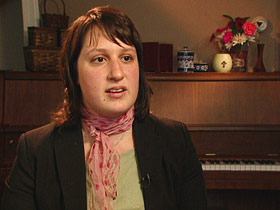
		<title>By: Emily Lowe</title>
		<link>http://www.pbs.org/wnet/religionandethics/episodes/april-10-2009/orthodox-chanting/2625/comment-page-1/#comment-1206</link>
		<dc:creator>Emily Lowe</dc:creator>
		<pubDate>Tue, 21 Apr 2009 12:00:16 +0000</pubDate>
		<guid isPermaLink="false">http://www.pbs.org/wnet/religionandethics/?p=2625#comment-1206</guid>
		<description>I just discovered these comments and have enjoyed reading them!  You all have blessed me greatly.  It&#039;s an honor to sing in praise of Christ, our true God.

I am not a theologian, and my musical training is largely limited to instrumental skill (I&#039;m a piano teacher who just loves to sing!)  I have read and studied a fair amount of other scholars&#039; words about chanting, so forgive me if I&#039;ve misquoted them.

What I meant about the music not being sacred was part of a much larger discussion about translation.  (They took probably 8 hours of footage for those two minutes!)  The problem I&#039;ve seen in modern Orthodoxy is that many of the hymns were composed in Greek or Arabic, and the melodies have become so beloved by the people that they try to force English words on them, often with awkward and ugly results.  The example I&#039;ve heard is the famous Tone 5 Christos Anesti, &quot;Christ is Risen.&quot;  In English, we sing, &quot;O Christ is risen,&quot; in order to preserve the melody in its original form.  That seems odd to me, as we don&#039;t sing those words to any other melodies, whether Arabic, Romanian, Serbian, etc.

As a musician, of course, I believe strongly that the tones and melodies of the church are sacred.  They have the power to transform hearts and to communicate on a level that is beyond words and rational thought.  If it weren&#039;t for melody, I couldn&#039;t attend Matins on Patmos and sing along with the Evlogetaria in my heart!

Really, the problem of translation (although a frustrating one) is a good problem to have.  It means the word of Christ is being spread to many different cultures.  I am honored and humbled to be a part of that ministry.</description>
		<content:encoded><![CDATA[<p>I just discovered these comments and have enjoyed reading them!  You all have blessed me greatly.  It&#8217;s an honor to sing in praise of Christ, our true God.</p>
<p>I am not a theologian, and my musical training is largely limited to instrumental skill (I&#8217;m a piano teacher who just loves to sing!)  I have read and studied a fair amount of other scholars&#8217; words about chanting, so forgive me if I&#8217;ve misquoted them.</p>
<p>What I meant about the music not being sacred was part of a much larger discussion about translation.  (They took probably 8 hours of footage for those two minutes!)  The problem I&#8217;ve seen in modern Orthodoxy is that many of the hymns were composed in Greek or Arabic, and the melodies have become so beloved by the people that they try to force English words on them, often with awkward and ugly results.  The example I&#8217;ve heard is the famous Tone 5 Christos Anesti, &#8220;Christ is Risen.&#8221;  In English, we sing, &#8220;O Christ is risen,&#8221; in order to preserve the melody in its original form.  That seems odd to me, as we don&#8217;t sing those words to any other melodies, whether Arabic, Romanian, Serbian, etc.</p>
<p>As a musician, of course, I believe strongly that the tones and melodies of the church are sacred.  They have the power to transform hearts and to communicate on a level that is beyond words and rational thought.  If it weren&#8217;t for melody, I couldn&#8217;t attend Matins on Patmos and sing along with the Evlogetaria in my heart!</p>
<p>Really, the problem of translation (although a frustrating one) is a good problem to have.  It means the word of Christ is being spread to many different cultures.  I am honored and humbled to be a part of that ministry.</p>
]]></content:encoded>
	</item>
	<item>
		<title>By: Fr. Jerry Kramer</title>
		<link>http://www.pbs.org/wnet/religionandethics/episodes/april-10-2009/orthodox-chanting/2625/comment-page-1/#comment-1198</link>
		<dc:creator>Fr. Jerry Kramer</dc:creator>
		<pubDate>Sun, 19 Apr 2009 19:57:19 +0000</pubDate>
		<guid isPermaLink="false">http://www.pbs.org/wnet/religionandethics/?p=2625#comment-1198</guid>
		<description>This is just wonderful! So uplifting! Happy Pascha to all Orthodox friends.</description>
		<content:encoded><![CDATA[<p>This is just wonderful! So uplifting! Happy Pascha to all Orthodox friends.</p>
]]></content:encoded>
	</item>
</channel>
</rss>