
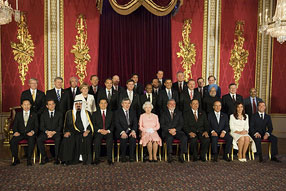
Photo Credit: www.kremlin.ru |
Buzzwords appears each Friday on the Wide Angle blog and breaks down the lingo, jargon and hot topics of the world’s headlines.
Erin Chapman
As the Obamas delivered newfangled gifts to Queen Elizabeth, the G-20 finance ministers and heads of state were sharpening their claws in preparation for a spending vs. regulation cat fight. Quoth Sarkozy, “Miaou.” Now that all the fuss seems to have simmered into a compromise to spend $1 trillion and impose stricter regulation measures, we’re all left to ponder — who exactly is the G-20, again? Are they related to the G-7? And what’s with the G-8?
The G-20 (or Group of Twenty) was established in 1999 as a forum for finance ministers and central bank governors of important industrialized and developing economies to discuss hot topics in global economic policy. It was created as a response to the financial crises of the late ’90s and a realization that key emerging markets needed to be included in decision-making. Like any new endeavor, there were a few false starts, with a G-22 conference and a G-33 conference. Even “G-20” is a bit misleading in its name (economists fudging the numbers — surprise, surprise). The G-20 actually consists of 19 member countries and one representative from the European Union, as well as power players from the IMF and the World Bank. The nations are: Argentina, Australia, Brazil, Canada, China, France, Germany, India, Indonesia, Italy, Japan, Mexico, Russia, Saudi Arabia, South Africa, South Korea, Turkey, the United Kingdom and the U.S.A. The countries were selected on the basis of their significance for the international financial system — as well as geographic location and population representation — and the member countries have remained the same since the G-20’s inception.
This year, the chairmanship is held by the U.K.; South Korea takes over in 2010. With no permanent staff, it is the chair’s responsibility to establish a pro tem team to organize the summits. Continuity between meetings is maintained by a managing body called the Troika, made up of the past, present and future chairs — who no doubt go on to teach Ebeneezer Scrooge a lesson about the true meaning of Christmas. Normally, the G-20 meets annually to consider policy challenges and options. In the increasingly grim global economic climate, country leaders have now joined their financial policy wonks on two occasions in the past 6 months.
While the G-20 incorporates developing economies, the G-7 is a forum of only industrial economic powers: Canada, France, Germany, Italy, Japan, the United Kingdom and the United States.
The G-8 consists of the heads of state of the G-7 nations, as well as Russia. Macroeconomics is always on their plate, but in recent years the discussions have expanded to incorporate issues like energy and terrorism.
Enough G’s for you? I suppose we’ll leave the G-5, G-10, G-15, G-20, G-24, G-30 and G-77 for some other Friday….
(Sources: Christian Science Monitor, G20.org, University of Toronto G8 Information Centre)
