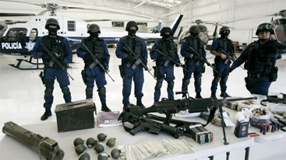
Weapons seized by the Mexican Policia Federal Preventiva under the Merida Initiative |
Buzzwords appears each Friday on the Wide Angle blog and breaks down the lingo, jargon and hot topics of the world’s headlines.
Erin Chapman
In the last 15 months, over 7,000 lives have been claimed in Mexico’s drug-related violence. U.S. pundits are calling Mexico a ‘failed state.’ The administration’s new pick for ambassador to Mexico Carlos Pascual is, in fact, an expert in failed states. After years of ineffectual policy, how will the U.S help its neighbor pull out of this downward spiral? And lo, Obama smiled and sent unto the troubled state his only appointed Clinton….
Secretary of State Hillary Clinton visited Mexico this week and vowed to help speed the delivery of equipment promised in the Merida Initiative, a security partnership between the U.S., Mexico and other Central American nations to combat drug trafficking and organized crime.
The Merida Initiative was named for the city where ex-President George W. Bush and current Mexican President Felipe Calderon met in 2007 to discuss expanded counternarcotics efforts in the region. (Honestly, isn’t it a bit surprising there aren’t any initiatives named the Crawford Ranch Initiative?) In the months after their meeting, officials from both governments met to hash out the details of a three year, $1.4 billion aid package to be spent mostly on training and equipment. One portion of the Merida Initiative aims to support U.S. and Mexican efforts against drug, human and arms trafficking. The other portion covers the rest of Central America, supporting its capacity to cut off drugs and arms trafficking, aiding anti-gang efforts and strengthening judicial reform.
In July 2008, Congress approved $465 million for the first phase of Merida. In December, the U.S. signed a letter of agreement with the Mexican government obligating $197 million of that total for counternarcotics programs. Mexico receives the lion’s share of funding — more than all the other countries combined — and the largest part of that aid goes toward equipment for the Mexican military and law enforcement agencies — i.e. helicopters, scanners, x-ray vans and canine training (hopefully including bi-lingual “Don’t pet me, I’m working / No me acaricie, estoy trabajando” jackets for the dogs).
Mexican officials, as well as their U.S. counterparts, have complained of lag times on delivery for this equipment, but Clinton seemed to promise re-focused American attention on the plan. While President Obama has expressed support for the Merida Initiative, escalating levels of violence in Mexico have not shown any quick successes with its implementation and some critics question whether sufficient benchmarks have been set to measure progress.
Sources: Congressional Research Service, LA Times, Washington Post, U.S. Dept. of State