


China had warned that it would repay past debts to Koreans who had fought with them against Chiang Kaishek by defending North Korea against a U.S. invasion. But Washington had ignored the notice.
As North Korea resorted to guerilla warfare both at home and in scattered outposts in the South, Beijing announced that it would aid its “comrades” to prevent the U.S. from becoming “more belligerent and arrogant.”
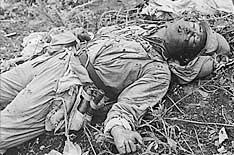
A Chinese soldier lies dead after a U.S. air attack. |
Meanwhile, Stalin maintained a cool distance. If U.S. forces invaded the People’s Republic, Soviet support was pledged for China’s defense, he reportedly wrote Mao. But the advice from Moscow to Kim Il Sung was to form a government-in-exile in northeast China. After losing 20 million people in World War II, the Soviet Union was content to watch the U.S. and China bleed each other before moving in to claim the debris.
North Korea and its Chinese allies, numbering 200,000, made their move as U.S. forces reached the town of Ch’ongjin, 45 miles south of China. Beijing would send some 1 million Chinese People’s Volunteer Army soldiers into Korea, with an eventual estimated casualty count of 186,000.
Two weeks later, UN forces had been pushed out of North Korea. Weeks later, Seoul was again in communist hands.
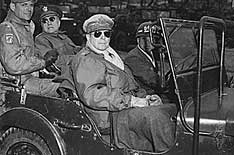
U.N. Forces Commander-in-Chief General Douglas MacArthur 15 miles north of the 38th parallel. |
But only temporarily. U.S. forces surged back across the 38th parallel and fighting sank into a stalemate: UN forces just to the north of the border, Chinese and North Korean forces just to the south.
U.S. forces in North Korea would destroy most of its industry and agriculture, plus its transportation and communications grid. The ancient city of Pyongyang, the North’s capital, would be mostly destroyed by bombing – according to North Korean accounts, some 428,748 U.S. bombs were dropped. Thousands of refugees, reportedly often strafed by U.S. planes, jammed the North’s gravel roads. Destruction in South Korea was equally devastating.
Fifty years later, North Korean media would depict Kim Il Sung’s 10-year-old son, Kim Jong Il, as playing an integral part in the North’s war planning: “Sometimes he sat up all night together with Comrade Kim Il Sung at the table for mapping out a plan of operation, asking about the situation of the front, thinking of how to frustrate the intention of the enemy and learning Comrade Kim Il Sung’s outstanding commanding art,” the Korean Central News Agency detailed.
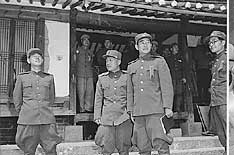
North Korean refugees heading south in 1951. |
That “outstanding commanding art” would be sorely needed as the war neared its one-year anniversary. Rumors gained pace in the North that the U.S. intended to use the atomic bomb to win the war. They were not unfounded.
In March 1951, General MacArthur requested a “D-Day atomic capability.” The request was considered but with one catch: MacArthur, increasingly critical of White House policy and gunning hard to invade China, got the axe. Under Truman’s successor, President Dwight D. Eisenhower, the nuclear option was permanently shelved. It was time to talk peace.
- Previous: June 1950 UN Responds
- Next: 1951-1953 Peace And Pows
