


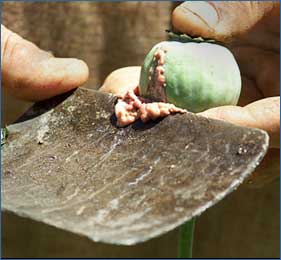
A farmer scrapes off raw opium that has oozed out of the pod. (Photo: AP) |
Since pods ripen at different stages, farmers must carefully examine each one to determine if it is ready for harvesting. Farmers typically begin to harvest opium about two weeks after the petals have fallen. While still on the stem, the farmer makes vertical incisions on two or three sides of the pod. The farmer must carefully cut the pod so that the cut is not too deep. Otherwise, the milky white sap, called sheera, will flow too quickly and drip to the ground. So that the opium will ooze out overnight onto the pod’s surface, incisions are made in the afternoon. The pods will continue to secrete opium for several days.
As the sap oxidizes, it turns brown and forms a resin called apeen or taryak that is collected the following morning. Yields of raw opium vary according to the size of the pod and the efficiency of the farmer. The average weight of raw opium collected per pod is 80 milligrams — about 15 to 20 kilograms per hectare of land. The raw opium, which does not spoil if it is stored in a cool, dry environment, is placed in a plastic bag, ready to be made into morphine base.
Sources: US Department of Justice, “Opium: A History” by Martin Booth, “Unholy Wars” by John Cooley

Photo: Itar-Tass |
Heroin Facts
AAlthough heroin can be smoked or snorted, the most effective and common form of consumption is to inject it. Before an addict can inject heroin, it must be made into a solution. To dissolve the heroin, the addict mixes heroin in a large spoon with water. Lemon juice is sometimes added to help dissolve the heroin. The solution or cocktail is heated until it boils and is then drawn into a hypodermic needle. While still warm, the addict will inject it just below the skin, a process known as “skin-popping.” For more of a quick fix, the addict can also inject it into a vein, otherwise known as “mainlining.”
- Previous: Step 1: Planting Opium Poppy
- Next: Step 3: Extracting Morphine
