


 |
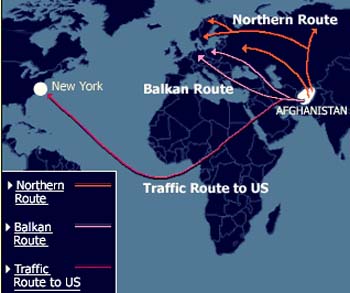
The Afghan drug trade takes in an estimated $25 to $100 billion a year. Drug traffickers rely mostly on various land routes to move opium and opium products such as morphine base and heroin out of Afghanistan to profitable markets further West such as Russia, the U.K. and Italy. The Balkan Route was traditionally the main drug traffic route, but in the 1990s the Northern Route, which covered territory from Central Asia’s ancient Silk Route, also emerged.
| Northern Route
Opiate shipments through the Northern Route — also known as the Silk Route — start at the northern border of Afghanistan. They wind their way through the Central Asian countries of Tajikistan, Kyrgystan, Turkmenistan, Uzbekistan, and Kazakhstan before ending up in Russian or European markets. Drug trafficking on the Northern Route has increased in recent years as shown by the number of seizures — 1.8 metric tons of opium in 2000 to 4.2 metric tons in 2001. Political instability and economic hardships have made the Central Asian region attractive to drug smugglers. |
| Balkan Route
The Balkan Route was once the dominant route for trafficking opiate products to Europe. In recent years, as the Northern Route gained more prominence, the number of opiate products traveling through the Balkans has dropped from 80 percent to roughly 50 percent according to UNDCP and other sources. To make the trip through the Balkan Route, opium, morphine base, and heroin from Afghanistan are shipped directly to Iran or are transported to Peshawar or Quetta in Pakistan before crossing the Iran-Pakistan border for transport to Turkey. From there, opiates are then trafficked through Bulgaria, Romania, Hungary and Czechoslovakia or through a southern leg in Albania and Yugoslavia before heading to the rest of Europe. The seaport of Karachi, Pakistan is also a main trafficking center for shipments overseas. |
| Traffic Routes the the U.S.
Southwest Asian heroin — almost all of which comes from Afghanistan — was much more prevalent in the 1980s, but now only accounts for six percent of heroin consumed in the U.S. To reach New York City, the primary U.S. transportation center for Southwest Asian heroin, Afghan-origin heroin travels from Pakistan through Nigeria. Heroin is also smuggled via mail packages, by couriers on commercial planes, and in containerized cargo. From New York, the drugs are shipped to Atlanta, Chicago, and Detroit for further distribution. |
