


 |
Start date: Late 1980s
Proposed length: Approximately 3,000 miles
Official purpose: Defense and stopping illegal trade
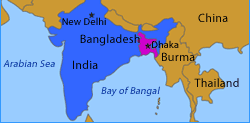
The 1947 partition of the Indian subcontinent created two Pakistans, one on each side of India: West Pakistan and East Pakistan. Following a war with West Pakistan — in which India entered the fray, siding with its neighbors to the east — East Pakistan proclaimed independence and, in 1971, became the nation of Bangladesh. (West Pakistan became Pakistan.) Ninety-eight percent of Bangladeshis are ethnic Bengalis, and more than 80 percent of the country is Muslim; 16 percent of the population is Hindu. Bangladesh and India share a border that stretches more than 3,000 miles, and in the late 1980s India began efforts to fortify the border.
Bangladesh has not embraced India’s barrier fence. Citing a bilateral 1975 agreement, Bangladesh insists that India may not build within 150 meters of the border; Bangladeshi troops have fired on workers to impose the buffer zone. In April 2005, India and Bangladesh reached an agreement requiring India to consult with the Bangladesh Foreign Ministry regarding any proposed construction within the 150-meter area.
Relations between India and Bangladesh have generally been good. Many Indians have objected to the barrier, too, as some border villages are very much dependent on informal (i.e., illegal) trade across the India-Bangladesh border. By some accounts, the value of illegal trade along the border exceeds that of legal trade between the nations. But conflict over the border has, on at least one occasion, resulted in fatalities: in April 2001, border guards fought in Kurigram, one of the few areas disputed by the two nations, and several soldiers died on each side.
- Previous: Cyprus
- Next: Iraq/Kuwait
