


 |
Start date: 1980
Length: Approximately 1,700 miles
Official purpose: Prevention of guerrilla warfare
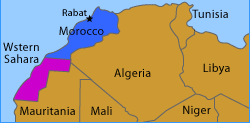
For nearly a century, Spain controlled a region between Morocco and Mauritania known as Spanish Sahara. In 1973, members of the Sahrawi population created the Popular Front for the Liberation of Saguia el Hamra and Rio de Oro (POLISARIO Front) in hopes of gaining independence from Spanish rule. In late 1975, as Spain’s colonial rule was coming to an end, the International Court of Justice recognized the Sahrawis’ right to self-determination and rejected Morocco and Mauritania in their petitions for the land. A month later, Morocco’s king ordered a “Green March,” in which more than 300,000 Moroccans entered Spanish Sahara. Spain capitulated, and in November 1975 — six days before the death of Spain’s longtime fascist leader, General Francisco Franco — signed the Madrid Agreement, giving two thirds of the land to Morocco and one third to Mauritania.
The POLISARIO Front responded to the Madrid Agreement by claiming sovereignty, announcing the establishment of the Saharan Arab Democratic Republic (SADR) in February 1976. Neither Mauritania nor Morocco recognized SADR until 1978, when the new Mauritanian government signed a peace accord with POLISARIO. Morocco then moved to control the remaining land in Western Sahara.
POLISARIO led a guerrilla war against Morocco, which responded in 1980 by starting to build a barrier through the eastern area of Western Sahara. The barrier measures nearly 1,700 miles long and 10 feet high, and is made of earth, sand, and stone; it is reinforced by trenches, soldiers, and land mines numbered in the hundreds of thousands. To date, the barrier divides Sahrawi families. Morocco refers to the barrier as “the berm,” while Sahrawis call it “the Wall of Shame.”
Since a 1991 cease-fire, the United Nations has tried to broker an agreement on the area’s final status. Several dozen countries and the African Union recognize SADR’s government-in-exile, but Morocco retains control over the land.
- Previous: Israel/West Bank
- Next: North Korea/South Korea
