


 |
Start date: 1953
Length: 151 miles
Official purpose: Border security
After the defeat of Japan, which controlled Korea during World War II, Korean troops north of the 38th parallel were instructed to surrender to the Soviets while Koreans in the south would surrender to the United States. Following failed efforts at unification, in 1948 two separate nations were established: the Republic of Korea (South Korea) and the People’s Republic of Korea (North Korea). Border skirmishes broke out a year later, and in 1950 Northern troops invaded the South, triggering civil war. U.S. troops were soon fighting with the South Koreans, and Chinese troops eventually joined the North. Though the Soviet Union did not deploy its military, Korea was widely seen as the first battleground of the Cold War.
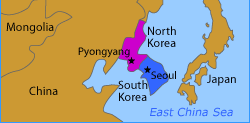
Following three years of war, the 1953 armistice established a new border, most of which runs north of the 38th parallel. The end of the Korean War did not mean the end of the Cold War, with the United States maintaining a military presence in the South and the Soviet Union backing the North’s communist regime. Measuring 151 miles long and 2.5 miles wide, the demilitarized zone (DMZ) has separated North and South Korea for more than a half century, and is considered the most heavily fortified border in the world. For decades, the DMZ was second only to the Berlin Wall in Cold War border symbolism; like the Germans, Koreans at the border were separated by the dual chasms of a physical barrier and political ideology. The Cold War saw many border clashes, including a 1976 incident in which North Korean troops killed six Americans and five South Koreans in a dispute over the pruning of trees (which gave U.S. troops better views) in the DMZ. From 1974 to 1990, South Korean, United Nations, and U.S. troops identified four tunnels that the North had dug underneath the border and into South Korean territory. (North Korea has denied any involvement.)
The Soviet Union no longer exists, and China is communist in name only; politically, economically, and culturally, North Korea is arguably the most isolated country in the world. North Korea’s nuclear program has caused other nations — especially the United States, South Korea, and Japan — to focus less on the particulars of the DMZ than on the existential threat of nuclear catastrophe. Once an allegory for the Cold War, the DMZ now symbolizes the dangerous threat of rogue actors unhinged by global alliances. Some people still accept former President Bill Clinton’s assessment of the DMZ: it is, he said, “the scariest place on earth.”
- Previous: Morocco/Western Sahara
- Next: Pakistan/India
