Visit Your Local PBS Station PBS Home PBS Home Programs A-Z TV Schedules Watch Video Support PBS Shop PBS Search PBS

August 14th, 2008

China Prep
Video: Full Episode

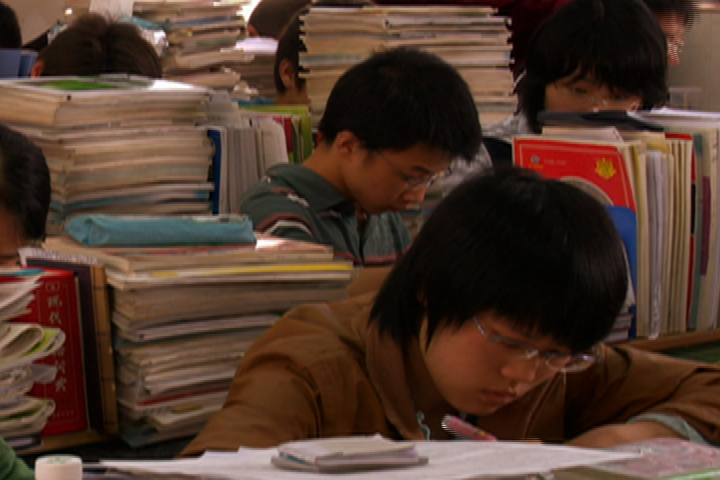
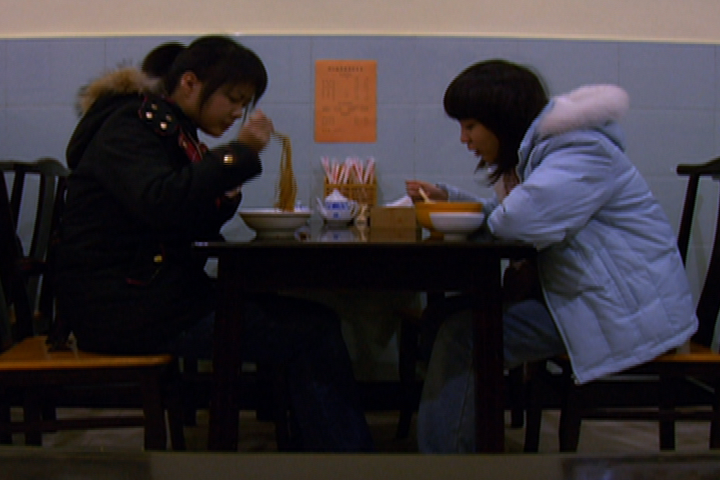
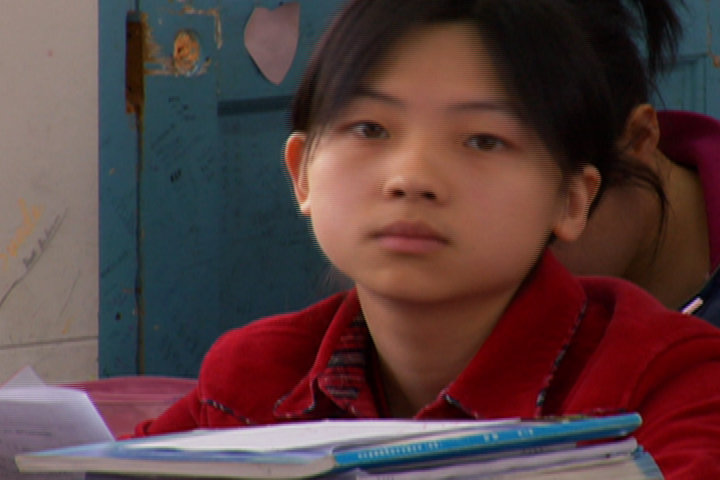
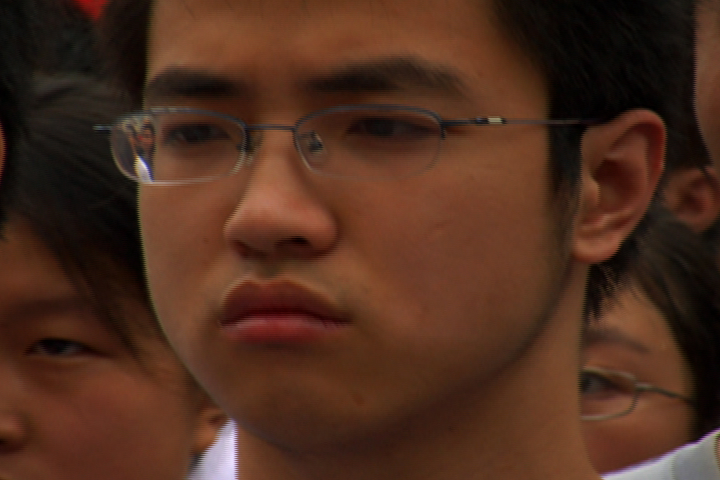
China Prep follows five Chinese students through their final high-pressure year at an elite high school in Sichuan Province. Eighteen hundred students vie for spots in Beijing’s top two universities. Last year only 59 made it.

Studying seven days a week, the students’ lives are regimented almost every minute of the day as they prepare for the end-of-year exam that can determine their fate. For many students from poor or rural backgrounds, a strong performance on the test is the only way to climb the social ladder and excel without connections. Competition is fierce and the majority of high school seniors will be relegated to vocational schools.
Get the Flash Player to see the wordTube Media Player.

   Print    Email    comments (51)

(35 votes)
Loading ... Loading ...
51 responses
B -- August 14th, 2008 at 5:06 pm

Very Interesting. I saw 2 Million Minutes in the last couple months and this is an interesting addition about Chineese Schools. I was interested if any indication of the percentage of students who pass the test going into high school. Very good video.

simfish inquilinekea -- August 15th, 2008 at 3:10 pm

interestinggggggggg.
meh, things get sad with scarce resourcesssssssssss

Ronald -- August 17th, 2008 at 3:57 am

I live in Chongqing. Find this video very interesting.
I have met many graduate of the system. Sent copies of this to friends there. Thanks..well done.

Kim Dillard -- August 21st, 2008 at 4:16 pm

This was so interesting!! I teach in the U.S. and most of the children I teach, sadly does not care about education. They have no idea of the importance of their education and how it can alter their lives!

Peggy -- August 22nd, 2008 at 12:39 am

Prompts some thinking. If there’s one thing I’ve learned in life, it’s to have balance, and this seemed rather extreme, though I can understand because of the circumstances. Yet it still makes me wonder whether these kids are actually “smart”er than their counterparts, especially those in Europe and America. Is intelligence calculated by ability to memorize? Ability to invent new ideas? Because I’m quite sure memorizing alone doesn’t mean intelligence. To be honest, most anyone can memorize well enough given ample time. I also wonder if the Chinese miss out on other things in life when they concentrate so much on school. They concentrate so much on working that I’m curious to know how other parts of them develop, such as individuality, creativity, curiosity, etc. Perhaps those things are experienced as well, but just amidst a flurry of tests.

Alan -- August 24th, 2008 at 12:37 am

TO the EDITERS:

Translation errors: 04:10~

Two “dumplings” should be “grantee” or “make sure that…”
The teacher said ” BaoZheng”(grantee) in both occasions, not “Baozi”(dumpling).

Paula -- August 26th, 2008 at 11:39 am

I think that its scary how here in the United States we have so many opportunities. So many that we don’t even take advantage of them, when in other countries they have to work so hard for something that we have and sometimes don’t even appreciate it….

Eddie Murphy -- August 27th, 2008 at 4:31 pm

“This was so interesting!! I teach in the U.S. and most of the children I teach, sadly does not care about education. They have no idea of the importance of their education and how it can alter their lives!”
Lol your a teacher but you typed does instead of do?
Fail
You does not care about your education either.

Suoyang Hou -- August 27th, 2008 at 8:03 pm

I came to USA when I was 12 so I didn’t have to go through this process…but my cousin had too. I understand that many people thinks this process is unfair and really grueling for children…but China has 1.3 billion people and ONLY 2 really big universities. It’s the only way right now…hopefully the future will be better.

I don’t agree in that some people thinks this underminds the creativity for children. For people to create high techologies and such, they have to get a good foundation on basic academics…something that schools in the west lack. For example, Microsoft Corp. have 3 creative offices world wide in Seatle, China, and Europe. Bill Gates in one interview said that the China one contributes the most creative and inventice ideas.

Regardless of political differences, just think that the future Chinese political rulers are all top students who are experiences in not just history but also Scientific engineers…they will speak both chinese and English.

For the European and American students…think of this as a warning…because the next generation, your kids are competing with these kids who will battle to the end to get to the first place. Are your kids prepared???

P.S. I speak chinese and I notice some of the translation are bit off…leads to biased ideas for the non-chinese speaking audience.

kimarie -- August 29th, 2008 at 11:23 pm

I love how China is made and I would like to see how life is in China.

Ming Xia -- September 2nd, 2008 at 2:35 pm

There is a translation problem: As the chemistry teacher Guo Qingrong speaks to her students, she means that all students should arrive at class at 7:10 AM; but for “Zoudusheng” (”Students who are not living on campus and have to commute between home and school”) or “Yubeisheng” (”Probationary students”–I quess those who are repeating the college entrance exam),which are not two names, can come a little bit later. The teacher means that they can come a little bit later (she was not sure about whether it is 7:20 or 7:25 AM).

Spencer B -- September 19th, 2008 at 2:44 am

The video was made to scare americans and you can see this in the way that aaron brown is leading his interviewer. On the other side of things she is overexagurating how healthy this is for the generations of modern chinese students. To me the video illustrated a couple important truths. 1) Most westerners take there education for granted. 2) The chinese students studying in such schools are deprived of their ability to think independently and what more, orginially.

Taylor DeMario -- September 20th, 2008 at 11:10 am

And I thought I was stressed.. I could never imagine being one of those students.

N -- September 30th, 2008 at 6:16 pm

I’m a high school student in the U.S. in Fairfax County, Virginia. I watched this documentary because I am studying Chinese at school, and wanted to learn a little more about Chinese culture.

I just wanted to point out that there are a few places in the U.S. where high school is this tough and competitive. There is an elite high school called Thomas Jefferson High School for Science and Technology (abbreviated to TJ) near where I live that a few of my friends go to. It reminds me of the high school in the documentary. In order to even be considered as a student there, you have to pay a fee of about $100 to take an entrance exam. Then, if you get in, the pressure to succeed and the work load is enormous. The school day there is about an extra two hours long, and students get about 6-7 hours of homework each day. If your grades fall below a certain point, you will get expelled.

I could never make it at a school like TJ or the one in China. But, I think that in order to have a good education system, schools need to have an equal balance of both the rigorous study at elite high schools and the more laid-back, relaxed and open environment at most American high schools. If there is a good balance, then students will get a good mix of creativity and study, and they will be more well-rounded people. I think that the environment at the Chinese high school supresses freedom and creative thinking, but the approach of Western schools is not strict enough, and lets students slack off.

Also, considering that there are only two top universities in all of China, the pressure level seems about right on the students. And maybe the one child only policy factors into how harshly parents raise their children. These are all just my opinions, though. :)

Xian -- October 11th, 2008 at 2:50 am

The teacher in part 6 is actually pretty funny. But they didn’t translate any of her jokes. The translators should have a better sense of humor.

Y.F. -- November 2nd, 2008 at 3:01 am

Actually in this video the Bashu High School is one of the top high schools in China. If we comparing this to an ordinary high school in the U.S., it is sort of misleading people.

I was in China until half way in high school (the topmost I could go in the city), then I moved the U.S., and studies at a public school, probably the worst, in Boston. But still I would say the schools (not just high school) in the United States have a lot of opportunities that students in China could never be able to imagine, e.g.,I was lucky to be in a high school program at MIT and a summer school program at Harvard. And for the class workload, the AP courses offered are still very challenging if a student really wants to learn the stuff.

I have high school education from both countries, if I am asked to choose, I will choose the high school in the United States with no doubt. I don’t want to have no life and I want to have the freedom of choosing my life. When life is all about sleeping, eating, and studying, life itself just becomes meaningless, Life then becomes just a process of a machine.

And Also I want to correct that, there aren’t just two universities in China, for most of the high school kids their dream schools are basically the top colleges in their provinces. As I could remember, in my high school class (in china, the whole class of a grade is brokendown into small classes), there are only 3 or 4 out of around 60 students go to colleges outside our province. Probably because I lived in the coastline but it is still very clear that only a small portion of the kids are dreaming of Tsinghua Univ. and Beking Univ. And the college application in China also prevents a lot of hardest and smartest kids from applying these two schools.

For those who worry about the Chinese Educaiton would surpass the U.S., I would say there is no need to think about that. The k-12 education in China are very intense, however, the college educaiton in China is so bad that it almost completely erases the advantage the Chinese have during the k-12 education. They fail exams, they skip classes, and they play video games most of the time, all they need to do is to make sure the certificate is secure.

Everything in China is still undergoing change, when a college certificate in China is no longer guaranteeing a job and until they have learned the lesson that skills are more important then a certificate, people in the U.S. should then be cautious. But that takes a long time, and I believe it takes at least a generation.

Karla -- November 5th, 2008 at 7:49 pm

i really appreciate this documentary, but i didnt like the questions and answers from the host. It look like he was agaisnt china. Thanks again for this doumentary!

马驰 -- November 29th, 2008 at 7:03 am

we Chongqing are not belong to Sichuan province now“`

viola.d -- November 30th, 2008 at 4:52 am

………..this is my schoolmate…haha

piet -- December 2nd, 2008 at 5:20 pm

@Karla
Ofcourse it is against the system, this kind of ‘teaching’ systems do not help. A person sucks up information about 3 hours per day. The rest they forget or they don’t remember it anymore. If you learn from 07:00 to 22:00 thats just sick and not human. I won’t believe thats good.

gasnemo -- December 19th, 2008 at 1:59 pm

i graduated from this school. we hate and love it.every thing is real. good video.thanks.

Jim -- December 24th, 2008 at 5:34 am

This isn’t the whole story. The struggle really begins in elementary school. The students need to do well to get into a good middle school, where they also need to do well to get into a good prep school so that they have a shot at making it into a good college.

John -- January 17th, 2009 at 12:19 pm

I am a graduate of American elite schools, at the postgraduate level. I have also attended Beida University, Taiwan University, and Waseda University in Tokyo. The self-discipline at the elite level is the same in all three countries; one does not enter elite schools (with rich exceptions in Japan and the U.S.) without having done an enormous amount of work, and having innate abilities. There are Horatio Alger elements to this story, befitting a certain hisorical level in industrial development. However, it would have been instructive to have compared Japanese, Chinese, and American entrance tests, to show which values are prized most. It also would have been most instructive to have compared an elite school in China with the average school. One further note: when I attended Waseda, Ezra Vogel declared Japan would surpass the U.S. in GDP within a short time. One and one half billion people with limited resources and an aging population may also be the leveler to the assertions in the film.

Tommy -- February 22nd, 2009 at 3:08 pm

I enjoyed the whole thing. My favorite part is when the students were massaging their temples, eye sockets, and eyebrows. I watched this with my social studies class and everyone enjoyed it. I think however that the educational system is too strict because the Gaokao especially puts a lot of pressure on the students.

Sherry -- March 2nd, 2009 at 8:44 am

This is just another education system.Some students might enjoy it while others keep complaining about the heavy task.Is it really better or worse than other systems?Who knows?

brent -- March 8th, 2009 at 10:37 pm

@ #8 Eddie Murphy: “Lol your a teacher but you typed does instead of do? Fail”
I hope that is sarcasm in the first line. Otherwise, you should stop throwing bricks in “your” glass house…Failed

Lucie -- March 10th, 2009 at 10:19 pm

It’s very impressive and realistic. I was once a student in Bashu and graduated in 2005, now studying in Beida. I could not hold my tears during watching this vedio, because it reminded me of so many tough and happy things I experienced in the fiercest year. YOu can not blame the education system,since the reality is that there are so many people in China and everyone has to suffer a lot for a good future. I think the biggest problem is: all the high school students are focusing on a solitary goal and heading for the same way, so they don’t have time to think about their dreams and life value. Once they enter the universities, most of them lose theirselves and don’t know what to pursue. Around me, besides myself, we don’t have great ideal and dream, simply for a comfortable job. Thus the society cannot get into a better direction because of the loss of the new generation. I am really pessimistic about China’s future~

Jiaxi Zhang -- March 11th, 2009 at 6:45 am

I graduated from this high school.
In my opinion, since China has such a large number of kids while the education resourse is so limited. The only possible way for the Universities to choose students is by an normalized entrance test, though it seems to be unfair, destroying the creativities. The ones who got the chance to receive advanced education have the responsiblity to make the education of China better. That is the only way for our sons and grand sons to study happily as well as effectively.

yujie -- March 12th, 2009 at 8:44 am

“There is a translation problem: As the chemistry teacher Guo Qingrong speaks to her students, she means that all students should arrive at class at 7:10 AM; but for “Zoudusheng” (”Students who are not living on campus and have to commute between home and school”) or “Yubeisheng” (”Probationary students”–I quess those who are repeating the college entrance exam),which are not two names, can come a little bit later. The teacher means that they can come a little bit later (she was not sure about whether it is 7:20 or 7:25 AM).”

So funning, “Yubeisheng” is actually means 预备铃 , the pre-ring ( ring before the official ring, she means that Students who are not living on campus should can come to class a little bit later but should before the pre-ring)

BTW she is my teacher

absolute -- March 12th, 2009 at 5:26 pm

I graduated from this school

absolute -- March 13th, 2009 at 1:31 pm

我曾经在这里呆过

The Pookums -- April 5th, 2009 at 10:07 pm

I agree that the commentator definitely has anti-Chinese sentiments, or else is just trying, sadly, to boost his ratings. Throughout the “interview,” he is trying to bait the Harvard professor into saying things that would strike fear, unreasonably, into the heart of some (ill-informed) American/western viewers. For example, he claims that not all countries care to be number one, suggesting that the US is too “above-it-all” and yet, tries to get the savvy interviewee to say that she feels China will compete aggressively and eventually dominate the US. If he weren’t so worried about the US being number 1, why would he have baited the professor with this question? Wide Angle is a (mostly) intelligent show with intelligent viewers. Don’t treat us as if we are stupid. Please.

beijene -- May 3rd, 2009 at 1:40 pm

I have lived in China and worked with development of social education here and in other countries for 25 years. Unfortunately, the video is not available (blocked?), so I am basing my comments on the the others’ comments above and my own life experience here and in other countries. I am also a teacher, and do recognize the challenge of getting a good education here. But what is a good education? My adult students tell me they learn no skills in university. They believe one has to lie and cheat to get ahead in business, but the thinking ones abhor it. I agree with many of the comments quoted here. But I also know there are professors of leading Normal teacher training universities in Beijing, Jinan and other cities who are concerned about the standards for education in China and actively are working towards its improvement. They recognize there is a need to educate/teach more than facts and information; more than what the teacher knows, and the books know, and more than testing the students to see how well they have been stuffed with second hand knowledge. What about the whole person? Values, ethics, morals.. this is a great concern in China on the part of many educators. But patience is needed. I like the old American Indian adage, which I quote here, recognizing and welcoming comments if I don’t quote accurately: don’t judge me until “you have quoted a 1000 miles in my moccasins.” Not only does China have a long way to go to upgrade its educational standards… where is there a system that can claim it has opened minds to think creatively, that gives equal emphasis on creating new minds, ideas,that helps its graduates excel in moral and ethical values, in a world where competition is king, survival of the fittest is the standard, and money and personal power rules all?

DnShr -- May 21st, 2009 at 8:49 am

i could not imagine living a life like this, considering the suicide rate is one of the highest in the world. It reminds me of New York Public high schools only much worse, being 1,800 students in the senior class alone and there are only “2 top colleges” that students try for, i do not think I could make it in this type of world.

Madosn -- May 22nd, 2009 at 8:22 am

It makes me really worried that this kinda thing can happen in China. I feel so bad for students that don’t get that chance to even go to high school go or if they are late bloomers. That’s Because I’m a late bloomer and its not fair that they don’t get a chance to go to college and get the fair education that everyone else can have. But there is also a good side to this because if there are students that don’t want a education they don’t even go to high school. Because here in our schools we see students that don’t even want to learn but yet teachers have to waste their time on them. So in china its kinda better that they can only focus only on students willing to learn.

Nicole -- May 22nd, 2009 at 8:44 am

The movie was very interesting. I was surprised how hard Chinese students work. One student at Bashu Prep school said she studied for 16 hours a day. I can’t imagine studying that much. I was also surprised that students didn’t participate in sports and extra curricular activities. In America to get into a good college you have to be more than just a good student. You have to be well rounded. In the interview with Vanessa Fong, a professor at Harvard University explained that in China a test you take at the age of 14 determines whether you will go to college. This seems very scary because a test you take that young can determine your whole future. She also said there were no second chances. In America there are so many opportunities. College is not the only chance to be successful. Another interesting thing from the movie is that in China creativity and art are not valued. In America creativity gives you so many opportunities. In China I would not be able to take media and art classes.

Priscila -- May 22nd, 2009 at 11:11 am

This video is intense. I am amazed that at the end, only two of the students that they are profiling makes it into the top two universities in China. To me, they all seem fairly intelligent and very determined. These Chinese students study so much that it almost makes the rest of the world look like slackers. Although I like how they live in the dorms at their high school, I can’t imagine being a teenager without having any extra curricular activities, such as sports, music, art, and such. The video portrays the students as if they have little to no time to hang out with their friends and family. Based on the video, I would look at the lifestyle that those students have and find it rather depressing. There actually is a part in the video where one of the guys mentions that he knows a student who is suffering with depression and has to go through therapy. In my opinion, I wouldn’t put so much pressure on myself to the point where I crack just so I can have a better chance at getting into a top university. There is more to life than books, you know.

Britt -- May 22nd, 2009 at 4:59 pm

This video was really good and crazy. It shocking and very different to see how intense and important is in other countries. I feel that in the US we take what we have for granted where as in China, they focus on what they need to do. This video shows why China is developing so quickly in everything because they take school work so seriously. The school is very hardworking and is really determined to be the best, like the students who attend. One thing I didn’t like was when they spoke about how the kids at the school weren’t involved in extracurricular activities. I think doing those things could help you as well as learning in the books. Taking ONE test when your 14 shouldn’t determine what happens in your future. That’s one thing I don’t believe in. People should be given chances to prove what they can do as many times as they want, and not have it forced on them. I really enjoyed the video and it really explains why China is developing so well.

Teresa -- May 25th, 2009 at 10:11 pm

I think that this video is extremely interesting, it shows how different other countries can be. Me living in America I can already see a difference in how China is more competitive and willing to do whatever it takes to be the best. Every student there or their parents have probably sacrificed something and it just shows how important their education is to them. It makes me also realize how in other places in the world not everyone really cares about school and usually just slip on by taking the easy route out. These students show how dedicated they are to having a successful life. I do feel that there are other aspects of life that you need to learn about during school such as art and culture. Electives to me seem very important because there are other jobs in the world that don’t require just book smarts. I overall enjoyed this video because you really got to understand how the students live their lives and how they really feel about their school life. It’s nice to see how other people in the world live then just my country, and this video provided that.

Erik -- May 25th, 2009 at 11:00 pm

That’s incredible. They weren’t joking when they said they will be the hardest working people in China. They have to do so much just to have a shot at having a succesful life. It seems to me like too much for one person to handle. They are pretty much allowed no free time, no sports, nothing. These people seem to be the best of the best, but it all comes down to grades and/or money. I felt bad for the kid who’s parents lived on teh farm, he said his mother was embarrassed to go out with him into public. It is such a sad existence for students, they focus all their time and resources on school, no time even for family. Bashu prep is “make it or brake it” to the extreme. That one girl had her mindset so when she wakes up in the morning she is so happy and ready to go to school. Now most people I know dread waking up any earlier than 7:30, but then again, none of us have those eye massagers.

Mengmeng -- May 26th, 2009 at 12:05 pm

This school is in my hometown in China- it did pressure kids but it doesn’t define their lives completely! It gives them an opportunity to go work hard and dedicate themselves to something to achieve something. As someone who didn’t achieve the highest score, I still got into a good university in China and am currently in graduate school in the US.

Keith -- May 27th, 2009 at 10:01 pm

I think that the attitude towards education and life in general portrayed in the video is disgusting. The fact that people are brainwashed into thinking that their only worth in life is to become financially successful is terrible. The country of China is basically trying to breed a race of super-humans when it comes to academics, the problem is they forgot the human part. It all comes down to the idea that the government still controls everything even though the country is no longer communist officially. The government is totalitarian, the schools are totalitarian, the way people think is totalitarian. The mind set that is established in the people growing up in this environment is an all or nothing philosophy, which is so harmful to the pursuit of happiness in life. They are taught to see the world in black and white, failure and success. In reality life has so much more to offer, not only the shades of gray in between, but also all the colors and hues that make life worth living and existence bearable. Children are taught that the best thing they can be is a rich but overworked business executive with no time or desire for creativity or emotion. This is simply not true. Creativity and emotion are what make us human, they are what make the beating of our hearts more than just a countdown to our deaths. Life is short and happiness is fleeting, you might as well actually live while you’re here. The main problem lies in that the government forces a culture that doesn’t value the actual valuable thing in life on the people living there.

Asa -- May 29th, 2009 at 9:57 am

So far i have not finished the video, but from what i’ve seen it has been very scary. These students give a good image of out competition. It also seems as if school defines who these children are. ill finish the video on monday

Asa -- June 1st, 2009 at 9:56 am

It’s not as scary as it seems considering they are showing us one of the top high schools in the country

storion -- June 13th, 2009 at 11:33 pm

I just happend to see this video when I poked around on the internet. I took the same test 13 years ago and I was surprised to see how these people in the video looked at everthing in the world. I think they may exaggerate the situation. 13 years ago the acceptance rate of colleges and universities is even lower than now, but I didn’t feel that much pressure when I was senior in my high school. I gotta say my high school is the top 1 in my hometown, Harbin, a city which is mentioned as “close to Russia” in the video. I really had a good life there: class ended at 4:00pm, you could play basketball and computer games after class and you didn’t need to live in the cramped dorm everyday. As a graduate from Tsinghua University and PhD in the US, I don’t think the education system in China is that bad as a lot of people criticize and complain about. I have seen a lot of talented people in my college and it seems that they are not ruined or brainwashed by this “ordeal”. So this is just another type of education system in a different culture from western one. You can see the same thing in Korea and Japan. Just take it easy, you Americans.:-)

Aaron -- July 12th, 2009 at 2:37 am

For some reason I cannot view this video and I really want to see it. Can anyone please tell me where else I can see it, Thanks

fries -- July 14th, 2009 at 8:45 pm

hahaha, I’ve heard about running backwards in China, but this is the first time I’ve seen it.

fries -- July 15th, 2009 at 11:44 am

The government is not totalitarian, and much of how it does influence the gaokao is through the lack of a social safety net in China. If you land a good enough job, you don’t have to worry about your own healthcare (maybe paying to get into the ER) and retirement and that of your parents.

Much of the pressure to succeed comes from the culture and from self-interest. What I know here is pretty superficial, but I think the test-taking thing goes back to the history of Confucian civil service exams that were comparably grueling and egalitarian. Those tests mattered for hundreds of years. One difference is there was a chance to study again and retake the test if you didn’t score high enough. The test, or at least the way of taking tests, carried over into some other Asian countries like Vietnam and Japan. I remember reading about Ho Chi Minh and how his father was a mandarin, but he didn’t pass the exam on his first try. And David Halberstam’s The Reckoning (about Nissan and Ford through the 1980s), I read about either a Nissan engineer or a top government bureaucrat in Japan who spent six months cramming for his country’s test to get into a top college.

The other cultural pressure that seems to mix poorly with this test-taking tradition is the way some parents in this documentary think helicopter parenting is the only kind of parenting. Li Mengjia, the girl whose parents cook her breakfast and do her chores, hilariously is told by her dad not to burn too much energy in the morning, after she said she went running for five minutes. The student whose parents rented a hotel near the exam site coughs, and his dad suggests lozenges, his mom tells him to drink some water, as if his parents still don’t remember that he turned 18. Even the girl whose father is a military official, and who we hear is more independent than her classmates, tells us that her parents worry about every little detail, including whether she has enough blankets when she sleeps.

Something to bear in mind is that young migrant workers who head to the cities face similar pressures. Many of them send money they earn back to their parents in the countryside. There’s another Wide Angle episode, To Have and Have Not, that spends some time on their situation.

fries -- July 15th, 2009 at 12:00 pm

I get the impression there’s a widespread underlying belief in China that learning can be done through sheer willpower. The high pressure rote learning in this documentary reminded me of what I read in Factory Girls, a recent book that deals specifically with young female migrant workers in Dongguan. The author gives a good description of other forms education in China can take. English classes are popular, and they highlight the problem with Chinese style rote learning more than any other subject, because you can’t memorize the conversational use of a foreign language. There’s a businessman detailed in Factory Girls who invented a machine to teach English. You sit in front of one for hours as it flashes random words. Or in classes taught by a human, students are reluctant to actually use the language in front of their classmates, for fear of making a mistake. When a teacher asked students to summarize a passage, one girl recited the whole thing verbatim. A guy attempted the same feat, but as soon as he made a mistake, he was unable to go on. (In public school, English is described as being taught in a similar way, by rote from a textbook, by a teacher who is not a native speaker.)

However, in contrast to the gaokao students at Bashu, the English, vocational, and etiquette classes taken by migrant workers in Dongguan come from a much more individual and self-reliant mentality. The students work by day and pay for their evening classes themselves; they do this in order to gain qualifications for a promotion, a better job in another factory, or a clerical job; their parents could be hours or days away. And the students who are not so afraid to make mistakes will make money by teaching their own courses to older white collar workers, even if their own English seems terribly ungrammatical.

James Fallows did some entries on his blog (http://jamesfallows.theatlantic.com/archives/education/, all in May 2009) on the gaokao and education in China, very relevant further reading with comments from students and Western teachers in China.

One reader also notes the memorization approach to learning (and teaching):

“As an example, I work at a medical university with over 100 foreign students. A few of the students told me that they were attending a lecture one time, given by a Chinese student, in English. They noticed very quickly that they were able to read exactly what the student was saying as she said it from their textbook because she had memorized, word for word, her entire lecture. Another example can be seen with students who take the post-graduate entrance examination and memorize, again word for word, all the essays that will be tested in the exam.”

(http://jamesfallows.theatlantic.com/archives/2009/05/further_on_the.php#more)

Nancy -- August 23rd, 2009 at 6:29 am

I went through the same thing in my ‘home’ country. I got into the top high school there but it was hell. I hated it. All I did was study, study & more study. And that was just high school. So my parents decided to send me to America. It’s so much better here. I now have a life. :P

Charlie -- November 1st, 2009 at 1:53 am

Who can help me on the subtitle please? I cannot understand some of the words. For example, the second sentense: “China’s top high school students cram for ??? decide”. What does the word of ??? stands for? Thanks!

post a comment
Please note that the THIRTEEN editorial staff reserves the right to not post comments it deems to be inappropriate and/or malicious in nature, as well as edit comments for length, clarity and fairness. No solicitations or advertisements will be allowed. Users may link to other Web sites relevant to discussion, but most often links to commercial Web sites will not be permitted.

Produced by THIRTEEN    ©2009 WNET.ORG Properties LLC. All rights reserved.

Sponsored by Mutual of America

Funding for Wide Angle is provided by PBS, Ford Foundation, the William and Flora Hewlett Foundation, the John D. and Catherine T. MacArthur Foundation, the Miriam and Ira D. Wallach Foundation, Judy and Josh Weston, the Estates of Helen and Sam Roseman, Bernard and Irene Schwartz, The Shelley & Donald Rubin Foundation, and the Dr. Robert C. and Tina Sohn Foundation. Corporate support is provided by Mutual of America Life Insurance Company. Special funding for Time for School 3 is provided by Ida C. Schwartz, in memory of Bernard S. Schwartz; Carnegie Corporation of New York; and Paul P. Tanico. Additional funding for educational materials is provided by The Overbrook Foundation.