


Portraying the world’s countless human smuggling routes would require a map lost in a web of arrows. While the maps below are far from a complete catalog of trafficking routes, they denote some of the major regional trends in human trafficking.
Europe
Though most of the movement is from east to west, many migrants from Eastern Europe are also trafficked east, to the Middle East.

Source: CIA, The Protection Project, and UNICEF |
Important gateways into Western Europe are the Strait of Gibraltar, where North Africans cross into Spain especially during the summertime, and the Adriatic Sea, where migrants, often women and girls, are trafficked from Albania to Italy. By land, migrants from Eastern Europe and Asia follow the Balkan route from former Soviet republics and satellite states through Greece. Illegal immigrants from North Africa also travel across the Mediterranean to Sicily. Many arrive in Britain by smuggling themselves from northern France across the English Channel to the port of Dover. Since the breakup of the Soviet Union, young women from Russia, Estonia, and Latvia are trafficked to Finland, where prostitution is legal, to work in the sex trade. Russian women are also trafficked to Norway and Sweden, where prostitution is also legal.
The Americas
Most of the movement on this map is directed toward the United States, but a number of South America migrants are trafficked to work in the Japanese sex industry.
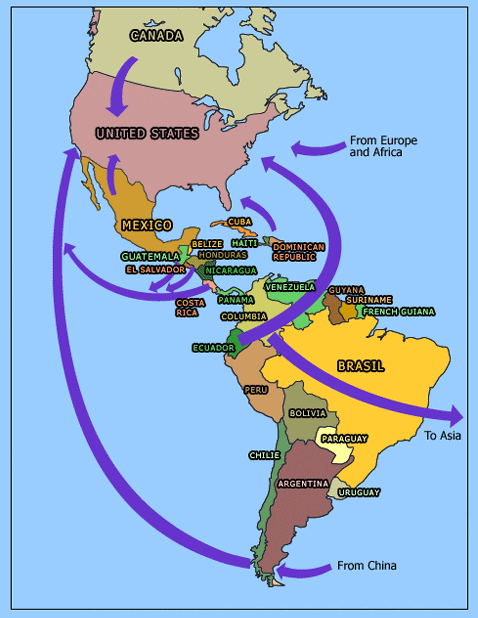 Source: CIA, The Protection Project |
According to Interpol, most human cargo is being smuggled into the United States by plane. Increasingly, victims travel first to South Africa, where fraudulent documents may be obtained. Interpol also suggests that seafaring ships usually approach America via the Pacific Ocean, where Canada has also intercepted a number of cargo vessels carrying illegal Chinese immigrants trying to enter through the Vancouver area. But recently, use of this method has declined. Instead, many trafficking victims are arriving in Central or South America to enter the U.S. via Mexico.
Southeast Asia
Most of the women smuggled in this region are sent to work in the commercial sex trade, particularly in Japan.

Source: CIA, The Protection Project |
Much of the human trafficking in Southeast Asia centers around Thailand, where the sex trade accounts for between 2 to 14 percent of the gross national product, according to a 1998 report by the International Labor Organization. It is an important location for sex tourism, and the source of many of Japan’s prostitutes. There is an increase in the number of illegal immigrants from South Asia and the Middle East who are arriving on the western shores of Australia, particularly on Christmas Island, which is located quite close to Indonesia. Not featured on this map are land routes from Asia that run through counties like Kazakstan, Kyrgyzstan, Uzbekistan, Tajikistan, and Turkmenistan to Russia and then on through Ukraine to Western Europe.
- Previous: Criminal Groups
