


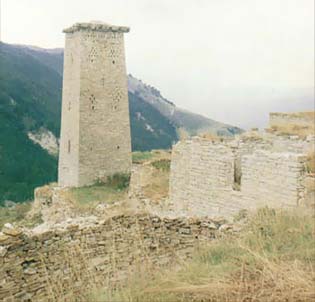
In the 14th century, Chechens began to build stone towers across the mountains for residential purposes. They also built watchtowers and military forts to protect themselves from invading forces. |
Attempts to control the Caucasus, Europe’s highest mountain range, set between the Black and Caspian Seas, date back to the 13th century when Mongols first invaded the region. By the 1400s, the Ottoman Empire had spread over the western half of the Caucasus, while the Persian Empire extended over the eastern half. Russian interest in the region can be traced to 1559 when Ivan the Terrible annexed the Caucasian city of Astrakhan, former site of the Tatar khanate. Forts were built in or near Chechnya’s neighbor Daghestan and an alliance was made with the Christian kingdom of Kakhetia in Georgia in an attempt to offset Muslim influence in the area, but further inroads were repulsed by Daghestani and other mountain warriors.
Russia’s first full-scale military operation in the North Caucasus came in 1604 when Tsar Boris Gudonov invaded to gain control of valuable military and trade routes to Persia. Though supported by local Christian Cossack troops, Russia’s invasion failed a year later in the face of stiff resistance from Chechen and Ottoman Turk forces. Russia would not return to the region for another 120 years.
 |
Did You Know?
The Chechens, who call themselves Nokhchi, are an indigenous people of the North Caucasus mountains. Russians coined the name “Chechen” based on the village Chechen-aul in which they first encountered the Nokhchi. Chechens speak an Ibero-Caucasian language influenced by Georgian, Turkish, Russian, Arabic, Ossetian, Daghestani and Persian.
- Previous: Introduction
- Next: 1700s: Holy War
