


Aslan Maskhadov during his 1996 inauguration ceremonies as president of Chechnya. |
In 1997, Chechens elected military leader Aslan Maskhadov as president and changed Grozny’s name to “Jokhar” in honor of slain Chechen leader Jokhar Dudayev. To impose order, Islamic Sharia law was introduced. But true peace did not come. Kidnappings and armed skirmishes between rival Chechen warlords occurred frequently. Islamic fundamentalists, backing an independence movement in neighboring Daghestan, exercised increasing influence over the Maskhadov government.
On August 7, 1999, two Chechnya-based warlords, Shamil Basayev and Omar Ibn al Khattab, believed to be a Jordanian associate of Osama bin Laden and a mujahaddin who fought against the Soviets in Afghanistan, invaded Daghestan. Weeks later, when a string of bombings in Moscow and Volgodonsk killed some 217 people, blame was put on Chechen terrorists. Russian Prime Minister Vladimir Putin, riding a wave of anti-Chechen sentiment among voters, ordered an attack on the warlords.
On October 29, 1999, Russian armies invaded Chechnya after ten days of heavy aerial bombardment. In February 2000, Russian soldiers reclaimed Grozny, forcing Maskhadov and the rebel forces to flee to the mountains. Moscow installed Chechen mufti (Muslim religious leader) Ahmad-Hadjii Kadyrov, a participant in the 1994-1996 conflict against Russia, in Mashkhadov’s place. But the rebel attacks continued. In an attempt to weed out rebel fighters, Russian forces instituted a campaign of zachistki – “clean-up operations” – among the civilian population, resulting in the disappearance or death of hundreds of Chechen civilians. In response to the ensuing chaos, tens of thousands of Chechens have fled to the neighboring republic of Ingushetia or to Georgia’s Pankisi Gorge. Russian attempts to convince Chechen refugees that they can safely return to their homeland are ongoing, but, set against a backdrop of ruined cities, mined fields and an ever-changing security situation, have not met with success.
 |
Did You Know?
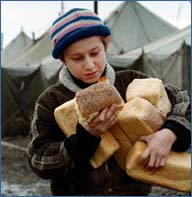
More than 150,000 Chechen refugees – or roughly 15 percent of Chechnya’s pre-war population – are now located in the neighboring Russian republic of Ingushetia. Hard-pressed economically, the Ingush, the Chechens’ ethnic cousins, have periodically pressured their unwelcome guests to return home. Camps are often threatened with the cut-off of bread, electricity and gas, while Russian troops regularly raid refugee dwellings in search of rebel collaborators.
- Previous: 1994-1996: War with Russia I
