SUMMARY
In recent years, there has been attention and worries about how reading has changed among kids. Those concerns include the nature of what kids are reading and how many fewer books are part of their education diet. A new cover story in The Atlantic is casting a broader spotlight, raising similar questions for the overall population. Jeffrey Brown discussed more with The Atlantic's Rose Horowitch.
View the transcript of the story.
NOTE: If you are short on time, watch the video and complete this See, Think, Wonder activity: What did you notice? What did the story make you think about? What would you want to learn more about?
News alternative: Check our recent segments from the News Hour, and choose the story you’re most interested in watching. You can make a Google doc copy of discussion questions that work for any of the stories here.
WARM-UP QUESTIONS
- Who is Rose Horowitch, and what is her background?
- What do the statistics presented reveal about American reading habits and how they've changed over time?
- Why are we reading more words than ever, despite reading for pleasure decreasing, according to Horowitch?
- Where does Rose Horowitch say we are entering as the period of reading comes to an end?
- How does social media play a role in restricting individuals from challenging themselves with complex works of literature, according to Horowitch?
ESSENTIAL QUESTIONS
- Why do you think fewer Americans are reading for pleasure?
- Can you think of any way to encourage more Americans to read for pleasure? Do you think such an effort would be worthwhile? Why or why not?
Media literacy:
Take time to analyze the following graph.
- What data stands out to you?
- Why do you believe that Americans are beginning to read less as they get older?
- How does technology play a role in shifting reading patterns?
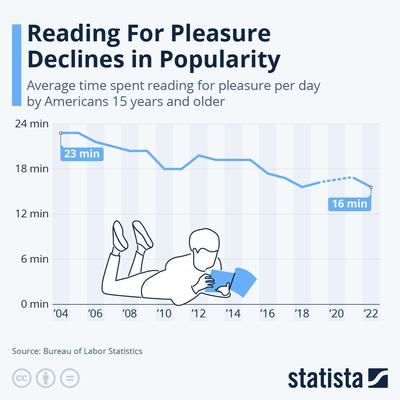
[From Statista]
WHAT STUDENTS CAN DO
How much do you read for pleasure. Track your own reading habits.
- First, ask yourself: How many books have I read this year for pleasure, not related to school?
- Are there any books that you've intended to read but just haven't got around to yet? Why do you think you haven't been able to make time?
- If you were to pick up a book to read for pleasure, what could it be? To decide, you might take time to jot down your favorite genres of movies or TV shows that you liked to watch. Once done, use said genres to then research books that fall under the same umbrella as your favorite shows/movies.
The Internet Archives are an excellent way to find millions of books that are completely free to read.
Once you have found your choice of book, take time to read the first chapter. Afterward, share with your friends your experience and what you learned.
Written by PBS News Hour Classroom Intern Justin Vasquez with editing from Classroom's Luke Gerwe
Sign up to receive our weekly newsletter with Daily News Lessons and community events.
To provide feedback on News Hour Classroom's resources, including this lesson, click here.