 |
|
 |
 |
| JOSE ZALAQUETT | |
 February 26, 2000 
|
||
|
|
Editors' Note: This interview was conducted
Feb. 26, 2000, shortly before the decision was announced in London to
return Augusto Pinochet to his home in Santiago on the grounds of ill
health. Brackets indicate editors' clarifications to place questions
in context. |
|
ELIZABETH FARNSWORTH: What's the importance of the Pinochet case [in London] just as a precedent? |
||||||||||||||||||||||
| A political precedent | |||||||||||||||||||||||
|
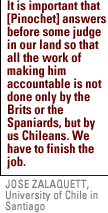
Now his immunity has been cut down to size. He's a normal person, answerable before the law. He's been humbled down, and that's good, even for him, even if he wouldn't agree with that. He's been reduced to human level. Now, that having been obtained, and international law having been strengthened by the rulings of the British court, now it's important that he's sent back. Because we Chileans have to finish the job of making him accountable. Even if he doesn't end up behind bars. That's not the point. He's elderly, maybe he's infirmed, and not fit to stand trial. But it's important that in the annals of the Chilean courts, it is established that he did commit these crimes or at least that he is subject to indictment. It is important that he answers before some judge in our land so that all the work of making him accountable is not done only by the Brits or the Spaniards, but by us Chileans. We have to finish the job.
JOSE ZALAQUETT: It is far more likely now that it will happen than it was a year and a half ago. When he was still in Chile he was indeed a fearful figure and judges would hesitate before initiating any proceedings against him. But now the situation has changed. … I'm not saying that he will end up behind bars, because if he isn't fit to stand trial in London, he is also unfit to stand trial in Chile. The point is that somehow in Chile, investigations are conducted by the proper courts to establish what he did. If he then is let go because he's too infirmed or unfit to stand a proper trial, that's a separate matter. And that, I believe, it is now far more likely. ELIZABETH FARNSWORTH: What else has changed here as a result of his arrest [in London]?
|
 |
||||||||||||||||||||||
| Accepting responsibility | |||||||||||||||||||||||
|
ELIZABETH FARNSWORTH: I interviewed General [Guillermo] Garin [Vice Commander in Chief of the Army '94-'97, close associate of Pinochet], and he spoke only of "mistakes" made after the coup. There was no admission [on his part] of systematic violation of human rights. Does that surprise you?
First they denied that it ever occurred. Then some people tried to call them mistakes, errors or excesses. Euphemisms for crimes. Now, the line of defense is yes, there were violations. On the one hand, you people from the left wing somehow provoked them or created the conditions under which these violations could occur. That's the line of defense. On the other hand, these were some people -- maverick people, maybe -- that committed violations contrary to the military code. But the institution as such has got to be preserved. That's their latest line of defense.
JOSE ZALAQUETT: We tell them that there are different kinds of responsibility. Certainly criminal responsibility falls on the one who commits the crime or orders the crime, on the one who pulls the trigger or orders the trigger to be pulled. But then you have political responsibilities. They are not criminal or legal. They are moral, they are historical, if you wish. And institutions do have political responsibilities. So collective responsibility exists, not in the criminal sense, of
course -- that is always individual responsibility -- but in the sense
of failures by a whole nation, by an institution, by the army, by a
political party, for not doing enough in order to stop something or
having condoned a certain practice and that is a responsibility the
Chilean army and the armed forces in general have got to acknowledge.
Because if you ELIZABETH FARNSWORTH: Is this the kind of thing you talk about with the generals at the table? You say this to them? JOSE ZALAQUETT: Absolutely ELIZABETH FARNSWORTH: What do they say? JOSE ZALAQUETT: Well, they say that there is something else to be acknowledged: the failings of the political parties during the period previous to the military coup when the country was torn apart by radical politics, and they have a point there. Politicians have got to acknowledge their moral responsibility in playing with the Chilean democracy as if it was an unbreakable toy -- as if it would hold any irresponsibilites and would survive because we're a democratic country. Well, it doesn't sometimes. And you bear some responsibility for having gotten inebriated with radical politics. But that doesn't justify what happened after the coup. Everyone has got to acknowledge their own responsibilities.
JOSE ZALAQUETT: I think there is a good chance that it will happen. … In Chile, it's been 10 years since the downfall of the military regime. Soon, I predict, maybe it will take a year or two, maybe three or four, but it will happen. And it's needed for the moral sanity of the nation. And indeed for the moral sanity of the army itself that they acknowledge what happened and that they stop denying what everybody knows, even themselves.
|
 |
||||||||||||||||||||||



 JOSE
ZALAQUETT: Certainly people debate whether it is a good or bad thing.
By and large, I believe it is a good thing that dictators or people
who trample on the rights of their subjects are served notice that they
can be tried anywhere. Some people wonder whether dictators may refuse
to step down if they fear that they may be prosecuted. But actually,
dictators do not step down graciously. They are forced to step down.
So I don't think that that's a good argument. It's important that they
know that if they commit such egregious crimes, they are going to be
hunted down and persecuted regardless of where they are or which country
they happen to land into. …
JOSE
ZALAQUETT: Certainly people debate whether it is a good or bad thing.
By and large, I believe it is a good thing that dictators or people
who trample on the rights of their subjects are served notice that they
can be tried anywhere. Some people wonder whether dictators may refuse
to step down if they fear that they may be prosecuted. But actually,
dictators do not step down graciously. They are forced to step down.
So I don't think that that's a good argument. It's important that they
know that if they commit such egregious crimes, they are going to be
hunted down and persecuted regardless of where they are or which country
they happen to land into. … ELIZABETH
FARNSWORTH: Do you think that'll happen?
ELIZABETH
FARNSWORTH: Do you think that'll happen? JOSE
ZALAQUETT: Well, after 27 years following the coup d'etat that brought
him to power, there's a new generation of generals that were lieutenants
or maybe they were still in the military academy when Pinochet took
over in 1973. Now they're running the army or navy or the air force.
There's a new generation of judges. The previous generation was completely
subservient to the regime. They never challenged the regime. They never
took any effective action to protect human rights. This new generation
of judges is more ready to take action. Maybe because now they have
not much to fear. We live in a democratic regime after all. And they
feel now that their promotion up the ladder of the judicial career depends
on the decision of the president and the congress that are elected by
the people. Maybe because genuinely they want to be more concerned about
human rights and they're learning the lesson. Whatever the case, the
new judges are more readily to act on behalf of human rights. Still
we have a long way to go, they're not really on the frontline of human
rights activism, these new judges, but they're a far cry from the previous
generation.
JOSE
ZALAQUETT: Well, after 27 years following the coup d'etat that brought
him to power, there's a new generation of generals that were lieutenants
or maybe they were still in the military academy when Pinochet took
over in 1973. Now they're running the army or navy or the air force.
There's a new generation of judges. The previous generation was completely
subservient to the regime. They never challenged the regime. They never
took any effective action to protect human rights. This new generation
of judges is more ready to take action. Maybe because now they have
not much to fear. We live in a democratic regime after all. And they
feel now that their promotion up the ladder of the judicial career depends
on the decision of the president and the congress that are elected by
the people. Maybe because genuinely they want to be more concerned about
human rights and they're learning the lesson. Whatever the case, the
new judges are more readily to act on behalf of human rights. Still
we have a long way to go, they're not really on the frontline of human
rights activism, these new judges, but they're a far cry from the previous
generation.  And
thirdly, in addition to the new generation of military people and a
new generation of judges, you have a new crop of politicians. One of
them came very close to winning the presidential election in January
2000. He came within two percent of the president, Ricardo Lagos. This
runner-up, Joaquin Lavin, distanced himself from Pinochet. He's from
the right wing, but he felt in order to have any chance of winning the
democratic election, he had to take distance from Pinochet and he even
said publicly that every Chilean had to answer before the courts, even
Pinochet. That's new. What are the reasons for him to do that? If it's
political calculation or a change of heart, it's hard to say. But the
actual reality is the politicians that once supported him are now distancing
themselves from him. This has changed….
And
thirdly, in addition to the new generation of military people and a
new generation of judges, you have a new crop of politicians. One of
them came very close to winning the presidential election in January
2000. He came within two percent of the president, Ricardo Lagos. This
runner-up, Joaquin Lavin, distanced himself from Pinochet. He's from
the right wing, but he felt in order to have any chance of winning the
democratic election, he had to take distance from Pinochet and he even
said publicly that every Chilean had to answer before the courts, even
Pinochet. That's new. What are the reasons for him to do that? If it's
political calculation or a change of heart, it's hard to say. But the
actual reality is the politicians that once supported him are now distancing
themselves from him. This has changed….  JOSE
ZALAQUETT: General Garin is a few years older than those who are now
in command. These people who are now in command admit that there were
human rights violations. They admit that there were disappearances.
But they still try to isolate the institution -- the army or the navy
-- from those facts. They tell you that the secret police did it.
JOSE
ZALAQUETT: General Garin is a few years older than those who are now
in command. These people who are now in command admit that there were
human rights violations. They admit that there were disappearances.
But they still try to isolate the institution -- the army or the navy
-- from those facts. They tell you that the secret police did it.  ELIZABETH
FARNSWORTH: And what do you say to them about that? For example, in
this roundtable that you're in. [The "Mesa de Dialogo" --
a group of human rights lawyers, military officers and others working
to facilitate finding those who disappeared after being detained by
Chilean authorities.]
ELIZABETH
FARNSWORTH: And what do you say to them about that? For example, in
this roundtable that you're in. [The "Mesa de Dialogo" --
a group of human rights lawyers, military officers and others working
to facilitate finding those who disappeared after being detained by
Chilean authorities.]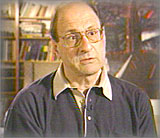 do
not acknowledge that, then the new generations of military cadets and
military people are going to absorb a lesson from the past that these
things may be acceptable in extreme circumstances. Instead of that,
someone has to speak out and tell them: these things were done, they
were wrong, they won't be done again. …That message has got to
be stressed very clearly and they have yet to comply with that duty.
do
not acknowledge that, then the new generations of military cadets and
military people are going to absorb a lesson from the past that these
things may be acceptable in extreme circumstances. Instead of that,
someone has to speak out and tell them: these things were done, they
were wrong, they won't be done again. …That message has got to
be stressed very clearly and they have yet to comply with that duty.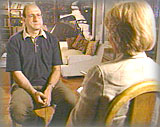 ELIZABETH
FARNSWORTH: Is there any chance this is going to happen, do you think?
ELIZABETH
FARNSWORTH: Is there any chance this is going to happen, do you think?