 | |
 |  |
| GEORGE W. BUSH | |
 April 27, 2000 
|
||
|
|
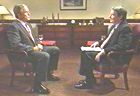
Texas Gov. George W. Bush discusses partisanship in Congress and Social Security reform.
|


|
JIM LEHRER: Governor, welcome. GOV. GEORGE W. BUSH: Thanks, Jim. JIM LEHRER: Last night you said as president you would end the arms race of anger in Washington. Describe what you mean by the angry arms race.
You know, I had two questions to ask myself before I ran: One, was could my family endure the run for the presidency? Is our love strong enough between Laura and me and the girls? And the answer to that is yes. It's even gotten stronger, by the way, since the campaign has begun. But the other question is: Can an administration change a tone? I mean, can we come together as a country and solve some basic problems -- by bringing people to Washington who are committed to the country first and foremost. They recognize there's a type of partisanship in campaigns, but not when it comes to policy - and I've reached the conclusion that, yes, that can happen. And it's going to be a test to my leadership to determine whether or not I'll be able to do so. JIM LEHRER: Have you given any thought to specifically what you're going to do to change the tone and get rid of this thing? GOV. GEORGE W. BUSH: Let me just give you an example of what I did in Texas. And the only thing I know to do is go by my gut instincts when I get sworn in. But in Texas, one of the first things I did was I went and called upon Democrats. I called upon Bullock, the great lieutenant governor; he was a little gun shy at first. But I put my cards on the table, and I said I want to get something done for America. Yesterday -- and I'll do the same with Democrats -- yesterday, Bob Kerrey -- somebody in the press goes, "Well, he's leaving office." He may be leaving office, but he --
GOV. GEORGE W. BUSH: Nebraska -- but he cares about, deeply, about Social Security reform and Medicare reform. There will be other Senators -- Democrat Senators -- who also care about those issues, but I asked Bob, I said, is it possible for a Republican president to call upon your colleagues to sit in a room and say, let's get this -- let's get something done in a positive way -- he said he thought so. And I was encouraged by his assessment of the ability of a President who is willing to spend the capital. And I think that's what's necessary, Jim, in Washington. Beside reaching out -- look -- the other day somebody else said your Dad said the same thing in his Inaugural Address -- and he did -- and it turned out to be a pretty partisan era -- not nearly as partisan as this last one. But it's the president who sets the tone. And it's the president who reaches out. But it's the president who also must share credit, as well, if something positively is done. But the president is also going to spend the capital -- sorry to be blowing on too long... JIM LEHRER: It's all right. GOV. GEORGE W. BUSH: -- But the need to say this is an important issue. I'm going to spend my capital that I earned in the course of the campaign and I promise no political recrimination -- that's what's needed for Social Security and Medicare. |
||||||||||||||||||||||||||||
| Where did the partisanship come from? | |||||||||||||||||||||||||||||
|
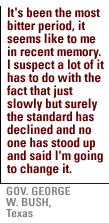
JIM LEHRER: But what caused this thing to happen? Why did it get to be the way it is in Washington now? Have you looked at it? GOV. GEORGE W. BUSH: It's hard for me to tell. I think it's just politics, and I think that over the -- it just didn't happen instantly. This administration isn't the only administration that's been involved with partisan -- you know -- bitter partisan rhetoric. It's been the most bitter period, it seems like to me in recent memory. I suspect a lot of it has to do with the fact that just slowly but surely the standard has declined and no one has stood up and said I'm going to change it. And it requires more than just the president. The president sets the tone, but it's going to have to require commitment by members of both parties in Washington. JIM LEHRER: What about your party, has your party contributed to this as much as the Democrats?
JIM LEHRER: Do you think President Clinton is really responsible for this? GOV. GEORGE W. BUSH: No, I think both sides are responsible, and I said so in my speech last night. You said -- I don't want to assign degrees of guilt, but, yes, the Republicans have responded in kind; yes, the Republicans have sometimes -- you know -- fallen into the trap of tearing somebody else down. JIM LEHRER: The reports that I read - I wasn't there last night -- but the reports that I read were that they - that part of your speech -- when you talked about the Republicans -- was not warmly received. Did you read it that way? GOV. GEORGE W. BUSH: You know, I was asked that again today. I didn't see it -- JIM LEHRER: Didn't see it that way? GOV. GEORGE W. BUSH: But that's okay; it doesn't trouble me in the least. JIM LEHRER: Why not? GOV. GEORGE W. BUSH: Because my job is to lead, and I'm the leader of the party, as far as I'm concerned, and I want to make it clear to people in the Republican Party -- there were Congressmen there, there were senators there, there were -- you know -- contributors there, and there were "hangers-oners" there. I wanted to make it clear to them what my intentions are, and I didn't ask at the door when people came in -- you know -- here's what I'm going to say, do you think I should say it or not say it? I felt like it was important to say. |
 |
||||||||||||||||||||||||||||
| Within the Republican Party | |||||||||||||||||||||||||||||
|
JIM LEHRER: Specifically, Tom Delay, the House Minority Whip, a friend -- Majority Whip from Texas, a friend of yours, a supporter of yours... Most of the Democrats and others even say that this is the most partisan Republican in the Congress of the United States. Is he -- would you go to him and say, "Cool it, Tom? ". Is that the kind of thing you might do? GOV. GEORGE W. BUSH: It depends on the situation, but yes, Tom is partisan; he's a loyal Republican; he battles for what he thinks is right, and I think Tom, himself, would sometimes say, gosh, he may have gotten a little carried away in his rhetoric. But I like Tom. I can work with Tom, and if the situation got so bitter or it was heading to being bitter, I'd call in members and say, "Let's tone down the rhetoric." Because America is more important. I mean, these issues are more important. I keep talking about Social Security reform, Jim. It's so important that we get it done right, and there's a movement that's taking place in both parties to understand the need to trust younger workers to manage some of their payroll money in the private sector so it could take advantage of the compounding rate of interest. I think we need to capture that moment.
And the commission laid out a bipartisan plan that would have included prescription drugs and providing a myriad of options from which seniors could choose, and the president didn't go forward with a bipartisan option, and I thought he made a mistake on that. JIM LEHRER: You would have -- if you would have been President, you would have accepted that? GOV. GEORGE W. BUSH: Well, I would have accepted the premise and the format. By the way, it has now been fine-tuned. Senator Frist and Senator Kerrey, Senator Breaux, and other members have fine tuned it, so now the eligibility age doesn't need to be raised to make sure the Medicare money balances. But, yes, I would have accepted the premise, and I would have called members in and said, this is a great start. |
|||||||||||||||||||||||||||||
| Social Security: a priority | |||||||||||||||||||||||||||||
|
JIM LEHRER: Is this -- how important is Social Security to you? You've been talking about it a lot. Where does it rate on your list of priorities when you become president? GOV. GEORGE W. BUSH: I think it's got to be one of the top. JIM LEHRER: Why? Why is it so important? GOV. GEORGE W. BUSH: Well, because now's the time -- because I think it's going to go bankrupt. I think in 2035, I think, now is the number, that there's going to be more recipients than payers and it's going to -- it's an unfounded liability that overhangs our government. And I know that unless we devise a system that takes advantage of the compounding rate of interest in the private sector, we're not going to be able to have a Social Security system for younger workers. And the interesting dynamics of this -- the political dynamics of the issue have changed pretty dramatically. You remember the days when if you just mentioned Social Security... JIM LEHRER: Third rail - they call it --
We have an opportunity with the budget surpluses to dedicate a lot of that money to reforming Social Security. But the sticking point is going to be whether or not we trust individuals to manage their personal savings accounts. I'm fully prepared to say to Congress we'll work together to devise a plan but inherent in that plan has got to be the opportunity for younger workers so that the benefits, so the money set aside will begin to exceed the benefits they would have received under a normal system. JIM LEHRER: But, as you know, the other side, Democrats, Vice President Gore included, would come and say, wait a minute, inherent in any plan to reassure young workers is that the government guarantees it in the final analysis. GOV. GEORGE W. BUSH: Well, that may be right. That may be a part of a future plan. But what Vice President Gore and other Democrats won't accept is the investment in the private sector by individuals. Here's the difference of philosophy here: We want -- or at least what I want -- is people owning assets -- people having an asset base, which means when they retire, there is a comfort zone. It's not just an income stream; it's a pile of assets. And I would like to see all workers have that asset base available to them as a result of reforming the Social Security system. JIM LEHRER: You think you can get this done? GOV. GEORGE W. BUSH: I do. JIM LEHRER: Knowing what the Democrats believe and knowing what the politics are, that you think as president you can get this done? GOV. GEORGE W. BUSH: I hope so. You may replay this tape about four years from now and say, hey, wait a minute, but I think -- I know it can't get done unless you get a president who stands up and says, this is a fundamental priority, and I want to spend the political capital necessary to get it done. One of the interesting things about a campaign is that a candidate who is clear in the vision and consistent in statement earns political capital from the voters, and that's why in my tax relief plan people say, well, now the primary is over, change it; I'm not going to change it. It's the right thing to do.
|
 |
||||||||||||||||||||||||||||



 GOV.
GEORGE W. BUSH: Well, the language of recrimination and finger-pointing
and trying to tear somebody down. Americans, they think of Washington
today, they think of the endless bickering that takes place and wonder
aloud, at least to me, why Social Security hasn't been modernized or
Medicare hasn't been reformed.
GOV.
GEORGE W. BUSH: Well, the language of recrimination and finger-pointing
and trying to tear somebody down. Americans, they think of Washington
today, they think of the endless bickering that takes place and wonder
aloud, at least to me, why Social Security hasn't been modernized or
Medicare hasn't been reformed.  JIM
LEHRER: The Democratic Senator from Nebraska.
JIM
LEHRER: The Democratic Senator from Nebraska.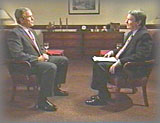 GOV.
GEORGE W. BUSH: I don't know about as much, because I think that the
president sets the tone; the president's the leader. But, yes, it has.
GOV.
GEORGE W. BUSH: I don't know about as much, because I think that the
president sets the tone; the president's the leader. But, yes, it has. I
thought the President -- and I'm going to try to be as respectful as
I can to the President during the course of this campaign because he's
the last chapter of the 20th century, and we're heading to the new chapter
in the 21st century -- but I thought he made a mistake in not seizing
the moment on Medicare reform when you had Johnny Breaux of Louisiana
and Congressman Thomas of California and others like Kerrey and other
members of the Senate Democrats saying give us a chance to modernize
Medicare.
I
thought the President -- and I'm going to try to be as respectful as
I can to the President during the course of this campaign because he's
the last chapter of the 20th century, and we're heading to the new chapter
in the 21st century -- but I thought he made a mistake in not seizing
the moment on Medicare reform when you had Johnny Breaux of Louisiana
and Congressman Thomas of California and others like Kerrey and other
members of the Senate Democrats saying give us a chance to modernize
Medicare.  GOV.
GEORGE W. BUSH: Now, younger workers - our younger citizens - fully
understand - I think the polls - it's more likely to see some of you
go to Mars than to receive a check from the Social Security system.
GOV.
GEORGE W. BUSH: Now, younger workers - our younger citizens - fully
understand - I think the polls - it's more likely to see some of you
go to Mars than to receive a check from the Social Security system.
