 | |
 |  |
| GEORGE W. BUSH | |
 April 27, 2000 
|
||
|
|
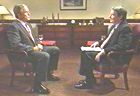
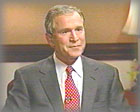
Texas Gov. George W. Bush discusses the Elian Gonzalez and Microsoft antitrust cases.
|


|
JIM LEHRER: Five days later, do you still feel the Justice Department did the wrong thing in reuniting Elian Gonzalez with his father? GOV. GEORGE W. BUSH: I do. JIM LEHRER: Why?
JIM LEHRER: Florida. GOV. GEORGE W. BUSH: Florida. The state of the Florida. The night before this event took place -- and he said I think this is going to be mediated -- there's mediation discussions going on - evidently a friend of Attorney General Reno's was a part of the mediation process. Jeb felt very good about it; he had talked to the president. And the next morning I called him. I said, "What the heck went on?" He said, "Right before that happened -- I was positive something positive was going to happen, I wish this could have been mediated." I don't know the facts. It's hard for me to second guess, but I am disturbed by the picture I saw in the newspaper. JIM LEHRER: Are you disturbed about the tactics, or are you disturbed about the fact of the reuniting? GOV. GEORGE W. BUSH: I don't mind the reuniting. I wish it had been done in a family court of law, just like the -- just like the INS said ... the day the boy arrived or the day the case became evident, the INS said, this needs to be resolved in a family court of law in the state of Florida. I wish they had followed through. For some reason they changed their opinion shortly after the December 1999 statement. You know, I understand the boy's being with his Dad. Heck, I'm a dad. You know, we preach family values as Republicans; this is family values. But I wish it had been done in a place where there wasn't a lot of suspicion about what took place. You know, if I had to guess today, I'd guess the boy's going back to Cuba, but it's a hard prediction to make. |
 |
|||||||||||||||||||||||||||
| Whose choice in your administration? | |||||||||||||||||||||||||||||
|
GOV. GEORGE W. BUSH: No, I'd make the decision on a situation that had risen to this level in the national conscience, and I'd, of course, rely upon the attorney general's opinion, I would rely upon the advice of those who are fully involved in the case, but this seems like a decision that would have risen to the Oval Office to me. JIM LEHRER: Your view of this, is it colored in any way by the fact that it involves Cuba, rather than another country say like France or Britain or Haiti or Argentina or Peru or whatever? GOV. GEORGE W. BUSH: That's a really interesting question. Yes -- in this way: The boy is seeking political asylum and that's different. Cuba is so close to our coast, and there's a history of people seeking asylum. I had an interesting story from the equivalent of a county judge -- we call them county judges in Texas -- I don't know what they call them in Florida -- but in the Orlando area. And he's one of those boys that his parents shipped over here... Remember the orphan program? Well, they weren't orphans but they were orphaned to America -- and his parents put him on an airplane when he was six or seven years old and said, see you later, son, we love you, we hope to join you. But they got him out of this, this country where there's no freedom, and he came here. And I had a long talk with him about the situation. He said, you've got to understand, he said, that this boy can't go back to Cuba -- at least in his mind -- he can't go back to Cuba, because he's not going to realize the wonderful freedoms I've realized; I've come from orphaned child, so to speak, to now political leader in the state of Florida; I want this boy to have the same freedom. I think the proximity to the country and Cuba's -- Fidel Castro's stranglehold on the freedom of Cuba makes ... probably clouds my vision a little bit, to be frank with you. |
|||||||||||||||||||||||||||||
| Continuing Cuba's isolation | |||||||||||||||||||||||||||||
|
JIM LEHRER: Does it make sense to still isolate Cuba?
And I'm asked about all the time about my, you know, apparent inconsistency. They say you're for China being admitted into the WTO and you're for trade with China, but somehow you don't feel the same way for Cuba. And the difference is -- it's the interface between the entrepreneurial folks in both countries, as opposed to money going into prop up this dictator. JIM LEHRER: What do you say to folks who say, hey, wait a minute, we've been -- we've had the embargo on now against Cuba for all these years, Fidel Castro has now out served nine U.S. Presidents? What do we have to show for this isolation? GOV. GEORGE W. BUSH: Be patient, I guess. I believe that one of the things we have to show is that he's no longer as active in our hemisphere as he once was, that his influence of spreading his brand of government and his so-called "revolution" around our hemisphere has been -- is much less onerous today, and that's important. Because a peaceful democratic, market-oriented hemisphere is in our nation's national interest, and the hemisphere is a little unsettling incidents taking place, unsettling facts in our hemisphere. One, of course, is Colombia, and an active Fidel Castro could easily aggravate that situation. JIM LEHRER: Just to get to the point, if you are elected president, would you -- do you have anything special that you might do toward Cuba, or would you just continue the status quo? GOV. GEORGE W. BUSH: As of right now, I'd continue the status quo. JIM LEHRER: What do you say to those who say, hey, that's a national policy that you just spoke of and yet ... Is this policy and this view being driven by what's happening in Little Havana by some people, understandably, have very strong feelings about Castro and Cuba? But the rest of the country, every poll that's been taken shows people have kind of tuned that one out now. GOV. GEORGE W. BUSH: Yeah. Well, I think it's interesting that the Elian Gonzalez issue -- and how do we free Cuba -- and... JIM LEHRER: You don't think they're intertwined? GOV. GEORGE W. BUSH: Well, I think they may be intertwined in the psyche of the American public now, but I think once the Elian Gonzalez issue is resolved, we'll go back to focusing on what is in our nation's interests, and a free Cuba is in our nation's interests, and it's not in our nation's interest to provide capital to prop up this current administration. |
|||||||||||||||||||||||||||||
| The Microsoft case decision | |||||||||||||||||||||||||||||
|
JIM LEHRER: The Microsoft case, tomorrow, reportedly, the federal government is going to recommend that Microsoft be divided up into at least two companies, is that a good idea? GOV. GEORGE W. BUSH: It's going to be up to the judge. I'm going to take - I don't want to get involved in second guessing judicial decisions on the Microsoft case. I'm not a lawyer and I really, frankly, haven't looked at all the facts. I hope, though, that whatever settlement is done it won't ruin this company because this company has been a very interesting innovator, and so I hope the judge would keep in mind that this company is an important part of the technological revolution taking place in America. JIM LEHRER: Would this action have even begun in a Bush administration? GOV. GEORGE W. BUSH: It's hard for me to say. It's hard for me to say. I don't know all the facts - the legal facts on the table. I'll enforce antitrust laws. JIM LEHRER: You do believe in antitrust laws? GOV. GEORGE W. BUSH: I do. JIM LEHRER: There's no question on that. GOV. GEORGE W. BUSH: I do. And - again this is new ground being broken, of course. But the old antitrust was: Is it a constraint to trade to the point where people can control price? That was the question. You know, Rockefeller antitrust law - the whole reason why Roosevelt insisted upon the antitrust laws in the first place was Standard Oil was driving out competition to run the price up - to make it harder for people to purchase product. And that's the old standard. It's still going to be a part of the standard in the future, but we'll see how this judge rules. JIM LEHRER: Conventional wisdom, as I'm sure you're aware, Governor, is that if you are elected President and the Microsoft is still pending in some way - either on appeal or whatever - that you'll stop it. GOV. GEORGE W. BUSH: I think those are - that's needless speculation, and I've - it's like the guy said - I've got friends on both sides of the issue. And you know, Jim Barksdale is a close friend of mine and a supporter, he's a really good fellah, who is part of the reason why the case came up in the first place - testified against Microsoft, so I think that's speculation that people should -- |
 |
||||||||||||||||||||||||||||
| Campaign advisors and Microsoft | |||||||||||||||||||||||||||||
|
JIM LEHRER: Is your flexibility compromised at all by the role of Ralph Reed, an adviser to you -- it also turned out had been hired by Microsoft to lobby you? GOV. GEORGE W. BUSH: No. I said - we're beginning to scrimp -- I typed this speech myself -- I'm beginning to save money in my campaign and I want you to know I typed this speech. "Ralph Reed was right. Microsoft '98 is great." I didn't have any idea Ralph Reed was representing Microsoft, nor would it have mattered to me. JIM LEHRER: It doesn't matter to you -- GOV. GEORGE W. BUSH: Not at all. JIM LEHRER: -- that a guy who was adviser to you was also advising a company with -- GOV. GEORGE W. BUSH: No, it doesn't matter to me that he represents Microsoft. It doesn't have any weight on my opinion -
GOV. GEORGE W. BUSH: -- in relation to the marketplace as to who he represents. JIM LEHRER: But he doesn't advise you on matters that - GOV. GEORGE W. BUSH: Technologically? JIM LEHRER: Technological matters or anything involving Microsoft, that could remotely involve Microsoft? GOV. GEORGE W. BUSH: No. No, he doesn't. I didn't even know he had the account -seriously. JIM LEHRER: Had he ever mentioned Microsoft to you in any whatsoever? GOV. GEORGE W. BUSH: Never has. JIM LEHRER: And you're clean about this? He's still advising you, though, on other things, right? GOV. GEORGE W. BUSH: I guess. I haven't talked to Ralph in quite a while. He may be talking to members of my staff, but - JIM LEHRER: Yeah. GOV. GEORGE W. BUSH: When I say it doesn't matter, what doesn't matter is that - you know … He could walk in my office and say, oh, by the way, you need to be generous to Microsoft, and I'd say if I don't agree, I'll say, see you.
|
|||||||||||||||||||||||||||||



 GOV.
GEORGE W. BUSH: Because the picture on the newspaper, it just seems
so un-American to me. the picture of the guy storming the house with
a scared little boy there... I talked to my little brother, Jeb -- I
haven't told this to many people. But he's the governor of -- I shouldn't
call him my little brother -- my brother, Jeb, the great governor of
Texas...
GOV.
GEORGE W. BUSH: Because the picture on the newspaper, it just seems
so un-American to me. the picture of the guy storming the house with
a scared little boy there... I talked to my little brother, Jeb -- I
haven't told this to many people. But he's the governor of -- I shouldn't
call him my little brother -- my brother, Jeb, the great governor of
Texas... 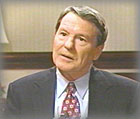 JIM
LEHRER: Janet Reno and the president have made it very clear that Janet
Reno made the decision on this. In a Bush administration would the attorney
general -- whoever it might be -- make that kind of decision?
JIM
LEHRER: Janet Reno and the president have made it very clear that Janet
Reno made the decision on this. In a Bush administration would the attorney
general -- whoever it might be -- make that kind of decision?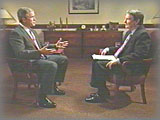 GOV.
GEORGE W. BUSH: Yeah, it does so far, and here's why, Jim: Trading with
Cuba -- you know -- hard capital into Cuba is really providing money
to the Fidel Castro administration. Because in order to invest in the
country, you invest with a government-sponsored entity, and I'm told
that you invest in hard dollars and workers get paid in pesos, that
there isn't that direct interface between entrepreneur and entrepreneur,
like there is in China, for example.
GOV.
GEORGE W. BUSH: Yeah, it does so far, and here's why, Jim: Trading with
Cuba -- you know -- hard capital into Cuba is really providing money
to the Fidel Castro administration. Because in order to invest in the
country, you invest with a government-sponsored entity, and I'm told
that you invest in hard dollars and workers get paid in pesos, that
there isn't that direct interface between entrepreneur and entrepreneur,
like there is in China, for example.  JIM
LEHRER: I get it. I see.
JIM
LEHRER: I get it. I see.