 | |
 |  |
| GEORGE W. BUSH | |
 April 27, 2000 
|
||
|
|
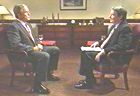
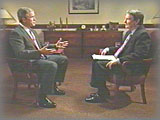
Texas Gov. George W. Bush discusses policy differences with Vice President Al Gore.
|


|
JIM LEHRER: What's the - what do you see as the major difference between you and Al Gore in terms of being the President of the United States?
There's kind of a healthy disrespect for faraway government, and there is no class distinctions in Midland; it's just pretty much who you are is who you are. To the extent I understand the man's biography, he was raised in Washington, D.C.. And I think inherent in that statement is a difference of philosophy, where I'll trust people and I'll trust people to make decisions for their own lives, and there's some - you know - a vivid example is our difference of opinion on the Social Security or the retirement systems. I think people ought to be allowed to manage their own personal savings accounts and he doesn't, and I think that there's a fundamental difference of attitude. JIM LEHRER: But going back to what I said about your father, your father was involved in the federal government for most of his adult life. GOV. GEORGE W. BUSH: True. JIM LEHRER: And you got -- you came away from watching your father with a kind of negative view of the federal government, right? GOV. GEORGE W. BUSH: Well -- JIM LEHRER: No? |
||||||||||||||||||||||||||||
| Views on federal government | |||||||||||||||||||||||||||||
|
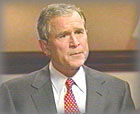
GOV. GEORGE W. BUSH: I was kind of skeptical about the process. Listen, I'm just as shocked as you are that I'm sitting here talking about the presidency -- it's never been a part of my … my life's ambition hasn't always been to be the president. And here I sit, one of two potential presidents. And I'm - I am - I want to be the President for the right reasons and … But, yeah, I got kind of burned out for a while on politics and Washington. That didn't - in the end - didn't deter me from wanting to change things, and my speech yesterday was a heartfelt speech, and I understand that people didn't clap. Actually, it made me feel better when they didn't.
GOV. GEORGE W. BUSH: Because I want people to know that I'm the kind of guy that stands up and not looking necessarily for accolades; I'm looking for results. JIM LEHRER: Speaking of results, all the polls show that -- all the polls I've seen - now maybe I've missed some -- that when people are asked - the American people are asked essentially: Are you better off today than you were when the Clinton-Gore administration began seven years ago, the overwhelming majority say, yes. Now, you're asking them to put in a new Bush administration. How will life be better for them under a Bush administration? |
|||||||||||||||||||||||||||||
| A Bush administration | |||||||||||||||||||||||||||||
|
GOV. GEORGE W. BUSH: You know, let me say, just to respond to that poll first, I readily concede if this country wants four more years of Clinton-Gore, I've got a tough battle, there's no question about that. Here's the difference - or here's what they'll see under a Bush administration: One, a strong economy. JIM LEHRER: Stronger than the one we have now? GOV. GEORGE W. BUSH: Well, it can be - you know, the one we have now has got a little - slightly rocky looking future to it, only because the stock market's got a lot of jitters. JIM LEHRER: Does that bother you, the stock market problems?
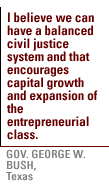
And so many people now have their assets tied up in the market it could affect in a longer term the economy, and that's why I think it's so important to share some of the surplus with the people who pay the bills as an insurance policy for economic growth. I'm a fierce free trader, Jim, and I wouldn't have - I wouldn't have - I would have had a better strategy in dealing with the GATT discussions in Seattle in the current administration, because I think it's important for us to free trade as a nation; I'm a tort reformer; I believe we can have a balanced civil justice system and that encourages capital growth and expansion of the entrepreneurial class. A difference would be: I'll strengthen the military. I know they're going to play like they've been strengthening the military here - they being my opponents - my opponent and the administration. But this is a military that's got very little morale now. I would go forward with an antiballistic missile system and mean it. JIM LEHRER: Do you think that President Clinton means it?
JIM LEHRER: Why don't you think - GOV. GEORGE W. BUSH: Because nothing coming to the floor every day. In all due respect to the president, he's been silent on the subject for an early period of time. Secondly, they amended the ABM, which made it even tougher to develop true intercept systems. And I think if he were really interested, we'd be seeing the fruits of research and development coming out of the Pentagon, and I don't -- I don't believe that. Now, maybe he'll prove me wrong, but I would hope he wouldn't sign - and I'll make a little news with you here - I would hope he wouldn't sign a treaty that would restrict our ability to fully develop an antiballistic missile system. I would hope he wouldn't constrain me -- or the next president -- or the next administration's ability to move forward by signing a halfhearted reform of the ABM. |
 |
||||||||||||||||||||||||||||
| Values vs. economy | |||||||||||||||||||||||||||||
|
JIM LEHRER: Back to the point about the way the average American feels about whether they're better off -- and I guess I was thinking more in economic terms - they have more money in the bank - they have more money in the stock market - your kids can go to -- whatever -- what do you think about that? GOV. GEORGE W. BUSH: You see, I can't argue with you on more money in the pocket, but there's something else going on in America. JIM LEHRER: Well, that's what I wanted to get at. What else is there beside the economic thing that you can make people feel better? GOV. GEORGE W. BUSH: Military - and peace - but there's a larger issue and the issue of values. People are concerned about an era really - and the way I like to summarize it is "If it feels good, do it, and if you've got a problem, blame somebody." People in America are concerned about that. They're concerned about a culture that seems to have undermined family and respect, respect for each other, respect for life. They're concerned about - you know - these movies and things that come on the screens and - you know - I'm not a censor guy but I will tell parents, pay attention to what your children are watching. Watch PBS. (Laughter)
JIM LEHRER: But how in the world as President of the United States are you going to change those kinds of things? GOV. GEORGE W. BUSH: Well, cultures take a while to change - no question about it, and government can play a role by passing laws. And back to your gun law issue, there needs to be a strong sense of accountability -- and that not only means law but enforcement. We don't want people walking around neighborhoods with guns that shouldn't be having guns and acting out their aggressions by shooting guns. They've got to have in the back of their mind there is a consequence. The problem is what government cannot do, is get people to love one another. And that's been the fundamental frustration with government. And so one of the ways the president can make our society as hopeful as possible is to have a very strongly active … including some expenditure of federal money -- mentoring programs, character education programs, encourage faith-based programs, become involved in drug and alcohol treatment programs. It's really to kind of gather up that fabric of society that makes America unique -- the charitable, loving side of our country … and be muscular at the governmental level, and encouraging contributions, and the expenditure of money, so long as the tax dollars will be -- will encourage faith-based programs to be involved in helping people in need. Now there's a constitutional question here. I'm confident some scholars will be scratching their head - how dare he spend money on faith-based initiatives. And the answer is because we're helping people and we're not funding the church or the synagogue or the mosque; we're funding the program that comes out of the church and the synagogue and the mosque. And I think that's important to change the culture, and I think -- it all starts with having a leader that people trust. And the president undermined the ushering of the responsibility era, and I'm not going to spend a lot of time talking about this, but he did; he did.
GOV. GEORGE W. BUSH: I can do something about that by when I complete the oath, take the oath to tell the truth, and to take the oath to uphold the honor and dignity of the office. JIM LEHRER: Governor, thank you very much.
|
|||||||||||||||||||||||||||||



 GOV.
GEORGE W. BUSH: Well, first of all, we're all products of how we're
raised, and I was raised in Midland, Texas, a country you've been out
to, a pretty isolated part of the world but people are independent thinkers
and when they think of government, they think of it in terms of patriotism
and that's about it.
GOV.
GEORGE W. BUSH: Well, first of all, we're all products of how we're
raised, and I was raised in Midland, Texas, a country you've been out
to, a pretty isolated part of the world but people are independent thinkers
and when they think of government, they think of it in terms of patriotism
and that's about it. 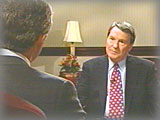 JIM
LEHRER: Why?
JIM
LEHRER: Why?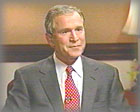 GOV.
GEORGE W. BUSH: Yeah, it does. I would hope - I mean, I'm not going
"hooray." I wish it wasn't as jittery. I wish it was stable
because I'm not - I'm not so crass as to want to be the president at
the expense of somebody's portfolio, but that does trouble me a little
bit because I think - and I think - I think there's some uncertainty
out there that's beginning to kind of creep into the conscious of investors.
GOV.
GEORGE W. BUSH: Yeah, it does. I would hope - I mean, I'm not going
"hooray." I wish it wasn't as jittery. I wish it was stable
because I'm not - I'm not so crass as to want to be the president at
the expense of somebody's portfolio, but that does trouble me a little
bit because I think - and I think - I think there's some uncertainty
out there that's beginning to kind of creep into the conscious of investors.
 GOV.
GEORGE W. BUSH: No, I don't.
GOV.
GEORGE W. BUSH: No, I don't.