 |
|
 |
|
| RELEASING PINOCHET | |
 March 2000 
|
|||
|
|
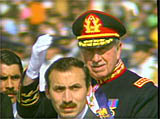
After 17 months under house arrest in Britain on alleged human rights abuses, Augusto Pinochet is back in Chile. Should he have been set free? Mark Falcoff from the American Enterprise Institute for Public Policy Research and Harley Shaiken, director of The University of California at Berkeley's Center for Latin American Studies, respond to your questions. |
|
|
|
Pinochet stands accused of the torture and disappearance of political dissidents during his 17 years as Chile's military leader.
British Home Secretary Jack Straw announced his decision March 2 not to extradite Pinochet to Spain or to uphold similar bids from Switzerland, France and Belgium. Even though Straw allowed the release he said Pinochet's ordeal should serve as a warning to other world leaders. "It has established, beyond question, the principle that those who commit human rights abuses in one country cannot assume that they are safe elsewhere," Straw told Britain's parliament. "That will be the lasting legacy of this case." But Chile Democratico, a group of Chilean exiles in Britain, said Straw "failed the cause of human rights" by allowing Pinochet to return home. "It is simply too convenient for the governments involved that Pinochet, who short months ago was giving long and lucid newspaper interviews, should suddenly be found incapable of understanding the charges against him," the group said. What do you think? Should Pinochet have been allowed to leave London? Does this decision set a precedent for future human rights cases? Mark Falcoff from the American Enterprise Institute for Public Policy Research and Harley Shaiken, director of The University of California at Berkeley's Center for Latin American Studies, respond to your questions.
|
|||||||||||||||||||



 He
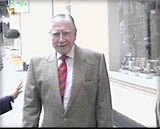
was arrested on a warrant from a Spanish judge in 1998 and remained
under house arrest in London while a lawyers debated whether he was
medically fit to stand trial.
He
was arrested on a warrant from a Spanish judge in 1998 and remained
under house arrest in London while a lawyers debated whether he was
medically fit to stand trial.