|
|
 |
|
| RELEASING PINOCHET | |
 March 2000 
|
|||
|
|
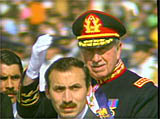
After 17 months under house arrest in Britain on alleged human rights abuses, Augusto Pinochet is back in Chile. Should he have been set free? Mark Falcoff from the American Enterprise Institute for Public Policy Research and Harley Shaiken, director of The University of California at Berkeley's Center for Latin American Studies, respond to your questions. |
|
|
P.
Romero of Sunnyvale, California asks: Neither Pinochet nor his henchmen cared about the medical condition of their tortured and murdered victims (except, I guess, to keep them alive during interrogations). Pregnant women and senior citizens had to endure torture as well as younger prisoners, while their families pleaded in despair (not unlike Pinochet's relatives since the beginning of this case) to no avail. Should we care about his medical condition in deciding whether or not to prosecute him?
Mark
Falcoff responds: Pinochet's medical condition--whatever it may be, and I am not in a position to say--is surely not the reason why he was released to go home to Chile. As the Chilean foreign minister said in a remarkably candid interview in today's (March 10) issue of Clarin (Buenos Aires), the Spanish didn't want him as a prisoner and the English didn't want him to die in London. But paradoxically, the way Pinochet danced out of his wheelchair once he got back to Chile, as well as the inopportune comments of his supporters, have had the effect of stiffening the resolve of the Chilean government to bring the matter to justice, and in fact I have no doubt that by overshooting the mark as they did the Pinochetistas have probably ruled out any possibility that he will be excused from justice on medical grounds.
Harley
Shaiken responds: As this comment makes clear, mercy was not part of the vocabulary of the Pinochet regime. All the more reason not to stoop to this level in charges against him or any member of his regime. Mental impairment that prohibits a person from understanding the charges against them or participating effectively in their own defense is an important reason for them not to be tried. Does General Pinochet meet this standard? The lack of transparency in the medical examination he underwent at least raises credible questions. Under Chilean law, mental impairment is grounds to avoid trial but serious illness is not. The question of Pinochet's mental fitness at the least ought to be revisited in the wake of the apparently curative powers of his plane flight and arrival home.
|
|||||||||||||||||||||||||