|
|
 |
|
| RELEASING PINOCHET | |
 March 2000 
|
|||
|
|
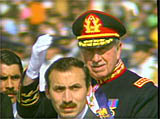
After 17 months under house arrest in Britain on alleged human rights abuses, Augusto Pinochet is back in Chile. Should he have been set free? Mark Falcoff from the American Enterprise Institute for Public Policy Research and Harley Shaiken, director of The University of California at Berkeley's Center for Latin American Studies, respond to your questions. |
|
|
|
Matthew
P. Malkowicz of Fairlawn, New Jersey asks: I would hope if a Marxist administration nationalized our economy, our military would take over executive powers. And really, how bad could Pinochet have been? A dictator who abdicates total power is almost an oxymoron. If Pinochet is so evil why does only a third of Chile's population dislike him?
Mark
Falcoff responds: The issue surely is not that the military took over power in Chile--most Chileans favored such a move at the time. Rather, it was the peculiarly vicious way that they went after functionaries and supporters of the former regime which shocked the world. As to how bad Pinochet could have been--I would say that the torture and murder of several thousands of people, the exiling of thousands more, the closing of all independent media and political parties, etc., etc., etc., and over a very long period of time, far longer than any resonable consideration of national security would dictate...I think this is bad enough. Maybe not as bad as a full-blown Marxist state, but bad enough, and no serious anti-communist should want to associate himself with such a regime. I am afraid that this questioner is misinformed as to the present state of Chilean opinion. Actually somewhere between sixty and seventy percent of Chileans feel that Pinochet should face justice. The questioner has things exactly backwards; it is a third of Chileans who like or in some way support Pinochet, although I think even that is a generous estimate.
Harley
Shaiken responds: This question is based on a number of misconceptions. First, a Marxist administration did not nationalize the Chilean economy. In fact, the most important nationalization during that period-the nationalization of the pivotal Chilean copper industry-was supported by the center and right parties as well as by the left Popular Unity coalition. The most effective remedy for challenging any government policy is to organize and vote for a different set of policies, an option that was available in Chile. What General Pinochet did is not simply topple a government or reverse a set of policies, but ruthlessly seek to eliminate dissent. Marxist professors were certainly targets, as were non-Marxist University rectors; leftists were hunted down, as were social workers; union leaders were murdered as were singers. Pinochet did agree to hand over power but under very carefully controlled and self-protecting circumstances. By this standard, the last government of East Germany ought to also deserve our praise. How bad was General Pinochet? The crimes his regime authorized and organized are not captured by the numbers and ought not to be forgotten. Consider just the beginning of this testimony cited in an Americas Watch report published in the early 1980s. "Cesar C. was a 27-year-old political community leader with some high school education; he was married and had three children. He was arrested seven times between 1973 and 1977, each time with great violence. He was subjected to a series of tortures; being beaten all over his body for four hours at a time; simulated executions; deprivation of sleep for 48 hours; humiliation and harassment; broken teeth caused by stones put in his mouth and then hammered; witnessing his brother's torture with electric prods; and other forms of violence and humiliation." This act and countless others like it represent systematic practices of the Chilean security forces, designed, ordered, and orchestrated from the highest echelons of authority. They are not instances of passionate excess nor aberrations in the historical record; they constitute the pattern itself. General Pinochet retains his supporters but they are far shy of the two thirds of the population this question indicates. And many of the third or so of the Chilean electorate that retains some fondness for Pinochet would prefer he remain in the past, not define the future.
|
|||||||||||||||||||