|
|
 |
|
| RELEASING PINOCHET | |
 March 2000 
|
|||
|
|
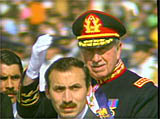
After 17 months under house arrest in Britain on alleged human rights abuses, Augusto Pinochet is back in Chile. Should he have been set free? Mark Falcoff from the American Enterprise Institute for Public Policy Research and Harley Shaiken, director of The University of California at Berkeley's Center for Latin American Studies, respond to your questions. |
|
|
Genevieve
Banks of Odenton, Maryland asks: The permanent international criminal court, temporary war crimes tribunals and other attempts to have people who commit atrocities will only be successful if some governmental body steps forward to use their territorial sovereignty to make wrong doers take punitive responsibility toward their actions. If the Holocaust survivors can live to see their tormentors brought to justice, don't others have the same right to have grievances redressed against power structures?
Mark
Falcoff responds: I am sure that victims of state crimes have "the right to have grievances redressed against power structures", but I am unsure of exactly who are supposed to be the redressers. Unfortunately the Nuremburg precedent did not resolve this question, since it is unlikely that in countries like Chile a foreign occupier will arrive to dispense justice. Even in the case of Holocaust survivors, my impression is that such justice as they have received has been due largely to moral suasion (the German reparations) or punitive threats (as in the case of Senator D'Amato threatening to shut off Swiss banks' access to New York financial markets) rather than any judicial process. In the case of Pinochet, jurisdiction was at the heart of the controversy. Why should Spanish or British courts have priority over Chilean courts? Is that because people in Spain and Britain thought that Chilean justice was not independent? If so, they have been proven wrong, because as of now 72 charges have been filed against Pinochet in the Santiago court of appeals, and in fact Congress and the entire political community is talking about lifting his congressional immunity.
Harley
Shaiken responds: I agree that the victims of state-sponsored torture and murder ought to be able to see "their tormentors brought to justice," an idea that has broad international support in the wake of the horrors of the holocaust. In many ways, the most appropriate place for this accounting to take place is in the country where the violations occur in order to allow justice for the victims, repairing the social fabric, and the construction of institutions that insure these acts not happen again. The problem is that justice in the home country is frequently not possible especially if the military retains a central role. Moreover, justice through an international body is unlikely, given the state of international human rights law, particularly the fact that an International Criminal Court is not yet a reality. What's left? About the only realistic option is for democratic nations to step in and prosecute the authors of these crimes. This is precisely what Spain and other European nations attempted with regard to General Pinochet. There are ample precedents under international law to support this course of action. These precedents hold states accountable for commitments already made under international law and covenants. The principle of "universal jurisdiction," for example, lays the basis for prosecuting crimes against humanity such as genocide in countries other than where they occurred. Moreover, almost 120 countries have ratified the United Nations Convention against torture which allows states to prosecute or extradite violators outside the country in which the crime occurred. After the "Pinochet Case" the practice of international human rights law has been changed forever. Not only will many former dictators have limited travel itineraries, but justice for those who engage in crimes such as genocide could have an important inhibiting effect on the actions of future regimes. The case has also inspired new efforts to prosecute other criminals, such as those responsible for genocide in Guatemala, who have thus far eluded prosecution in their own countries.
|
|||||||||||||||||||||||||