
4 Ways to Explore Science at the Dinner Table


Here are a few science experiments you can try with your child when you’re waiting for the food to arrive at a restaurant.
Materials
Directions
Sweaty drinks and condensation: After you’ve settled in and ordered, you’ll likely have glasses of water around the table. And by now, there might be water droplets forming on the outside of the glasses. Ask your child if they know why their drink “sweats.” It’s condensation! All air has water vapor (water as a gas) in it — and warm air has more water vapor than cold air. The air in the restaurant is warmer than the air close to the water glass. And as the glass cools because of the ice and cold water inside, the air by the glass also cools. The cold air turns water vapor in the warmer air into water droplets, and the water droplets stick to the glass.
Salt on ice cubes: Use your spoon to grab two ice cubes from your water and place them on a napkin. Sprinkle table salt on one ice cube and ask your child what might happen. With younger children, observe which ice cube melts faster. With older children, you can explain that the ice cube with salt melts faster because the salt dissolves into the ice, creating salt water. And salt water freezes at a lower temperature than water, so the ice cube with salt on it unfreezes faster.
Straws and wrappers: When you’re removing the wrapper for a straw, crunch it slowly against one end of the straw before pulling it off. The more compact you can make it, the better. Then place the scrunched-up wrapper on the table. Place your finger over the straw in the water, hold some drops inside, and lift it out of the glass. Move your finger slightly to get a few drops of water to land on the scrunched-up straw wrapper on the table. The wrapper uncoils and moves like a snake as the water causes the paper to expand!
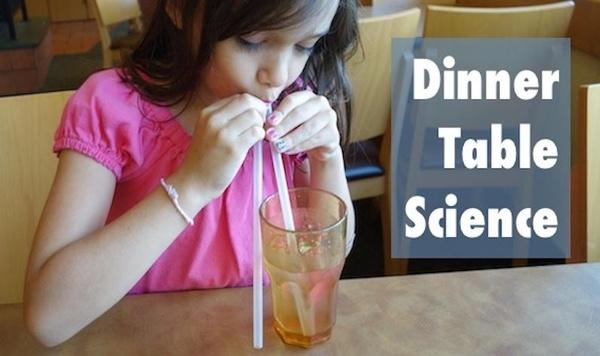
Straws and air pressure: For this experiment, ask your server for a few extra straws. If you ask your child how straws work, you’ll likely get an answer about the straw sucking up water like a vacuum. What’s really happening is that we’re removing the air around the straw and decreasing the air pressure in our mouths. The air pressure pushes down on the liquid outside the straw, which pushes liquid up into the straw. To test out the idea, give your child two straws. Put one in the water, the other in the air, and try to drink. They’ll have a hard time getting the water up now! The air pressure in the straw outside of the water is causing the pressure in their mouths to be the same, so water isn’t pushed up in the straw.
 Science