

Build Homes for Bats


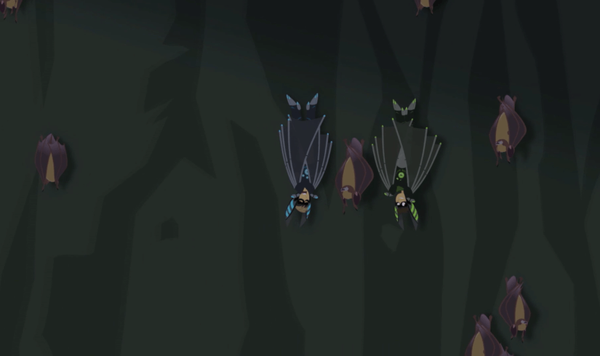
Help your child build a bat box and learn about the habitat preferences and shelter needs of the little brown bat. After building bat house your child can use the criteria for good bat house placement to choose the best spot for their bat house.
Before You Play
Explain to your child that bats spend winter months in caves and abandoned mines during the winter to hibernate, but in the spring and summer bats spend their time in trees, under bridges, and in old buildings where they give birth and rear young. Bats love tight spaces to crowd in and use their combined body heat to keep warm. There are several factors that make a good summer home for a bat, and it starts with the building of the bat house!
Choosing a Bat House
There are several commercial bat house kits (also called bat box) available that contain pre-cut wood and only require assembly. These are certainly an option for a home project and can be found from many sources. As well, it is possible to make a bat house from scratch.
Not all commercial bat house kits are the same. Often the less expensive kits are actually only decorative and at the very least would be unusable by bats. If choosing a commercially available bat house kit, be sure to purchase one that is certified by Bat Conservation International here.
Bat Conservation International also publishes The Bat House Builder’s Handbook, which includes the most recent bat-house research data and up to date bat box designs and tips for success. Note that for all options your child will need to be closely supervised as the use of hammers, nails, screwdrivers, and screws are necessary. For some options a saw may also be needed. It is recommended that an adult supervise each bat house being built.
Materials
Directions
Once you and your child have successfully built a bat house you will need to decide where to place it. The following criteria are important to keep in mind: (adapted from Bat Conservation International bat house criteria sheet)
- Sun exposure: Bat houses where high temperatures average 80° F (27º C) should received at least 10 hours of direct sunlight and more is better. At least six hours of direct sun is recommended for all bat houses where July’s daily highs are between 80° F and 100º F (27º C and 38º C). To create favorable conditions for maternity colonies in the summer, internal bat-house temperatures should stay between 80° F and 100º F as long as possible.
- The greatest bat house success has been achieved in areas of diverse habitat, especially where there is a mixture of varied agricultural use and natural vegetation. Placement should be within ¼ mile of water (preferably a stream, river, or lake).
- Bat houses should be mounted on buildings or poles. Houses mounted on trees or metal siding are less used. Wood, brick or stone buildings with proper solar exposure are excellent choices, and houses mounted under eaves are often successful. Mounting two bat houses back to back on poles is one option that is ideal. Houses should be placed ¾ inch apart and cover both with a galvanized metal roof to protect the centre roosting space from rain. Bat houses should be mounted at least 12 hours above ground, and 15 to 20 feet is better. The house should not be in a location where it is lit by bright lights.
- Houses mounted on the sides of buildings or on metal poles provide the best protection from predators. Bats may find houses more quickly if they are located along forest or water edges where bats tend to fly. However they should be placed far from tree branches or other perches where aerial predators can land.
- Open-bottom houses greatly reduce problems with birds, mice, squirrels or parasites entering the house, and guano (bat excrement) does not accumulate inside. If wasps nests accumulate, they should be removed in late winter or early spring.
- Bat houses can be installed any time of the year.
 Science