

Explore 2D and 3D Shapes with Peg


Send your child on a scavenger hunt to search for real-world objects that represent 2D and 3D shapes.
Before You Play
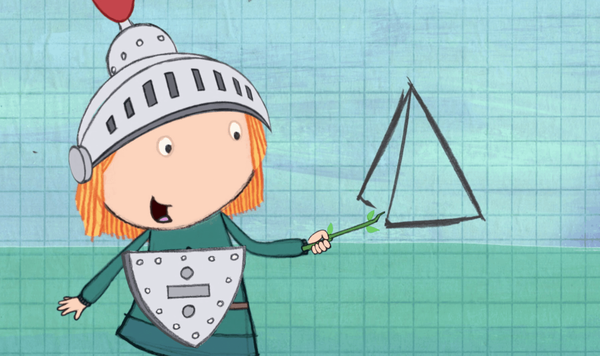
Have your child watch The Golden Pyramid Problem. Ask her to pay special attention to the shapes she sees in the episodes.
Materials
Directions
Have your child hold up her paper Peg doll. Together, review the shapes that make Peg. Ask, “What shape is Peg’s head?” Or say, “I’m thinking of a part of Peg that is round. Which part of Peg am I thinking of?”
Explain to your child that the shapes in her paper Peg doll are flat, but shapes can also be three-dimensional. For example, you can say “A ball is round and has no sides, like a circle. But, a circle is flat and this ball is not flat. It is a solid shape or three dimensional. It is called a sphere.” Or, you can use your finger to outline the face of a box and explain, “Here are four corners and four equal sides, like a square. But this box is three dimensional, not flat. It is called a cube.” Continue by discussing a triangle/pyramid and a rectangle/rectangular prism.
Ask, “Did you know that flat and solid shapes are all around us?” Hold up a piece of paper and ask your child, “What shape is this?” Point to something round and ask, “What shape is this?” Ask, “What other shapes do you see?”
Tell your child she is going to hunt inside and outside for things that have the same shapes as those that make up Peg. Move around the room or go outside together and hunt for Peg’s shapes in 2D, 3D, or both. Help your child keep track of the shapes she has found on a piece of paper. Encourage her to keep going until she's found all of Peg’s shapes. Then, ask her, “What shape did you see most often?”
 Math
Math