
Learn About Density With Dancing Raisins


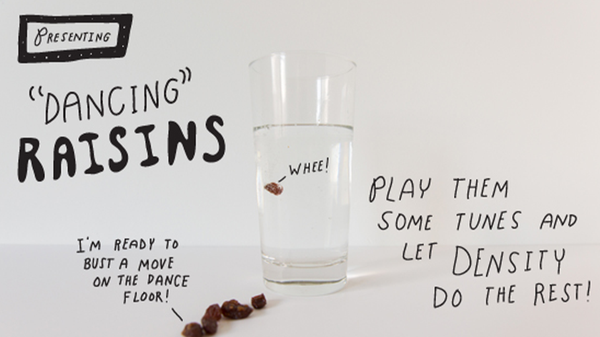
Build your child’s science vocabulary and understanding of measurement with this simple experiment.
Before You Play
Having a basic understanding of volume, mass, and density will help your child maximize his learning from this experiment. First, ask if he is familiar with the terms. If he gets stuck, use these simple definitions: Volume is the amount of space an object occupies. Mass is a fancy word for weight. It's basically the number of atoms (basic units of matter) in an object. Density tells us whether something will sink or float. It’s determined by dividing an object’s mass by its volume.
Materials
Directions
Fill a glass 3/4 of the way full with soda and have your child observe it. Does he see bubbles? Those little gas globes are filled with carbon dioxide (CO2).
Ask your child to drop 2-4 raisins into the glass. What does he notice? At first the raisins will sink, but then something changes; the raisins will be covered in gas bubbles. The gas bubbles have increased the raisins’ volume. Up, up, up they go!
Ask him, "What do you think will happen once the raisins reach the top?" The raisins will sink, then float again! Can your child guess why? What he's seeing is how an object’s density can change. At first, the raisins sink because their density is greater than soda. Then the bubbles increase the raisins’ volume, helping them displace more water. Their density is now less than soda, and they float to the top. Once the raisins reach the top, the gas bubbles pop, and the raisins’ volume decreases. That’s when the raisins fall back down and the cycle starts all over again. The raisins will dance until they run out of gas. Literally!
Jennifer Cooper is the blogger behind Classic-Play.com, an online resource for creative families. Her favorite pastimes include dancing around her living room, watching “The Pink Panther” with her kids, and daydreaming. Jennifer lives in Baltimore, Maryland, with her husband, Photographer Dave Cooper, and two children.
 Science