
Make Electric Play Dough Circuits


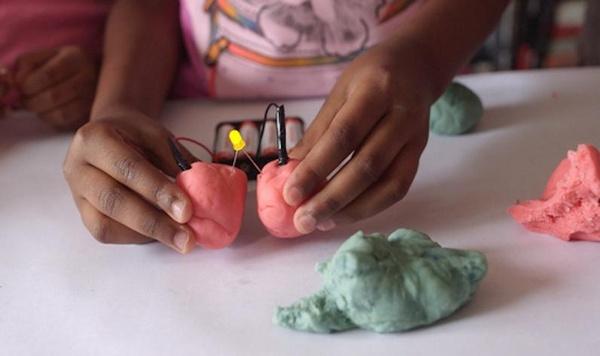
Use this fun, interactive activity to talk about how conductive materials allow electricity to flow freely, while insulating materials make it slow down or stop.
Materials
Before You Play
This experiment was developed by AnnMarie Thomas as a way to introduce the idea of circuits to young children. In their research, they discovered that salt dough was a great conductor, and sugar dough was a great insulator. Learn more by watching her TED Talk on “squishy circuits.”
Directions
Once you have the doughs made (click here for the dough recipes) and the materials (click here for a link for the light emitting diodes) ready, you can start by having your child create a circuit in its most basic form — a circle that allows electricity to flow in one direction to light up a light. Have your child place a wire into two pieces of the conductive dough, making sure the two pieces of dough do not tough.
Then, have your child close the circuit by placing a wire from an LED light into each piece of dough. (If the LED doesn’t light up, have the kids flip it around. LEDs only allow energy to flow in one direction. Once it lights up, you have a circuit!)
Now, have your child remove a piece from the circuit. Either take one of the battery pack wires out of the dough, or remove one of the LED wires. The light goes out! It’s a broken or open circuit. The energy can’t flow.
Have your child close the circuit again, then push the pieces of dough together. What happens to the light? They have a short circuit! To fix it, have your child place a piece of the insulating dough between the pieces of conductive dough. The light shines again!
Let your child sculpt, play, and create!
 Science