
Sort and Spot the Dangerous Doobles


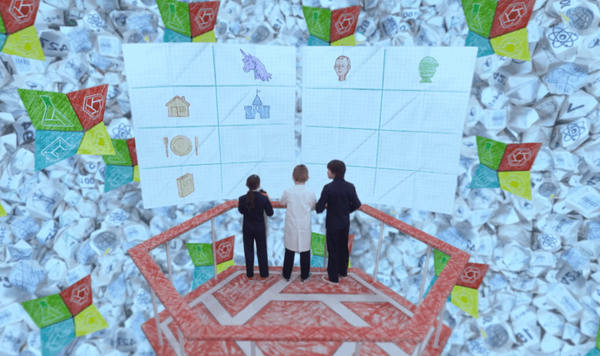
It’s a case for the Odd Squad: Dangerous Doobles are on the loose, and agents must work together to quickly find them all and put things right again. Like Olive and Otto in “How to Interrogate a Unicorn,” stellar sorting and classifying skills will enable agents to separate the Doobles from their creature cousins and send them back to Headquarters before they turn everything upside down!
Materials
Directions
Before you start, cut out the creatures from the “Doobles, Snoobles and Oobles Printable Creatures” page. Hide them around the room.
Explain to your child that today, you’ll be exploring sorting and classifying. Ask: “What three things do you and your child have in common? What are three things that are different?” If your child has siblings, try having both siblings identify similarities and differences.
Tell your child that you’ve received a letter from the head of Odd Squad, Ms. O, and that The Odd Squad needs help. Is your child ready to help crack a math case? Read the letter from Ms. O aloud.
Engage in “Training” and “Casework” with your child next, then celebrate with a “Case Closed” learning recap.
Letter From Ms. O
Agent! There you are! Something very odd has happened. Don’t look now, but dangerous Doobles are on the loose. These crazy creatures gobble up anything they see — windows, walls, even desks and chairs! I’ve just received a report that the Doobles have already invaded your room — along with some Snoobles and maybe an Ooble or two! Snoobles and Oobles won’t hurt a thing, but they do look a lot like those dodgy Doobles. I need you to find all the critters that you can, and then separate the Doobles from their creature cousins and send them back to headquarters, STAT. That means right now! So, are you on the case? Then hurry, because Odd Squad needs you!
Training
Explain that in order to crack “The Case of the Doobles, Snoobles and Oobles,” your child will need to practice identifying an object’s unique features, or attributes.
Show your child the different building toys you set out earlier. Draw a chart with four rows and three columns on the board. Along the side of the chart, draw a picture of each item or write its name. Above column 1, write “color,” above column 2, write “size” and above column 3, write “use.”
Explain that you and your child are going to practice identifying the unique features of each of these items. Together, you’ll be able to see what they have in common and how they are different. Start by checking if they are all the same color. Write each items’ color in the “color” column of the chart.
Next, check each item’s size. You can have your child measure each using a ruler or simply use descriptive words such as small, medium and large.
Finally, discuss each item’s use. Ask your child to tell you what each item is used for. In this case, they are all used for building things — that’s one thing they all have in common!
Take some time to notice other features or patterns. Ask your child to compare the bricks. In what ways are the bricks the same and in what ways are they different?
Casework
Let your child know that it’s time to crack “The Case of the Doobles, Snoobles, and Oobles.” Say: “We heard from Ms. O that Doobles, Snoobles and Oobles can be hard to tell apart. In order to tell which is which, we need to know exactly what the Doobles look like and how they look different from Snoobles and Oobles. Just as we did with the blocks, we’ll need to investigate these creatures’ unique features, or attributes.”
Give your child a “Creature Features Chart.” Point out the pictures running down the side of the chart and name each one. Have your child fill in the chart, counting how many eyes, legs and antennae each creature has, and filling in the corresponding box.
Discuss your child’s findings. Ask: “How many eyes does each one have? How many legs? Antennae? How will we be able to tell if something is a Dooble? What does a Dooble look like?”
Now go on a creature catch! Invite your child to search for and collect all of the Doobles, Snoobles and Oobles that you hid earlier. Once collected, have your child identify the unique features of each creature – the number of eyes, legs and antennae – and then refer to the chart to help them sort and classify each creature as a Dooble, Snooble or Ooble.
Together, put the Doobles in a red evidence bag (the red envelope) so they can be sent to Odd Squad Headquarters for closer inspection. Place the Oobles and Snoobles in white envelopes to be shipped back to their strange homelands.
Case Closed
Tell your child, “Great work, agent! We’ve rid ourselves of those dangerous Doobles! As part of our training, we like to review what we learned from the case and enter it in the case file so that future agents-in-training can learn from it.”
Ask: “What are some ways that we can sort items? How can a chart help us?”
Write down the learnings that your child shares, close the case file and write CASE CLOSED across the front. Congratulate your agent on a case well-solved!
 Emotions & Self-Awareness
 Social Skills
 Character
 Math
Math
- Activity Type
- Craft
- Topics