
“Paint” a Thanksgiving Turkey With Tissue Paper


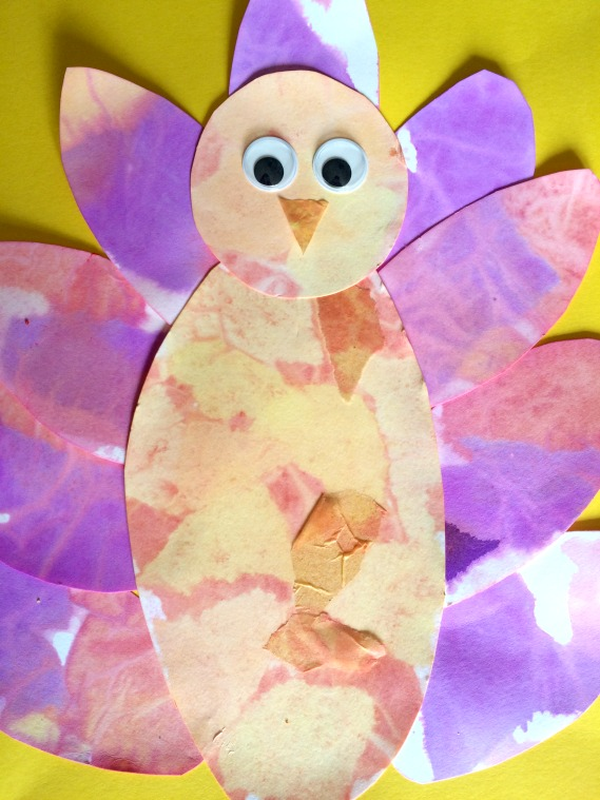
This Thanksgiving craft becomes a hands-on science experiment using non-colorfast tissue paper and a little water to make a colorful turkey.
Materials
Directions
On white cardstock, draw a circle for the turkey’s head, and oval for the body, and six or seven smaller ovals for the feathers. This is a great time to talk about what ovals and circles have in common — and what makes them different. Point to the shapes as you both draw, and have your child name each shape an oval or a circle.
Cut out the shapes.
Tear or cut the tissue paper into small pieces. You can continue practicing shapes by cutting the tissue into squares, rectangles, triangles, circles, and ovals. Or, your child can tear the tissue into free-formed pieces. (“Oh! That one kind of looks like a shark!”)
Have your child arrange the pieces of tissue on the white cardstock shapes.
Here’s where the water comes in: ask your child to predict what will happen if she adds a few drops of water onto the colorful tissue. Will the water just sit on top of the paper? Will it soak through? Will the color change?
Soak a paper towel with water and have your child blot the tissue.
Gently lift one of the tissue pieces to reveal that some of the color has soaked through to the white cardstock.
Let the wet tissue sit for about 30 minutes. Then, peel the tissue off the paper. (Some of the tissue might stick — leave it for “texture!”)
Ask your child if the tissue is the same color as it was when you first started the activity. (“Is it as bright as this piece of tissue paper we didn’t use?”) Talk about where the color went, and why there is suddenly color on the formerly white paper. (“Did any of the colors mix together to make new colors?”)
When the cardstock shapes are dry, it’s time to puzzle together the turkey! Have your child try different arrangements of the circle and ovals to make a bird, then glue the shapes in place on the colorful cardstock or construction paper.
To finish, draw on eyes and use a piece of the leftover tissue paper to make a triangular beak.
 Arts
Arts