

5 Tips for Encouraging Your Young Builder – With Math!


Updated 4/18/2026
Is there a small home improvement project or repair in your future? Any new pieces of furniture to put together? Here are five tips from Cyberchase for how to engage your child in the fun of building while reinforcing important math concepts.
Directions Build Math Vocabulary.
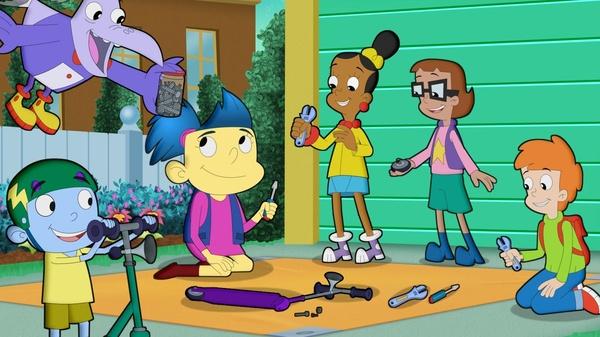
Does your child love brick building sets? Putting together a new toy or a piece of furniture can be a real-world puzzle for you and your child to solve together. Following the step-by-step instructions is a great way to boost your child’s math vocabulary and develop spatial skills. As you work, talk about how important it is to complete each step in order. Have your child read each instruction aloud or tell you what the picture is saying to do next. Point out direction words like “below", “above”, “inside”, “behind”, "between” etc. Watch the Cyberchase episode “Fix-It Time” to see the CyberSquad using spatial vocabulary in action to take apart (and put back together) a broken scooter.
Common household tools are math tools.
Children are naturally curious builders. When they see adults using a screwdriver or a tape measure, they are immediately interested in doing it themselves. Let them practice using basic tools – in a safe way – so you can reinforce the math they are using with encouragement and explanation. For example, next time you use a tape measure, invite your child to help you. Make your measurement together and count aloud the whole numbers starting with zero at the hook end. When you’re done, ask, “How long is it?” or “How wide?” With older kids, you can talk about the way that halves, quarters, eighths and sixteenths are marked and have them help you measure using fractions of an inch.
Righty tighty, lefty loosey!
The next time you use a Phillips screwdriver, set up some screws for your child to turn part-way into a scrap board. (You may want to start the screws into the board first to make it easier.) Stand back and allow the discovery of the difference between clockwise and counterclockwise rotation. To help your child remember which way tightens or loosens a screw, share this: “Righty-tighty, lefty-loosey!” By giving your child early, hands-on experience with rotation and direction, you are laying an important foundation in geometry. You might also pick up from the hardware store a few easily grasped bolts, nuts and washers for younger children to assemble and disassemble just for fun.
A Perfect Fit
Is there enough room here?
Even without construction and sawdust in your house or apartment, you can still involve your child in building and builders’ math. The next time you want to move a bookcase, bed, or sofa, measure it together before moving it. Then measure the space it will (you hope!) fit into. If your measurements show it will fit, problem solved! If not, using measurement to save all that time and effort will make a big impression, and your child will learn why a math tool like a tape measure can sure come in handy.
Continue the builders’ math fun with more Cyberchase science and engineering videos and games here.
 Author: