
7 Music Games for Practicing Self-Regulation


On a particularly rainy day, I found myself overwhelmed with the task of helping a group of hungry toddlers remove their raincoats and boots before lunch. As one toddler after another started to cry, I felt a presence behind me.
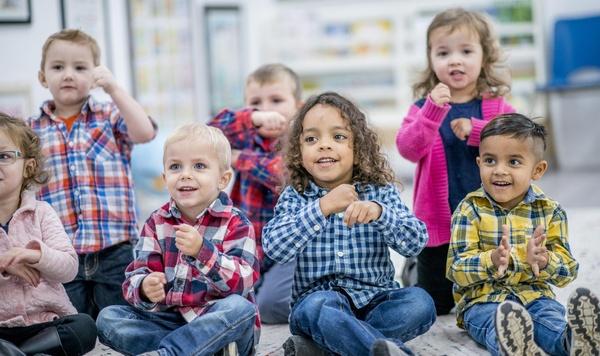
“What’s going on here?” our early childhood program director boomed with her characteristically gruff voice as she took in the sea of teary faces. She clapped loudly three times, raised her hands in the air, and started to sing, “Twinkle, twinkle, little star.” She could barely carry a tune, but that didn’t matter. Every little hand rose in the air with fingers opening and closing together. Tears stopped and, in unison, the children started to sing.
I smiled up at her gratefully and continued removing boots and unzipping raincoats until every child was back in the classroom contentedly eating lunch. Seeing the immediate positive reaction that children had to a song (as off-key as it was) gave me something new to think about — using music to help children learn.
Young children respond naturally to music and research shows that music and movement can be used to help children practice and learn important skills, including self-regulation. Self-regulation relates to the ability to pay attention to what is important, ignore distractions, follow through with rules and directions, make good choices when faced with challenges, and respond appropriately in social and academic situations. In a nutshell, self-regulation is the ability to stop, think and then act.
As an early childhood teacher, I started experimenting with music in the classroom. Years later, I found a mentor in graduate school who was as excited as I was to learn if music and movement games could be used to help children practice self-regulation. We piloted an intervention (Red Light, Purple Light) and it worked! Our intervention studies and others that followed showed that playing fun and engaging games have been shown to boost children’s self-regulation skills and and other early learning skills, including reading and math.
Here are a few self-regulation activities that you can try at home:
Teach children songs and fingerplays. Sing your favorite songs and create fingerplays to go along with them. Fingerplays can provide little hands with something to do during moments that require waiting, like standing in line, riding the bus/driving in the car, or waiting for food at the table. (Check out these books full of fingerplays and sing alongs!)
Dance and move to your favorite music. Dancing gives children an opportunity to practice self-control and helps them gain awareness of their own bodies and others’. Dance quickly to fast songs, slowly to slow songs and then try doing the opposite. Try playing “freeze dance” with music, like Daniel Tiger, to practice self-control.
Draw music maps. Practice fine motor skills while drawing, scribbling or painting along with music. As you listen, talk about what you hear. Is the music fast or slow? Does it sound happy or sad? Start and stop your art with the music and try your best to keep up.
Rock-a-bye baby. Turn on a slow song and rock your child’s favorite baby or stuffed animal to sleep. Try walking quietly or tiptoeing around the room while rocking so as not to wake the baby. Extend this game to your own children. Together, pretend to be asleep when music plays. “Wake up” and act out different animals when the music stops. Turn on the music and pretend to sleep once again.
Drumming. Use a drum to create a beat (an upside-down laundry hamper or a pot with a wooden spoon works as well). Take turns drumming different beats while marching, tiptoeing, stomping or hopping around your home. Move when the drummer plays and freeze when the drumming stops. (Get inspired by this drum performance from Let’s Go Luna!)
Conduct one another singing the ABCs or your child’s favorite song. Use a wooden spoon as a conductor’s baton. Take turns conducting one another (waving the baton back and forth) while singing together. Try following the speed of the baton, singing faster when the baton moves more quickly, slowing down with the baton and stopping when the baton stops.
Make up your own self-regulation games. Games that help children practice self-regulation often ask children to start and stop to different cues and sometimes to do the opposite. You can use music as a cue to start and stop different actions that your child chooses or even integrate self-regulation into folding laundry (hop when I hold up a red sock, pat your head when I hold up a blue sock), or driving in the car (touch your head when I say a word that starts with “H” and touch your shoulders when I say a word that starts with “S”). Add rules to your games to make them more challenging over time.
Through fun and simple games like these, you can help your child build self-regulation, ultimately helping them develop the skills they need to manage their emotions and behaviors, get along with others and learn.
 Author: