

Encouraging Curiosity With "Elinor Wonders Why"


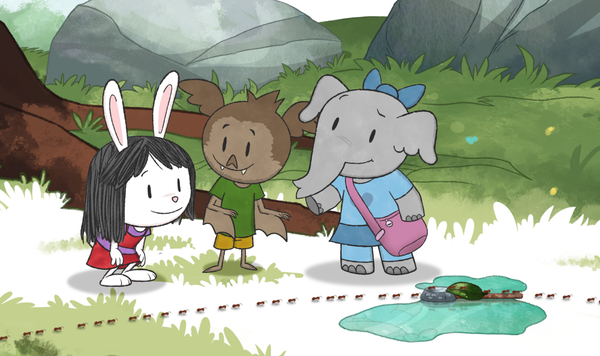
In the new show "Elinor Wonders Why," Elinor and her friends have fun engaging with plants, animals, and nature, asking simple but probing questions to figure out why and how things work.
As a mother of two young children, the endless, at-times exhausting questions are part of our own daily routine! This constant questioning makes sense, because young children are naturally curious, says pediatric neuropsychologist Dr. Jennifer Katzenstein of the Johns Hopkins Center for Behavioral Health. It’s important to encourage that curiosity, which enhances learning and children’s experiences with the world.
“Young children especially learn through cause and effect relationships, and should be encouraged to safely explore their environment through touch, scent, taste, smell, and sight to assist with development of problem solving skills and independence,” Dr. Katzenstein says. “This will help foster a lifelong love of learning.”
Parents can take a natural role in channeling their children’s enthusiasm. “Trusted adults should encourage this curiosity in a safe way, with plenty of enriching activities and opportunities for engaging in their environment,” Dr. Katzenstein says.
Play helps children as they try to make sense of the world and is an essential part of their growth. Here are five simple ways to encourage curiosity in your preschooler.
1 Model interest in the world around you.
In "Elinor Wonders Why," Elinor and her friends are full of curiosity about nature, trying to understand everything from webbed feet on ducks to how echoes work to why plants grow toward the sky.
Young children are fascinated by nature, so being outside together takes advantage of their natural curiosity. By gently observing and commenting about little details — everything from plants to animals to the weather ("Look at how fluffy that cloud is! I wonder how many ants are in that ant hill.") — parents have an easy teaching opportunity for learning that’s both fun and educational.
2 Encourage children to ask questions.
In one episode, the town lake freezes, and Elinor and her friends wonder what happens to fish during the winter and how they manage to survive. Their questions are answered when Ranger Rabbit cuts a hole in the ice so they can see below, realizing that the lake doesn’t freeze all the way through. By asking questions, the kids realize that the ice only skims the top of the lake and the bottom is still made of water.
Young children famously (and repeatedly!) love to ask “why?” While their seemingly endless questions can be frustrating, remember that curiosity is a great quality! By not only patiently encouraging questions but also responding positively and with interest, you support your children’s inquisitiveness and help build their confidence.
3 Ask open-ended questions to your child.
Children tend to see the world in black and white. However, by asking them open-ended — instead of simple yes or no — questions, you can unlock their creativity. "Would you rather play in the rain or in the snow? If you were an animal, would you rather have the ability to run fast or to fly? Why?"
Conversely, if your children ask you a question about a natural phenomenon that you already know the answer to, rather than simply replying with a quick answer, you could try to unlock their deductive reasoning skills by saying something like, “That’s a great question. How could we figure that out together?”
4 Allow for guided play.
Learning opportunities abound both inside the home and outdoors in nature. Guided play, where adults prepare a safe environment for children to explore and create, is an excellent way for children to have fun while also flexing their mental muscles.
Setting out pre-arranged arts and crafts is an age-appropriate way to keep young children engaged. “Using arts and crafts at home as a vehicle for active learning encourages innovative thinking, stimulates curiosity, and develops a creative mind,” says schoolteacher Frances Flicker, author of Creating Art for All Ages. “The brain processes visual images 60,000 times faster than written text. Therefore, it makes sense that interactive arts would heighten creative abilities and teach children from a young age to recognize symbols and sequencing.”
5 Back up their interests.
Young children tend to have certain special interests that make them tick: maybe they’re going through a phase when they’re fascinated by all types of trucks. Or perhaps they’re delighted by bugs and want to examine them up close. (In our household right now, horses and unicorns rule!) Whatever the preoccupation, bond with them by encouraging and celebrating it.
Find different and innovative ways to highlight their interests. If butterflies are the current interest — such as when Elinor and her friends learn about butterflies and caterpillars — read picture books about them, study the lingo (chrysalis! pupa!), watch videos on YouTube about butterfly life cycles, and create butterfly-inspired drawings or crafts. By actively supporting your child’s interests, you’ll help their curiosity bloom and grow.
 Author:
Elinor uses her amazing power of observation to ask questions and investigate nature.