
Fun and Easy Ideas for Water Play With Preschoolers


I remember taking my son for a walk to our local park, known for its wandering creek full of rocks to toss and splash, tadpoles to discover, and sticks to follow down the current. As I reminded him again and again “not too far, not too far,” it happened — as it always did — that his sneakers were soaked, as well as his socks and the hem of his shorts. (Pro tip: keep a set of extra clothes in the trunk!)
Kids love water. It doesn’t matter if it’s a puddle, a bathtub, a running faucet, or a water table at preschool! There’s something about water that draws children in and captures their attention.
There’s a reason for this. Exploring water — by splashing, pouring, dropping, and more — engages the senses. It feels good! Water play offers soothing sensory inputs, which can often help to calm and regulate children. (And adults! This is partially why we feel so relaxed after a bath.)
Water play also encourages learning through observation and making predictions. What happens when children drop two different toys into the water? Which sinks? Which floats? They practice problem-solving skills when they figure out how to pour water over a paddle wheel toy — making the paddles spin when the water hits them just so. And they are learning math concepts like measurement (warm or cool, heavy or light) and volume (full or empty). Children are building language and literacy skills when they act out a story with toy animals or plastic figures in the water bin, creating their own ocean adventures.
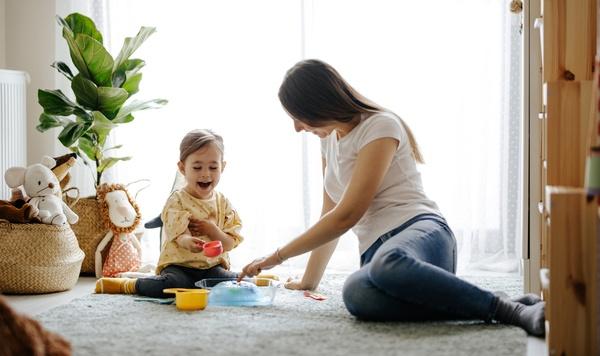
As we kick off the warmer months, here are some ideas for preschool water play, whether it’s in your backyard, your kitchen, or the sidewalk outside:
- Backyard potions: Give your child some buckets or plastic containers and a story about magical potions (try Strega Nona by Tomie dePaola), and then suggest they create a potion of their own. Fill the buckets about half-full with water and see what your child adds: dandelions, leaves, sticks, mulch, an old bottle cap? Stir it up with a stick and see what magic happens.
- Water painting: Offer your child a variety of brushes — paint brush, paint roller, old toothbrush, scrub brush, and more. Fill a tray and bucket with water, and encourage your child to explore the different brushes. Let them discover the different ways to hold and use these tools. Encourage them to notice the different patterns they leave on the sidewalk when children paint with water. Kick things off with Beautiful Oops! by Barney Saltzburg.
- Car wash: Inside or out, fill a plastic bin with warm, bubbly water. Offer your child a washcloth and old toothbrush or pot scrubber. Collect toy cars, dolls and doll clothes, or other items that need a “wash.” Share The Scrubbly-Bubbly Car Wash by Irene O’Garden for inspiration. Play the game, Scrub-A-Dub, from “Peg + Cat” to practice your washing!
- Go fish. During bath-time, drop in floating objects (like plastic blocks) and give your child a soup ladle or plastic measuring cup. “Go fishing” to scoop out the blocks and drop them in a bucket or bowl. This game also works outside with a plastic bin or water table. Try counting sets of blocks up to five to make this a playful math activity.
- Squeeze please! Fill a plastic bowl with water. Offer your child a sponge or two, and an empty bowl. Model how you can use the sponge to soak up water and squeeze it into the empty bowl to fill it up. This is lots of fun and also helps little ones build the muscles in their hands and fingers that they’ll use for writing and drawing later on.
- Same, same. This is a great activity for the bathtub or a plastic bin outside. Offer your child a variety of measuring cups in matching pairs — that is, two half-cup measuring cups, two quarter-cup measuring cups, etc. Explain that in this game, your child’s job is to find two cups that hold the same amount of water. Explore the concept of measurement through stories like Me and the Measure of Things by Joan Sweeney.
- Sink or float? This activity can be done in the bathtub, or a bin inside or outside. Gather up items from around your home or outside — anything that you don’t mind getting wet! Then try your very own science experiment: Think over which items you think will sink and which ones will float. Then test them out and observe!
Of course, anytime your child is doing water play, adult supervision is critical. But why stop at just watching when you can join in the fun? It’s hot out there, and the water is fine.
 Author: