
Great Adventures Start With a Story


When our oldest son was much younger, my husband and I could often count on being awakened by Miss Frizzle, a knight, or possibly a Brachiosaurus. And no, our child wasn’t watching a video at top volume. A tiny costumed version of the character of the day would bolt into our bedroom ready to erupt a volcano, start a sword fight, or have an outdoor breakfast picnic in the tallest climbable tree.
Bedtime stories from the previous evening were clearly having an effect. Books gave him joy that he had to share with us — the very first thing in the morning!
We didn’t mind. The books we read aloud gave us so much to talk about and do together. Sharing books that sparked curiosity and exploration supported our efforts to encourage his imaginative play. We got to know our son through the stories and adventures we shared.
As Miss Frizzle, he wasn’t anxious about taking chances or worried about making mistakes as he tried different amounts of baking soda and vinegar in his volcano, built a model solar system, and explored gravity with homemade rockets and all kinds of toys tossed off the front porch. His make-believe knight loved sword play and designing catapults, but was also excited to do good deeds — taking mail to an elderly neighbor and helping carry groceries. Imagining himself as a dinosaur, he happily explored our backyard on his own in paper-bag dinosaur feet, making a map of his “habitat” to share with family and friends.
So how can parents help bring stories from books to beyond the page?
Encourage Conversations About Books
Envisioning the characters, settings and action as we read together fired his imagination, but it was really our conversations about books that encouraged his creativity and confidence. As both a parent and an educator, I’ve noticed that kids like to talk! Frame conversations before, during and after reading to help your kids turn their natural curiosities into questions they can ask and find answers for:
- Share information about yourself with your kids. Point out your connections or experiences that relate to what you are reading. “Where I lived when I was little, there was a place with huge rocks to climb on. I pretended it was a magnificent castle.”
- Encourage your kids to make or point out connections to their personal experiences. “Who do you know that acts like Miss Frizzle?” “How does dad remind you of Arnold?”
- Learn what motivates your child. “Why did you pick out this book for us to read?” “I wonder what you liked about that story” or "Tell me more about why Miss Frizzle is your favorite."
- Answer kids’ questions with a question. “What is the rope on the catapult for?” “What do you think it is for?” or “What would you do with it?”
Take Stories Beyond the Pages
To boost imagination and curiosity to another level, try to anticipate questions and help introduce and reinforce interests by having more books at the ready! For our son, we’d follow up with other books, media, activities, experiments or outings to places like the planetarium and Renaissance fair that offered opportunities for him to take what he’d learned and really own it.
Reading, talking and having these adventures together provided the experiences our son needed in order to learn how to ask good questions about the world around him. Kids’ curiosity usually gets them asking questions about things they discover from books. Stories will get them wondering! Ask them what they wonder about. Could a school bus ever fly? Can you make friends with a robot? What kind of life could there be on Mars? I love seeing this kind of thinking with my own kids.
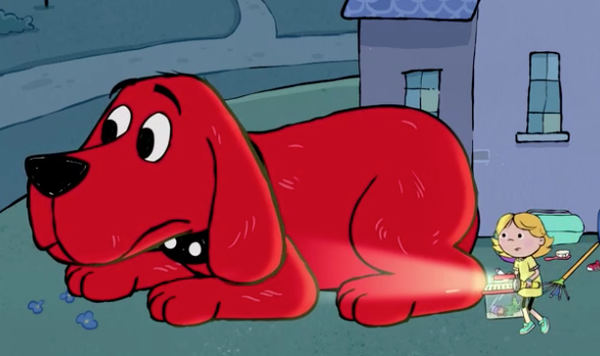
And I love seeing stories lead to questions and new experiences for Emily Elizabeth and her big red dog Clifford. In their new show, these classic characters are inspired by books and stories to launch all kinds of adventures. Kids watching are sure to want to follow suit — especially if reading aloud and sharing stories is a regular occurrence in your home.
What’s especially lovely about this Clifford reboot is the gentle reminder that books aren’t the only way stories are delivered. There are all kinds of sources for stories. A story doesn’t have to be written down in order for it to help you make sense of yourself and the world around you. Friends, family, television, movies, museums, nature and songs are all sources for stories. No matter where the stories comes from — a read aloud at the library, a legend shared by locals or objects found on the beach — Emily Elizabeth and Clifford learn from them and find inspiration for an adventure.
It works that way in our family too, especially for our youngest son, who finds stories everywhere. He would find stories in tech headlines read aloud at the breakfast table and then later invite us to watch a Steve Jobs-style demo of the latest operating system or software release. He and friend put on plays for us about cells and microorganisms based on science songs they learned at school. And when he heard the story about his grandfather having to make his own stuffed panda bear out of paper bags, he made one of his own.
Making that connection from story to adventure, whether it is pretend play or a real-world experience, has transformed our kids into curious — and hopefully — lifelong learners. When your home is brimming with books and your days filled with stories, be ready to fuel kids’ imaginations as they take off.
And don’t plan on sleeping in.
 Author:
Join Emily Elizabeth and Clifford as they play with friends and neighbors on Birdwell Island.