
Help Children Cope With Back-to-School Anxiety


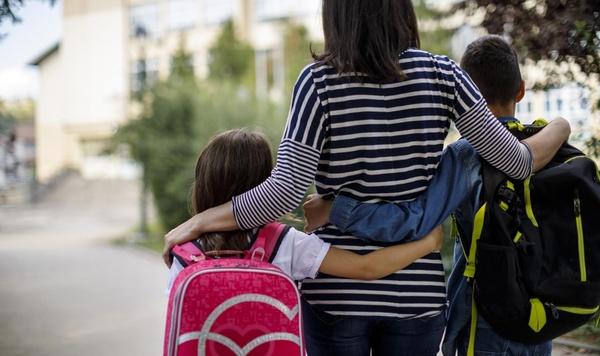
It’s been six months since my 5-year-old and 7-year-old have set foot in a classroom. (But who’s counting?) And as my family prepares for this year’s back-to-school season, we’re all feeling a little… anxious. My 5-year-old has the normal first day of Kindergarten jitters, while my 7-year-old is worried about what it will feel like to return to school with masks and new safety rules. Like other parents throughout the country, I’ve been wrestling with my own feelings about a school year that coincides with a pandemic, and I’m struggling with how to answer my kids’ often-endless questions. It’s hard to feel prepared when it seems like all our plans keep changing. (And this definitely was not in any parenting book I ever read!)
Where does back-to-school anxiety come from?
“Anxiety comes from all of the unknowns and the uncertainty,” says Kathryn Gardner, a licensed clinical professional counselor and Chair of the Board for Postpartum Support International in Illinois. “As parents, we have the imagery of what the future grade is going to hold and how it's going to be different. [But] right now, we still have a lot more questions than answers.”
It’s important to remember that sometimes back-to-school stress can hit parents harder than children, says Dr. Samantha Brown, Director of the Parent-Child Relationships and Well-Being Lab at Colorado State University. Dr. Brown has been studying the effect of stress and parenting related to COVID-19. She said we need to think about coping with back-to-school anxiety in tandem with other specific family stressors that may be going on — like a job loss, a pre-existing mental health condition, or a lack of social support. “All of those things accumulate,” she said.
What can parents and children do to cope with anxious feelings?
While there are plenty of strategies out there, “STOP” is a 4-step plan you can use to gain more control over anxiety-causing situations like back-to-school. Originally developed by Dr. Wendy Silverman, STOP does involve some role-playing (parents are both teacher and coach).
Here’s how it works:
S is for scared. “What’s going on with your body?”
The first step to overcoming scared or anxious feelings is to know when you are feeling that way. There is no clear anxiety emoji — it can feel different to all of us. And young children might have a hard time recognizing when they are anxious and putting those feelings into words. Our bodies take a lot of signals from our brains, says Kathryn Gardner. So it might be helpful to start by asking your child what their body does when they are scared. My 5-year-old told me, “I curl into a ball.” In other words, he tenses up! Just like so many of us do.
Try connecting those feelings to a school worry your child has mentioned. For example, you might say, “Let’s imagine you’re at school and the teacher calls on you. You think you know the right answer, but you are afraid you could be wrong. What do you think is going on with your body in that moment? Would your face turn red? Would you maybe feel a little hot? I can sometimes feel my heart beating when I’m scared.”
T is for thoughts. “What are you thinking?”
The second step focuses on noticing thoughts that make children feel upset. My 7-year-old has been worried about not being able to take the bus anymore. Aside from some serious FOMO (fear of missing out), she is also afraid of the new process. “What if I can’t find you?” “What if I’m late?” Gardner calls these strings of worrying thoughts, “worry streams.” When we’re in a worry stream, Gardner says, we start to ask a lot of “what if” questions, then we fill in the blanks with our imaginations and make guesses about the future.
I explained this to my kids as our brains trying to be a crystal ball, because they understand what that is from stories and movies. (“People look at crystal balls to see predictions about the future. Sometimes they are right, and sometimes they are wrong. That’s just how your own thoughts can work.”)
O is for other thoughts. “What is something else you can think?”
Once you understand and recognize the thoughts that make you or your child anxious, you can try to “flip the script.” Drawing on findings from her recent study, Dr. Brown recommends parents reframe the conversation to talk about what you and your children can control. For example, if your child is worried they won’t be able to find you in the school pick up line, you could say, “I’ll be looking for you, too! So we’ll find each other together. And if you don’t see me right away, stay with a teacher until I find you.”
You can also talk about what good things your new routine might bring. I told my daughter I was excited about driving her to school now because we’ll get some uninterrupted girl time for us! Flipping the script can also mean turning a frown upside down with some sillies. (“Remember when you ran for the bus in your socks?” “P.S., my car has air conditioning!”). Ask your child how having these “other thoughts” might help them feel less afraid in a scary situation.
P is for praise and plan. “What is something nice you can say to yourself?” “What can you do next time?”
At any age, it takes courage to share our feelings and thoughts. I asked my daughter to remember the first time she rode the bus as a kindergartener and had to be so brave. “It was hard, but you did it!” Right now, it’s kind of like all of our kids are heading off to kindergarten on the bus for the first time again. Gardner says parents can end this exercise by saying, “Thank you so much for telling me how you feel [or how scared you feel]. I’m proud of you.” If your child wasn’t the one to initiate the conversation, you might remind them that they can always come to you. Open communication from a young age will set the stage for the years ahead.
The plan element of STOP goes over what your child could do differently next time they have a problem or are feeling scared. As parents, we ask our kids, “What can you do differently next time?” a lot. Maybe your child was so anxious it came out as a tantrum or an upset tummy. Maybe your child let her worry streams take off when she should have talked with you. Whatever the case, the plan for next time is to STOP — with the reality that we will probably be saying, “What could you do differently next time?” again.
I am hopeful that this 4-step STOP plan will help my own kids learn to navigate their feelings around this new normal. (It’s also helping me work through my own!) While our school year is going to look different, one thing we can be grateful for is more time to communicate in a meaningful way with our kids. We can take some time to STOP.
 Author: