
How to Explore the Outdoors With Your Kids


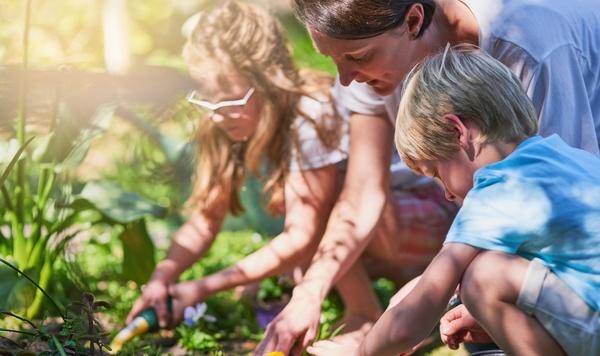
When I worked on urban farms, my favorite part was exploring the outdoors with kids. While we would start with a planned out activity, inevitably, we would discover something to touch, taste, smell, observe or even listen to (bees! wind!) — and then we would let the kids take the lead in talking and asking questions.
Getting outside in the garden, farm, park or playground is good for the whole family — they offer spaces suited for simply letting go. Planning what to do and where outdoors can be intimidating for parents, but going outside is an opportunity for little ones to take the lead and assert their curiosity.
The best preparation for going outdoors is dressing for the weather, and visiting some place nearby, if possible. Young children thrive and learn through repetition, and create joy through multiple opportunities to build on similar experiences. My family lives in Brooklyn, in the middle of the city. For us, learning in the “garden” sometimes means a trip to the Botanic Garden, but much, much more often it means the small playground around the corner. Amidst the jungle gyms and swings, there are two trees, a patch of grass and lots and lots of sticks. My kids know this section of Brooklyn like the back of their hands — they feel safe and comfortable to explore there. Learning about the seasons isn’t a planned activity, nor is learning about seeds, regrowth, deforestation, pollution. But we’ve explored each of these topics, and more, at length in this tiny section of urban green space.
The truth is, learning happens differently for everyone, but in my experience, it happens in every imaginable outdoor space. Here are some tips for getting outside.
Prep yourself for some dirt. It might sound simple, but for some of us, it’s a real hurdle. The first time I stuck my hands into the soil to grab a worm, I had to fight a real gross-I-shouldn’t-be-touching-this feeling. Push through it if you can. And though I recommend getting dirty, touching worms and getting down low with your kids, if you just can’t, don’t beat yourself up. Still go outside and encourage your little one with words, smiles, questions, nods, etc. A small, excited “cool!” can lead to the next tiny discovery in the earth.
Say “I don’t know” and look it up later. When I first started working with kids in an outdoor setting, there was so much I didn’t know (and still don’t!). I quickly got comfortable admitting my lack of knowledge and also learned a lot, really quickly. If there are others around, one really awesome part of outdoor play is the social benefits. If your little one asks a question you can’t answer, ask if someone near you knows. If your child can talk, and it feels safe to you, they can ask someone nearby. Building community through outdoor play is inevitable, beautiful and often unexpected.
Wondering what to do once you get outdoors? There’s lots to look for and do when there are living things all around you.
Identify parts of a plant. Identifying stem, leaves, fruits and seeds is appropriate developmentally from 18-months-old to 8-years-old. Beginning with developing vocabulary, this exploration of plant parts can extend to reproduction, pollination and pesticide use.
Investigate insects. Scooping up a handful of soil in a garden will provide you with all kinds of insects to explore. One of my favorite rules of outdoor exploration is about insects — If you find an insect in its home (outdoors) leave it alone to live and thrive. If you find it in your home, you can decide what to do with it (I encourage bringing it back outside! But that’s for you to decide). Some kids love insects — will hold them, search for them, collect them and explore. Others will look from a distance and ask questions. Both are awesome! Work together to discover why those insects are there — who eats them and what/who do they eat? How many legs does it have (does it have legs? Is it even an insect)? What are the antennae for? How does it breathe underground?
Use your five senses. If you know which plants smell good, smell them! If you know which parts of the plants to taste, taste them! Explore textures such as soil, leaves and flowers — our youngest one especially loves exploring texture. Explore the power of observation. For most of us, we’re always using our sense of sight, but drawing attention to how a scientist observes down to the tiniest detail will support deepening those powers and encourage further exploration. And find some time to stop and just listen. What do you hear? In each space you’re in, developing and exploring the vocabulary of sounds can be a way you or your child enjoy learning and communicating.
Somewhere near you there’s a tiny plot of bare earth to explore. Enjoy!
For more on gardens and on getting outdoors with your kids:
- Go on a scavenger hunt to find patterns in nature.
- Measure wind speed in your neighborhood by making a wind gauge.
 Author: