
How to Help Young Children Learn to Use Scissors


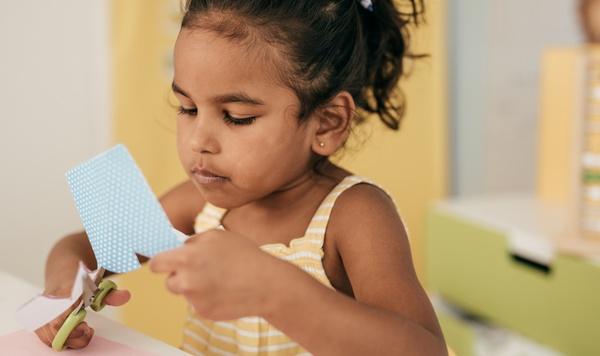
Let's face it, the scissors grip is awkward at first — especially for tiny hands and fingers. Young children have to figure out where to put their hands, their fingers, how to open and close the crazy-looking things, and how to hold the paper or material they are cutting. (Not to mention all the new rules they’ll need to practice, like how to safely carry or pass the scissors to someone else!)
This really hit me after I volunteered to help with a classroom party recently. The other parents and I did not factor in the number of tiny hands who would need extra help and time to cut pieces for the project we planned!
“I would say about 50 percent of my class struggles with scissors,” Laura Smith, a kindergarten teacher in Chicago, said. “Some don’t even have the strength in their hands to open and close the scissors.”
Fine motor skills have been declining for decades, and many researchers think that may be because children have less time for hands-on play. Families are busier, more parents work outside the home, and screen time is at an all-time high. But some fun activities and practice with a loving (and patient!) adult can set your child up for scissor skill success.
Here are a few ways you can start to introduce using scissors at home:
Be creative with hand and finger strengthening activities. Jamie Blough, a certified occupational therapy assistant and former preschool teacher, recommends water play activities like wringing out rags, using water and squirt bottles, or squeezing and emptying water from containers to build your child’s hand muscles. Picking up small objects like cotton balls with tweezers or tongs can also be fun when you make a game out of it. For example, you might say: “How many balls can you put into this container in two minutes?” This helps your child develop fine motor skills and creates the foundation for important skills like handwriting.
Play with scissors (under supervision). Start slow and let your child go at his own pace. Worried about safety? Blough recommends starting with playdough scissors and cutting the dough. Eventually, your child can graduate to safety scissors, which are designed without metal edges and can only cut paper.
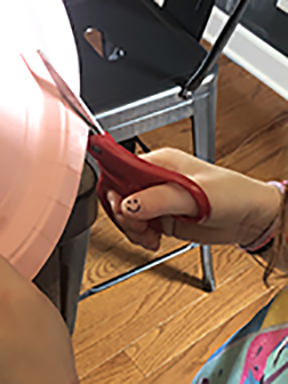
Check your child’s grasp. “For scissor skills, we use a tri-pod grasp (your thumb, pointer, middle finger), which is different from the pincer grasp used for holding a pencil,” Blough said. She recommends explaining to your child what you are doing at each step. She also suggests drawing a little smiley face on each of their thumbs, a reminder that the stabilizing hand is just as important as the cutting hand. “Both hands should be in the smiley face thumb up position–while holding the paper and while cutting the paper.”
Buy lefty scissors if your child is showing left hand dominance. True hand dominance isn’t developed until about age 5 or 6, but Blough, a leftie herself, said many kids will switch between hands because they have hand fatigue between tasks. “If you really aren’t sure, or if their teacher notices, then buy one of each pair and see which type your child feels most comfortable with,” Blough said.
Practice cutting in a straight line first. “Cutting out coupons from the Sunday paper is a great and inexpensive way kids can practice,” Smith said. “Giving projects with curvy lines or circles to cut out comes after kids have mastered the straight ones.”
Reward everyday scissor successes. Catch your child using the proper grasp without being corrected or sharing the playdough scissors nicely with his siblings? Let him know you see him! Your praise and recognition are powerful and helpful rewards as he learns.
I can understand now why our party craft wasn’t as simple as we thought — it required kindergarteners to cut out shapes on their own when they were still trying to figure out how to hold scissors correctly and cut a straight line. It was a good reminder to slow down and let young children explore — they’ll get there through play, practice and patience!
 Author: