


Seeing Myself and My Community in "Alma's Way"


I’ll never forget the feeling I had when I first heard the theme song for “Alma’s Way.”
Right away, the classic “lo le lo lai” rings out in the intro, a sort of musical catchphrase featured in countless traditional Puerto Rican songs. That “le lo lai” takes me back to dancing with family on tropical nights and exploring the colorful, cobblestone streets of Old San Juan. There’s a clear and distinct nod to reggaeton in the beat, a genre of music that originated in Panama but rose to prominence in Puerto Rico. As so many boricuas know, that tropical, undeniably Latin beat makes dancing (or at the very least, tapping your foot to the rhythm) utterly irresistible. Finally, we hear that one final, joyous “Wepa!” — a common celebratory exclamation of Puerto Rican pride. By the time the song was over, I was breathless.
As a Puerto Rican, I realized I had been waiting for something like this my whole life — this feeling of my community being represented. I felt seen.
“Alma’s Way,” a new series on PBS KIDS, is about the fun-loving Alma, a Bronx-born Puerto Rican girl who has adventures with her family, friends, and neighbors in diverse New York City. And the theme song, written and produced by Lin-Manuel Miranda and Bill Sherman, is an authentic celebration of Puerto Rican culture. It is a representation of Boricua joy like nothing I have ever seen in children’s media, and has made me realize what it feels like to finally be represented.
Working at PBS KIDS, I see firsthand that there’s so much power in children seeing themselves on-screen. In celebrating what makes them unique, they have the opportunity to think of themselves as the main character of their own story. Not as a background extra, comedic-relief sidekick, accessory to the hero, nor a box to be checked off — but as a dynamic protagonist that people can root for.
These moments of seeing myself in the world of “Alma’s Way” continue to spring up even after the theme is over:
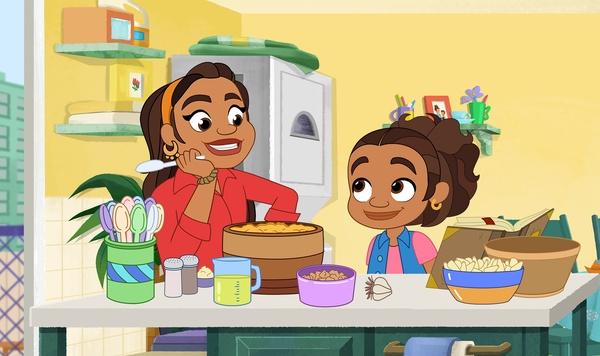
Hearing “Mami” and “Papi” on TV. This may seem like a small thing, but how special it is to hear Alma use “Mami” and “Papi” to address her parents! “Mami” is what I’ve always called my mother, what she calls her mother, and so on. It’s what I’ve heard the majority of my Latino friends and family call their mothers, and yet I’d never heard it on TV until now. To hear it in a kids show in place of the more common “Mom” or “Dad” was unexpectedly cathartic. Much like Alma’s Mami does in the story “No-Go Mofongo,” I have vivid memories of seeing my own Mami rush back and forth in the kitchen getting ready for a family cookout while my younger sister tries to grab her attention with an incessant “Mami! Mami!” That scene hit me with nostalgia and brought a huge smile to my face.
Seeing the lesser-known aspects of Puerto Rican culture on screen. “Alma’s Way” gives families a unique opportunity to experience the lesser-known parts of being boricua beyond just salsa and the beach. In the story “Bomba or Baseball,” Alma introduces us to the traditional Puerto Rican Bomba dance — a centuries-old dance in which the dancer determines how the musicians play based solely on her movements. I have always loved Bomba, and am happy to see it gain the recognition that dances like salsa also enjoy. More importantly, placing the focus on Bomba also highlights the island’s rich Afro-Puerto Rican heritage in a way I’ve never seen in the media before. Like many other Latin American communities, so many of Puerto Rico’s customs, music, and traditions can be traced back to communities of enslaved Africans in Puerto Rico dating back to the 1600s. In short, Bomba is not just a dance. It’s a powerful art form used to pass on oral histories, express sorrow or anger, and celebrate life and love. The dance has roots in historically Black barrios all over Puerto Rico — mainly Loiza, which has the largest black population on the island, but also San Antón, which was once known as “the barrio of freed slaves” and where I’m proud to have direct ancestry from. The beauty in “Alma’s Way” showcasing this tradition is that it highlights the rich diversity of Latin America and honors Afro-Puerto Rican culture and heritage.
The love, nostalgia, and connection to our homeland. There tends to be a mutual, often unspoken feeling that Puerto Ricans share upon meeting one another. I’m sure that others with roots elsewhere in the world experience the same thing, too: a fondness, nostalgia, sometimes even longing for a place our families and ancestors have called “home.” One of my favorite moments of seeing this shared experience in “Alma’s Way” is also in “No-Go Mofongo.” Alma and her family discover her great-grandmother’s recipe book and decide to make the staple Puerto Rican dish, mofongo. The way Abuelo speaks about his mother and life on the island struck a chord with me. The memories of my own Abuela speaking wistfully about her mom’s traditional cooking came flooding back. Just like Alma, my Puerto Rican family recipe book was passed down from my great-grandmother and also contains a tried-and-true mofongo recipe.
Given all this context, “Alma’s Way” is a breath of fresh air. No, it’s a warm tropical breeze in a climate that really, really needs it. No child from any background should feel as excluded as I did watching shows that only featured conventional heroes and their BIPOC sidekicks. Now, thanks to “Alma’s Way” and a slate of new PBS KIDS shows featuring diverse protagonists, many of them will have a different experience than I did. We are now able to look forward to a generation of people who will feel empowered, seen, and heard for all the things that make them beautiful. Not as “others,” but as parts of complex and diverse communities with so much to share.
Growing up, I’ve always seen the unique and magical beauty of my people, music, food, and heritage. Now, I am so excited for the world to see it too in “Alma’s Way.” It may have taken many years and hard work to get here, but I want to thank you, Alma, for finally helping me feel seen.
 Author:
Think it through with Alma as she explores her vibrant Bronx community with family and friends.