
Talking With Children About “Grandpa’s Drum”


When I was a young girl, my mother, aunties, uncles, and grandparents all spoke the Gwich’in language fluently among each other, but as children, we were never taught our Native language. We knew a few choice command words and maybe some words for animals, but that’s all. It wasn’t until I was in middle school that I asked my mother why she didn’t teach us our own language. She told me how Gwich’in was her first language and that when she was very young, she was sent to a boarding school. Whenever she spoke Gwich’in instead of English, she was slapped across her palms with a ruler. This was the first time that I learned the history of the Bureau of Indian Affairs boarding schools and how many Alaska Native children were forced to attend these schools away from their homes.
The fact that Gwich’in was not my first language — and that many of my generation have had similar experiences — can be directly attributed to the success of the decades-long U.S. policy of assimilation that also sought to destroy Native American cultural identity.
“Grandpa’s Drum” and “The Making of Grandpa’s Drum”
The “Grandpa’s Drum” story is a particularly powerful example of a show that educates while it entertains.
Part of telling the story of our Native history story, then and now, means grappling with complex and often challenging issues. Beginning in the 1870s and continuing into the 1980s, Indigenous children — some as young as five years old — were removed from their homes and sent away to boarding schools to learn about Western ways.
The schools were deliberately located far from home, because it was thought that separating children from their communities would make the assimilation process faster and more complete. Forced to abandon their Native American beliefs, clothing, and customs and to learn and speak only English, children were stripped of their Native American identity, culture, and history. Physical abuse, malnutrition, and other horrific conditions were common. Generations of children were traumatized by their experiences, and the repercussions of this national tragedy are still being felt.
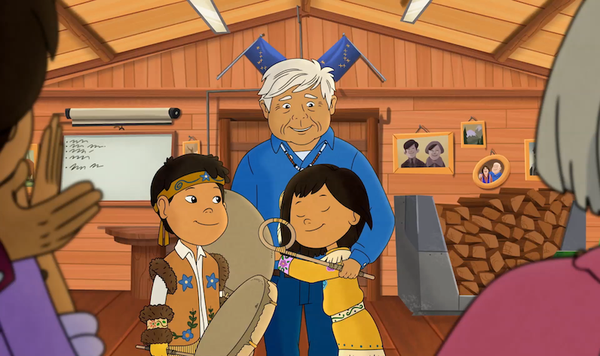
“Grandpa’s Drum” portrays the loss, confusion, and shame that many Alaska Native children felt. In the story, when Molly and her friend Tooey find and return Grandpa’s drum — which he had given away when he wasn’t allowed to sing his own songs — he sheds tears, even as he is filled with joy to discover his voice again.
“The Making of Grandpa’s Drum” describes how the real-life experiences of one of the series’ Alaska Native advisors, Minto Elder Luke Titus, inspired this episode. In the documentary, Elder Luke Titus recalls how confused he was as a child: “I did not understand why people were so angry with us for speaking our language and singing our songs.” Sovereign Bill, of the Tlingit and Muckelshoot Tribes, is the voice actor who plays Molly. She notes that the legacy of the boarding school experience is “a big weight for many Native American communities.”
Talking with Your Child
“Grandpa’s Drum” is exactly the kind of story I yearned for in my youth. It not only contains the positive elements seen in every MOLLY OF DENALI episode — a loving, contemporary Alaska Native family, a supportive community, and a celebration of Alaska Native traditions and values — but also brings to light a difficult part of our history that is rarely told or acknowledged in an authentic, beautiful, and sensitive way. The story will resonate for Indigenous children in particular but is equally important for all children to see. By dispelling myths, providing positive images, and yes, raising questions, it provides a wonderful opportunity for families to share and talk together.
Many children may enjoy the episode as is; others may be all too familiar with experiences of loss, trauma and hardship. Before or after watching “Grandpa’s Drum,” provide as much background as is appropriate for you and your child. “The Making of Grandpa’s Drum” provides helpful insights and information to start this conversation.
Your child may be curious about why Grandpa Nat was sent away to school and why his traditions and way of life were forbidden. Explain that Alaska Native people, like other groups considered “different,” were not always treated justly. After watching, you may want to help get the conversation started with questions such as:
- How do you think Grandpa Nat felt when he was sent away to boarding school as a child?
- Why do you think Shyahtsoo’s doll was taken away? What was it replaced with? What kind of doll is Shyahtsoo’s granddaughter shown playing with today? What do you think that means
- What happened when Molly and Tooey brought back Grandpa’s drum?
Talk about your own family’s heritage and history. Are there elements that are similar to Grandpa Nat’s story? Help your child recognize and celebrate her own culture while appreciating the experiences of others.
Find Out More
Native American history is rich and varied, reflecting the strength and resiliency of its people, yet Native Americans have been largely absent or misrepresented in the media, as well as in the classroom. Trusted sources that tell the history of Native peoples, as well as explore contemporary issues, are included below. Explore them on your own or with your child to learn more.
- Discover whose tribal lands you live on. Find information from the National Congress of American Indians or Native Land Digital.
- Access relevant toolkits and information regarding the visibility of Native Americans on the IllumiNative website.
- Learn about Alaska Natives by visiting the Alaska Native Knowledge Network.
- Delve into more about boarding schools by listening to the NPR story "American Indian Boarding Schools Haunt Many" or reading “A History of Schooling for Alaska Native People.”
- Watch the Emmy award winning documentary film “Dawnland” focused on this issue: http://www.pbs.org/independentlens/films/dawnland/.
- Read When We Were Alone by David A. Robertson, a picture book story about a Cree child and her boarding school experience.
About the Series
MOLLY OF DENALI, an animated series on PBS KIDS, is the first nationally broadcast children’s program in the United States with a Native American lead character. The series features the adventures of Molly Mabray, a resourceful, funny, and engaging 10-year-old girl whose parents run the Denali Trading Post in the fictional village of Qyah, Alaska. Molly and her family are Gwich’in/Koyukon/Dena’ina Athabascan. Athabascans are one of five major groups native to Alaska, and there are 11 Athabascan groups who speak similar languages. The MOLLY OF DENALI stories are infused with Alaska Native values, history, traditions, and language, ands well as portraying contemporary Alaska Native life.
 Author:
Join Molly, an Alaska Native girl, and friends on their adventures in beautiful Alaska.