
Talking to Kids About Personal Space With Help From Daniel Tiger


There are a handful of important life concepts that can feel a little — or a lot — intimidating to approach with our young children. One of these is boundaries.
Boundaries are the guidelines and limits we set that allow us to feel safe in the world. They help us to establish who we are and how we want to be treated. Parenting author and educator L.R. Knost says that boundaries are key for healthy relationships for children and adults. She identifies that one important way to practice healthy boundaries is to understand and respect personal space.
Maybe you learned early on in life how to set boundaries around your personal space. Or maybe, like many of us, you missed that childhood lesson and grew up feeling unsure how to ask others for the space you needed.
L.R. Knost assures parents that setting boundaries isn’t selfish, controlling, or unreasonable. Rather, it’s self-honoring, confidence-boosting, and foundational to healthy relationships. For young children, a good place to start is learning where their space ends and another person’s begins, as well as respecting the space of others.
I want my child — and yours — to know that they have the right to personal space, and feel comfortable asking others to respect that. The newest “Daniel Tiger’s Neighborhood” stories are a resource to help families explore these ideas together.
“Excuse me, I need more space!”
In the story, “Daniel and Miss Elaina Bake Pretzels,” Baker Aker puts it perfectly: “If someone is too close, say ‘Excuse me, I need more space!’” Part of building emotional intelligence is helping your child make sense of the discomfort they might have when someone gets too close, touches too much, or spends too much time in their “bubble” of space. Learning to set a boundary for their own personal space and respect the boundaries that others set is key to healthy social interactions throughout a lifetime.
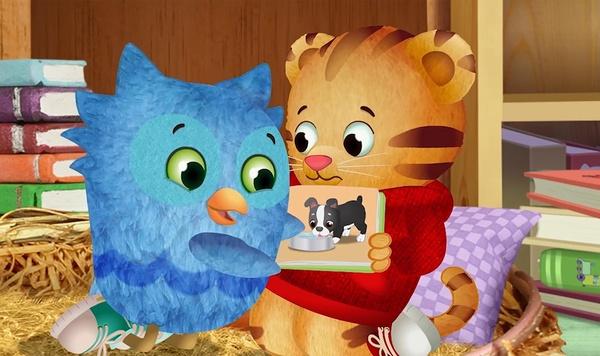
In “O Gives Daniel Space,” Daniel and his friends practice setting boundaries by asking one another for more space when they need it. Often, like with Daniel and his friends, the person who is in our child’s space isn’t trying to be irritating or hurtful — they’re simply unaware. There’s also nothing wrong with being the person who needs more space to move, breathe, or play. This simple phrase — “Excuse me, I need more space” — gives preschoolers the words they need to get their needs met, without blaming others or apologizing for their needs.
When we set boundaries, we are tuning into our feelings, and saying to ourselves and the people around us, “What I need is important!”
Practicing boundaries at home
You can help your child grow their confidence in setting (and respecting) boundaries with the help of Daniel Tiger. After watching the episode together, try these activities to build your boundary-setting skills as a family!
- Role play. Take turns being different Daniel Tiger characters, and re-enact the stories you just watched. (Or create your own stories for the characters!) Practice saying “Excuse me, I need more space!” to one another, and responding respectfully. Give your child the chance to play both the character who needs space, and the character who needs to give it. You can talk about what it feels like to be each character, and how it feels to ask for more space. You can also discuss the idea that it’s okay to want closeness sometimes, and more space at other times.
- Spatial games. Help younger children begin to understand where their own bodies begin and end with simple interactions like hand clapping games or stomping their feet to music. Some children might find it helpful to do an activity that involves spreading their arms as they move around to gain an understanding of body boundaries. In group settings, offering a child something like a small rug to sit on can help them see their space and the space that's needed for others.
- Boundaries with books. Head to the library, or flip through the picture books on your own shelves. Instead of reading, look at the people or characters on the pages. Are they close to each other or far from each other? Are there any clues that someone in the pictures needs more space? Do they look comfortable or uncomfortable? Do any of them look like they might want more space? You can enhance this activity by giving your own voices to the characters on the pages, having them ask for and respond to requests for personal space, and exploring what they are thinking and feeling about the distance between them.
Everyone has the right to their own personal space. For young children, it’s helpful for them to first learn what these space boundaries are for themselves and for others. Understanding their bodies and the space around them is an important step to asking for space and feeling comfortable doing so. All we have to say is simply: “Excuse me, I need more space!”
 Author:
Play, sing along, and learn with Daniel Tiger and his friends in the Neighborhood of Make-Believe.