
What to Do When Your Toddler Suddenly Stops Potty Training


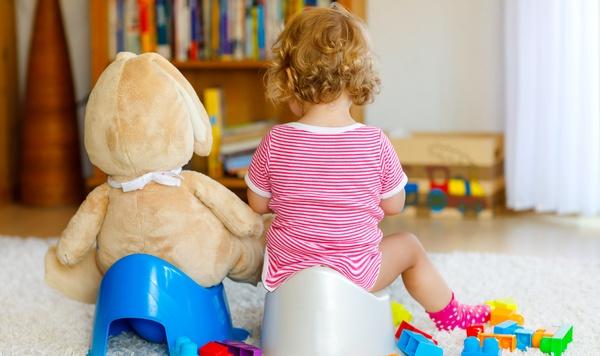
I’ve had a child in diapers for seven years straight. So, naturally, when my 2-year-old took an interest in potty training, I went all in. She was doing great and was going to move into the “toilet-trained room” at her daycare. A light was finally at the end of my dirty-diaper tunnel! Then her daycare closed due to COVID-19, and our potty training train didn’t only stop — it started going in reverse.
For answers, advice, and reassurance, I spoke with Dr. Arthur Lavin, a pediatrician and author of Who’s the Boss: Moving Families from Conflict to Collaboration, and Patricia Kane, a special education teacher and board-certified behavior analyst.
Is potty training regression normal?
YES! (Phew.) It’s normal for children to tackle potty training in phases, and it’s important for parents to realize that potty training often conflicts with other developmental milestones our toddlers are facing. Here’s what I mean:
If your child is interested and shows signs of readiness, the American Academy of Pediatrics advises parents to start toilet training around 18 months. And — what timing! — Dr. Lavin says 18 months is also the age when children are hardwired to declare independence and rebellion, especially from their parents.
Children who are 2- to 3-years-old generally “know what a toilet is, how it works, and what it’s all about,” says Dr. Lavin. “While we call [backward steps] regression, we can also call it a maturity issue.”
Dr. Lavin says it’s very common for children to begin potty training and then come to a “screeching halt” once they realize what it’s all about — particularly when they realize it’s important to you. (Sigh.) “If they are battling you over the toilet, they are probably also battling you on things like food, sleep, and discipline,” says Dr Lavin. “And if you are begging them to do any of these things, you are letting your child hold all of the cards.”
How to respond when your toddler suddenly stops potty training
Don’t take it personally. Toilet training is stressful — for kids and parents! Remind yourself that regression is normal, and can happen for many reasons, including normal child development stages, a change in routine, a new sibling, a move... a global pandemic. You get the idea. Any strong-willed toddler wants to feel in control, and these big changes from their routine can be frustrating or scary.
The good news is that dedicated time at home — like, um, during quarantine? — can actually help families navigate these difficult regression phases. Increased togetherness also increases a parent’s credibility in the eyes of our children.
Stay as calm as possible — even when cleaning up accidents. “Using the bathroom is a natural and necessary skill” and we don’t want to give children the impression that learning is stressful or upsetting, says Patricia Kane. She recommends parents present the consequences of having an accident in a neutral, even tone of voice. In other words, when you feel so mad that you want to roar, take a deep breath and channel Mom and Dad Tiger. Say something like, “You peed in your pants. Here are your clothes. You need to change.”
Have your child take charge of accident clean up. Children want to be viewed as helpers — and that can apply to cleaning up potty training messes, too. Dr. Lavin suggests having your child go into the bathroom and take off their own dirty clothes. You can close the door and wait outside until they have finished.
Use a checklist to remind children about bathroom routines. Patricia Kane recommends checklists children can see or hear to help them learn the steps involved in using the toilet. Strategy songs from Daniel Tiger (“When You Have to Go Potty, Stop...and Go Right Away” and “Go Potty, Go") worked as a checklist with two of my kids. However, my son responded better to a visual checklist taped up in the bathroom. We took photos of bathroom items (e.g. toilet, toilet paper, soap, etc.) and placed the pictures in order on a piece of paper. You could also draw photos, have your child draw photos, or cut pictures from a newspaper or magazine to show the steps.
Know that offering rewards can be good and bad. Patricia Kane says adding a motivating reward like candy or a toy can be helpful on tough days when you’re trying to get children back on track. But she recommends having a plan for phasing out rewards over time. (I know I made the mistake of using M&Ms, and while it worked for a while, it wasn’t effective long term.) “Motivators are okay as long as you fade them out as your child gets more confident,” she says.
The best reward? Encouraging words! We all like to hear we’re doing a good job — and giving our children encouragement during toilet training is essential. Patricia Kane recommends being specific about what children are doing well during potty training. It’s not uncommon, for example, to give multiple ‘good jobs’ during one bathroom trip. (Good job pulling your pants up!” “I like that you used two pumps of soap,” and “I like that you used a little bit of toilet paper.”)
Know when to call the pediatrician. Regression can sometimes signal an infection or other disorder that requires medical treatment. So if you’re feeling concerned, give your pediatrician a call.
Dr. Lavin said 1 in 3 toddlers suffers from constipation, and it factors into toilet training. “Some kids say, ‘I won’t poop anymore’ and try to hold it in,” Dr. Lavin says. “Of course, this has painful consequences.” He says parents can give their child a teaspoon of Miralax to keep stools soft. “It’s very safe, and parents can do it if they see their child struggling.”
Know that bedwetting is also normal — even after potty training progress. Staying dry overnight ― called nighttime urinary continence ― usually follows within a few months after a child has fully mastered daytime bladder control. (Although, it’s taken all of my kids much longer!) “Nighttime and daytime are totally different,” says Dr. Lavin. “Bedwetting occurs during REM sleep and is not under a child’s control. Even if you stop giving them drinks at 6pm, there will still be pee there.”
Bedwetting is in the same family as sleep talking, which Dr. Lavin says two-thirds of people do and are completely unaware. If you’re concerned, reach out to your pediatrician for additional advice.
While some kids pick up on potty training quickly, others have a harder time. After three rounds training three very different little personalities, I’ve learned one size doesn’t fit all! Am I trying these strategies to get my 2-year-old’s train back in motion? You bet. But, I also know my diaper-buying days may not be over for a little while longer. Accidents will happen, especially at night.
 Author: