Democracy Way, Part 2
A two-part series about Pennsylvania Avenue and its place in our nation’s capital and in American history. This is the second and final part. Read Part One here.
By Gene Tempest
Part Two
Pennsylvania Avenue had never seen anything like it.
‘It’ was “the strangest sight ever vouchsafed to a town accustomed to many strange and exciting demonstrations,” reported Harper’s Weekly. On May 1, 1894, Ohio quarry owner and populist Jacob Coxey’s “Army of the Commonweal,” some 300 to 500 men, several women, and a few children, including two of Coxey’s own, turned left off of 14th Street onto the great thoroughfare of Pennsylvania Avenue. They proceeded down Pennsylvania, to the Capitol, where their bespectacled leader planned to demand jobs for the nation’s unemployed. Coxey’s march to Washington and down Pennsylvania Avenue was the first such protest in the nation’s history; it started something entirely new on the American street.
Many of the men marching along Pennsylvania Avenue were young, in their twenties. The panic of 1893 had decimated their savings, if they’d had any, restricted their prospects, and virtually wiped out once booming industries like railway and road construction. Coxey’s men were part of a populist wave of discontent increasingly attractive, especially in the West, in the 1890s. Unemployment stood at 19 percent.
Coxey’s daughter, a girl of 16, bright blond hair partially covered by a red cap, could have reminded the hundreds of spectators of Delacroix’s 1830 painting, “Liberty Leading the People.” (Young Ms. Coxey was, in comparison to Liberty, more fully clothed.) Coxey’s infant son, actually named Legal Tender Coxey, rode with his mother in the carriage drawn by Coxey’s own fine black horses.
The capital had been anticipating the Coxeyites’ arrival for months. Their progress from Ohio had been closely covered in the Washington press. Stereoscopic images, for Washingtonians of means, had, in advance of the petitioners’ arrival, shown the look of them. On Pennsylvania Avenue, the men carried banners and small flags on “peace sticks.” Some signs read: “More money, less misery, more roads.” Or, a more historically pointed, “Death to interest on bonds.”
Along Pennsylvania Avenue, the marchers were divided into “communes” instead of companies, as a military procession would have been. The receiving crowd along the Avenue was large, and larger still at the Capitol. It was a nice day for a protest. “No such crowd was ever seen on the east plaza, except on inauguration days,” Harper’s reported.
For 89 years, since Jefferson established the tradition at his second inauguration, Pennsylvania Avenue had been used by generals, presidents, and promenaders. The Avenue also had shared in the less celebrated aspects of the nation’s history. Before the Civil War, slaves were marched along the Avenue to the capital’s markets. Slave labor likely helped build the thoroughfare.
At different points in time, Pennsylvania Avenue has been traversed by generations of Americans of all political stripes:
Anti-war protestors — men and women against the “war to end all wars,” against the war in Vietnam (on at least five different occasions), against the war in Afghanistan, against the war in Iraq — and marchers for American war in Vietnam. World War I veterans demanding their bonus pay and suffragists led by Alice Paul demanding the right to vote. Rabbis calling for intervention in Nazi Europe. Neo-Nazis. Americans against The Bomb and American Preparedness supporters calling for greater armament. Women marching for the Equal Rights Amendment. Marchers against apartheid in South Africa and marchers against a woman’s right to choose. Presidents and inauguration protestors. Civil rights activists, including Martin Luther King, Jr. on his way to deliver his “I Have a Dream” speech. In 1925, the Ku Klux Klan paraded along Pennsylvania Avenue, 25,000 strong, without masks, calling for immigration restrictions. Fifty-seven years later, Americans Against the Klan. Farmers and gay rights activists. Marchers for anniversaries of marches on Pennsylvania Avenue.
At around 1:00 p.m. on May 1, 1894, Coxey and his army reached the Capitol. They had had a permit for the Avenue, but not for the steps of Congress. Coxey was arrested at the old Federal House, and sentenced to 20 days in prison. Parallel to any story of a Pennsylvania Avenue march is the seldom-told history of the “First Amendment Activity” permit.
Eight days before the Women’s March on Washington D.C., planned for January 21, 2017, Janaye Ingram, who is the Head of Logistics, said that the protestors would not march on Pennsylvania Avenue.
At the time of the interview on Friday, January 13, the Women’s March route had not yet been announced, and Ingram, 37, had been in her position two months to the day. A veteran activist and organizer, Ingram joined the Women’s March in its first week, back in November 2016, after a conversation with National Co-Chair Tamika Mallory. The two women had formerly been colleagues at the National Action Network, a New York-based nonprofit civil rights organization founded by Reverend Al Sharpton in 1991.
“She asked if I would be interested in helping,” Ingram said, recalling the first conversation she had had with Mallory regarding the plans for the demonstration that would become the Women’s March on Washington. “At the time I don’t think we had discussed me taking over logistics, but in that conversation she said, ‘We need to get the permit.’ And I said, ‘I can do that.’”
Since L’Enfant and since Kennedy, the District of Columbia, the City of Washington, and Pennsylvania Avenue have continued to evolve. Different layers of permit-granting organizations — city, capitol, federal — have rendered the city and its streets a maze for prospective protestors. Organizing a march in Washington in 2017 requires geographically specific knowledge and experience, which Ingram has.
Janaye Ingram grew up in Camden, New Jersey, later moving with her family to nearby Cherry Hill. Alice Paul’s childhood home, Paulsdale, located outside of the Quaker township of Mount Laurel, New Jersey, was eight miles away.
Ingram attended Clark Atlanta University, a private historically black college in Atlanta, Georgia, earning a B.A. in psychology. She went on to earn an M.S. in nonprofit management from the New School in New York City. In 2004, Ingram was crowned Miss New Jersey U.S.A., and represented her home state at the Miss U.S.A. pageant in Los Angeles.
Ingram is an experienced “change agent,” as she describes herself on her website. She planned her first march for the National Action Network in the summer of 2011, and has since organized “marches and rallies and demonstrations of varying sizes and types,” many in Washington, D.C., and one, in 2014, on Pennsylvania Avenue. The Women’s March on Washington, however, is different. “This was the first one I’ve ever had to do . . . on the heels of an inauguration,” she said. “I can check that box.”
The Women’s March on Washington will take to the streets the day after Donald Trump’s inauguration as the 45th president of the United States. On January 20, Trump’s presidential parade will proceed along Pennsylvania Avenue, as have all inaugurations since 1805.
Ingram and the other organizers of the Women’s March had initially hoped to march on Pennsylvania Avenue, too. “Pennsylvania Avenue was actually the place where we wanted to be,” Ingram said. “That was the ‘A’ location.”
The cleanup after the inauguration would have overlapped with the Women’s March set up, Ingram explained, and this made their marching on Pennsylvania Avenue impossible.
One hundred four years — and 26 presidential inaugurations — earlier, Alice Paul, chairman of the Congressional Committee of the National Woman Suffrage Association, was planning a women’s march in Washington, D.C.
Alice Paul had asked for Pennsylvania Avenue for her march to call for votes for women, the first of its kind in the nation’s capital. The suffragists’ application was initially rejected.
Paul’s Woman Suffrage Procession was scheduled for March 3, 1913 and it, too, was tied to an inauguration. (Presidential inaugurations at that time took place in March, not January.) The women planned to demonstrate the day before Democrat Woodrow Wilson took office, and those women, and that president, intended to process on Pennsylvania.
In early January 1913, two months before the inauguration and the planned women’s march, Washington, D.C. Superintendent of Police Major Richard Sylvester rejected Paul’s request for the Avenue, offering the suffragists 16th Street instead.
In a 1976 interview given to biographer Amelia Fry and archived at the Regional Oral History Office at the University of California, Berkeley, Paul recalled: “We had asked for Pennsylvania Avenue, having been told by almost everybody we asked that that was the critical avenue where you always had your processions, from the Capitol to the White House, and that no one would pay much attention if we went down 16th Street.”
In 1913, 16th Street extended due north from the White House, through a quiet residential section of the city, past embassies and townhouses.
Major Sylvester was quoted in the D.C. press saying that he did not believe that he could protect the women should they march on Pennsylvania Avenue, where large crowds were expected in anticipation of the inauguration, and that he could not deploy his forces along the Avenue two days in a row. Sylvester also expressed concern that on Pennsylvania Avenue the women “might partake of the ‘London methods,’” a reference to the then-controversial and sometimes violent tactics of the British “Suffragettes,” led by Emmeline Pankhurst in London.
Alice Paul recalled it differently in her interview with Fry. She remembered Sylvester telling her, “We certainly won’t let you have it. It’s totally unsuitable for women to be marching down Pennsylvania Avenue.”
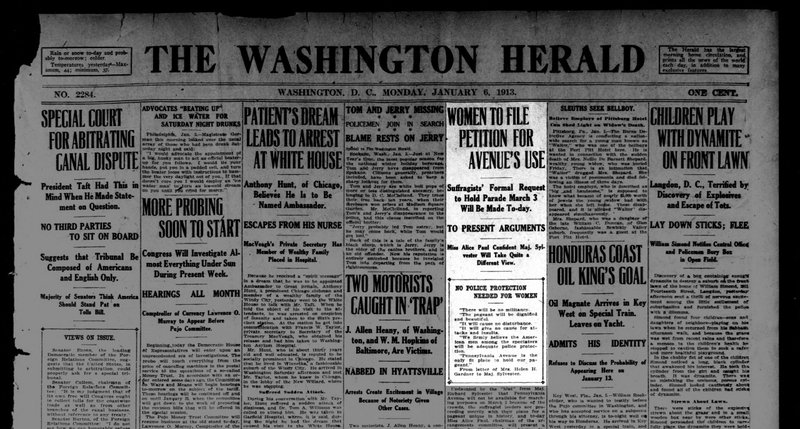
The march route controversy evolved publically in the press in January 1913. “The suffragists . . . do not intend to take ‘no’ for an answer,” the Washington Evening Star reported, “and will make a fight for the use of the Avenue.” The Washington Herald acknowledged that Pennsylvania Avenue was indeed “the famous thoroughfare of parades” and added that the “women believe only Pennsylvania Avenue, the route along which so many bodies have marched, is fitting.”
In 1967, Alice Paul recalled that she had sent suffragists Elsie Hill and her mother, Mary, into a meeting with Major Sylvester. Elsie’s father, and Mary’s husband, was Ebenezer J. Hill, then a Congressman from Connecticut. This was no accident, Paul pointed out to her interviewer — “the Congress supports and gives the money for the District police and everything else.”
On January 9, 1913, Alice Paul and the Congressional Committee received their permit to march on Pennsylvania Avenue. Major Sylvester, whom the suffragists subsequently praised extensively in the press, told reporters that he had never been opposed to the women marching on Pennsylvania Avenue, and had only been concerned for their safety.
Later that spring, some five to eight thousand women marched on Pennsylvania Avenue to call for women’s suffrage. They were met by a massive, violent crowd, and little police protection.
As per the D.C. Metropolitan Police Department’s reported street closures, on Saturday, January 21, 2017, the Women’s March on Washington will proceed west on Independence Avenue, having started just south of the Capitol at 3rd Street Southwest. The closest metro stop is L’Enfant Plaza (named in 1968 for the eighteenth-century Frenchman) on the Green and Yellow lines.
Independence runs east-west on the quieter lower edge of the Mall, half a mile south of Pennsylvania Avenue. In Ingram’s opinion the route is “a good, solid, workable route.” Marchers will file west to 14th Street, then turn north, before heading west again on Constitution Avenue. “I don’t think that there’s history [there],” Ingram said, “so it is an opportunity for us to carve out something that will have new meaning.”
Works cited
+“Coxey in Washington,” Harper’s Weekly, 12 May 1884
+ T.B. Veblen, “The Army of the Commonweal,” Journal of Political Economy, Vol. 2, No. 3, June 1894
+ www.janayeingram.com
+ Alice Paul interview with Amelia Fry, Regional Oral History Office, University of California, Berkeley
+ “Keep up the Fight,” Evening Star, 5 January 1913; “Suffragists to Fight Action,” Washington Herald, 5 January 1913
+ President’s Council on Pennsylvania Avenue, Pennsylvania Avenue: A Report (1964)
“The tides of taste, the scars of war and national emergencies, the shifting urban structure of the city, have all left their mark. But all the changes of a hurtling civilization have not altered the fundamental position and the value of the Avenue. So far as we can see into the future, this position and this value promise to remain.” - President’s Council on Pennsylvania Avenue, 1964
Originally published on January 20, 2017