FRONTLINE and NPR Investigate “The Healthcare Divide” in America — And How the Pandemic Has Exposed Growing Inequities
May 12, 2021
Share
The Healthcare Divide
Tues., May 18, 2021 at 10/9c on PBS and on YouTube
Streaming at 7/6c at pbs.org/frontline & in the PBS Video App
www.facebook.com/frontline | Twitter: @frontlinepbs
Instagram: @frontlinepbs | YouTube: youtube.com/frontline
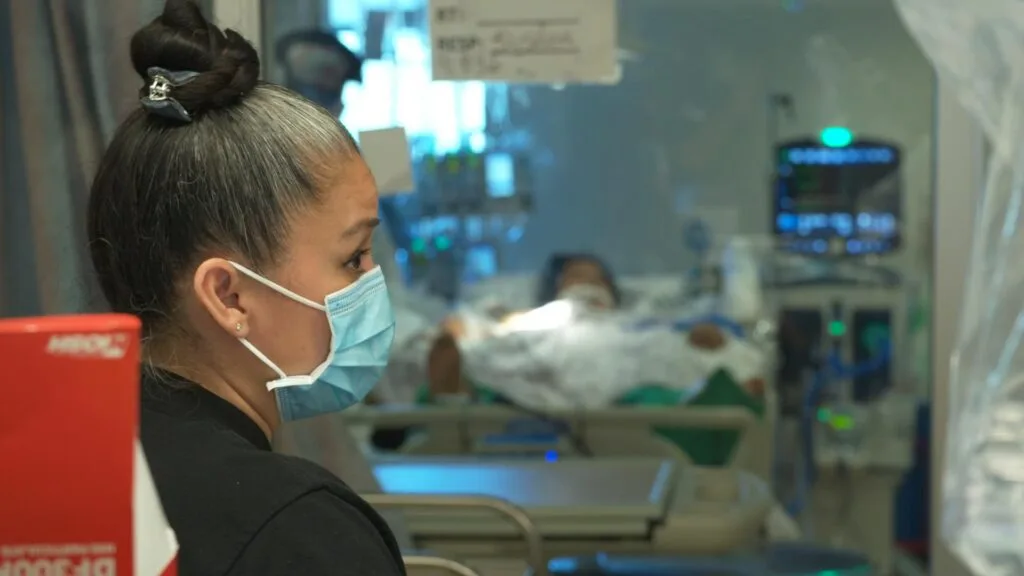
COVID has put a spotlight on disparities in American healthcare and the large urban hospitals hit hard by the pandemic.
But many of these “safety net” hospitals, whose primary mission is to serve low-income, working-class communities, have been in crisis for years.
This month, The Healthcare Divide, an investigation from FRONTLINE, NPR and American University’s Investigative Reporting Workshop, examines the market forces and uneven government support that are deepening the healthcare divide, with profits at some hospitals booming, while many safety nets struggle to stay afloat.
“I think we’re on the brink of a precipice,” Dr. Bruce Siegel, president of America’s Essential Hospitals, says in the film. “Even before the pandemic, many of these [safety-net] hospitals were losing money and the pandemic is only going to make that worse.”
“Unless there’s a substantive change in the way safety nets are funded, things are simply going to keep going in the direction they are, which is a great disparity in how patients are taken care of,” says Dr. Chris Young, chief of the medical staff at Erlanger, the safety-net hospital in Chattanooga, Tennessee. “That divide is only going to grow.”
The Healthcare Divide, a documentary from FRONTLINE producers Rick Young, Emma Schwartz & Fritz Kramer and NPR correspondent Laura Sullivan, premieres Tues., May 18, on PBS (check local listings) and online. NPR will air a story as a part of this joint investigation that same day on All Things Considered (see stations and local broadcast times and NPR.org/stations).
FRONTLINE, NPR and the Investigative Reporting Workshop have previously collaborated on numerous projects — most recently in Plastic Wars, an investigation of how the plastics industry publicly promoted recycling as the solution to the waste crisis despite internal industry doubts, from almost the beginning, that widespread plastic recycling could ever be economically viable. Other collaborative projects have included an in-depth look at Trump’s Trade War with China and investigations of Hurricane Maria and Hurricane Sandy relief efforts (Blackout in Puerto Rico and Business of Disaster), and America’s affordable housing crisis (Poverty, Politics and Profit).
Now, in The Healthcare Divide, this award-winning team probes why some hospitals are thriving and others are in dire shape.
“It’s a little unfathomable to me how a hospital system could be making a huge profit in the middle of a COVID pandemic,” says Dr. Brad Spellberg, chief medical officer at the safety-net hospital, LAC-USC Medical Center, where the documentary shows the heavy burden COVID took during the winter surge earlier this year. “This system itself makes no sense and when you have a system that makes no sense, there are going to be some winners and there are going to be some losers. Is that how you want your health care to be delivered?”
The documentary traces the story of the safety-net hospital Erlanger, whose struggle to stay afloat led it to focus on more profitable aspects of healthcare, raising concerns among the staff about the hospital’s dedication to its core mission.
“We were seeing patients in hallways and in the waiting room,” says Dr. Sudave Mendiratta, chief of emergency medicine at Erlanger. “It became very clear that spending money as an organization to gain market share and to increase volume was not effective to deliver quality care.”
The film also takes viewers to the hub of the healthcare industry: Nashville, where more than 50 years ago for-profit hospitals chains took root, most prominently Hospital Corporation of America, HCA. As the investigation shows, the growth of these hospital chains and the subsequent consolidation of the industry, both for-profits and nonprofits, has created a progressively competitive environment that has made it harder for safety-net hospitals to live up to their mission and stay afloat.
“So that dynamic you have today in American healthcare is that wealthy hospital systems are able to invest in [profitable business lines],” says Siegel. “They’re able to attract more commercial, privately insured patients. It makes it even more profitable and then they can invest even more. So you have the situation where, really you have two tiers in a way rich hospitals are getting richer and the poor hospitals are getting poorer.”
Says Jeff Goldsmith, a long-time healthcare consultant,“The real problem is the inequities in the society as a whole have reached the point where we really need to address them. The disparities in the circumstances of the hospitals are an outgrowth of a failure of social policy and politics. That’s what I believe. I’m not going to blame the hospitals.”
The documentary also explores how Medicaid’s reimbursements to hospitals are often lower than those made by private insurers — and how that has made it more difficult for safety nets to cover their costs. To help offset losses on Medicaid and care for the uninsured, the government gives many hospitals additional funding, called supplemental payments. But the team uncovers how in Tennessee, this program isn’t keeping up with the increasing costs safety-net hospitals face.
“Your findings really show that in Tennessee, there’s obviously something worth examining going on,” says Diane Rowland, a former top adviser to Congress on Medicaid. “I suspect that one would find similar differences among other states.“
At the end of the day, the fact that Medicaid pays hospitals less than private insurers “is completely a result of the structural racism baked into the fabric of how we pay for healthcare and how the Medicaid program has been underfunded over time,” Siegel says.
The Healthcare Divide premieres Tues., May 18, at 10/9c on PBS stations and will also be available to stream on FRONTLINE’s website, YouTube and the PBS Video App. NPR will air a story as a part of this joint investigation that same day on All Things Considered (see stations and local broadcast times and NPR.org/stations).
###
Credits
The Healthcare Divide is a FRONTLINE production with American University School of Communication’s Investigative Reporting Workshop in collaboration with NPR. The writer and director is Rick Young. The producers are Emma Schwartz & Fritz Kramer. The correspondent is Laura Sullivan. The senior producer is Frank Koughan. The executive producer for FRONTLINE is Raney Aronson-Rath.
About FRONTLINE
FRONTLINE, U.S. television’s longest running investigative documentary series, explores the issues of our times through powerful storytelling. FRONTLINE has won every major journalism and broadcasting award, including 95 Emmy Awards and 24 Peabody Awards. Visit pbs.org/frontline and follow us on Twitter, Facebook, Instagram, and YouTube to learn more. FRONTLINE is produced at GBH in Boston and is broadcast nationwide on PBS. Funding for FRONTLINE is provided through the support of PBS viewers and by the Corporation for Public Broadcasting. Major funding for FRONTLINE is provided by the Ford Foundation. Additional funding is provided by the Abrams Foundation; the John D. and Catherine T. MacArthur Foundation; Park Foundation; and the FRONTLINE Journalism Fund with major support from Jon and Jo Ann Hagler on behalf of the Jon L. Hagler Foundation.
About NPR NPR, which is celebrating its 50th anniversary this year, is widely known for its rigorous reporting and unsurpassed storytelling that connects with millions of Americans every day — on the air, online, and in-person. NPR strives to create a more informed public — one challenged and invigorated by a deeper understanding and appreciation of events, ideas, and cultures. With a nationwide network of award-winning journalists and 17 international bureaus, NPR and its Member Stations are never far from where a story is unfolding. Listeners can find NPR by tuning in to their local Member stations (npr.org/stations), and now it’s easy to listen to our stories on smart speaker devices. Ask your smart speaker to, “Play NPR,” and you’ll be tuned into your local Member station’s live stream. Your speaker can also access NPR podcasts, NPR One, NPR News Now, and the Visual Newscast is available for screened speakers. Get more information at npr.org/about and by following NPR Extra on Facebook, Twitter and Instagram.
About the Investigative Reporting Workship at American University The Investigative Reporting Workshop publishes in-depth stories about government and corporate accountability, on topics ranging widely from the environment and health to national security, immigration and the economy. The nonprofit news site was founded in 2008 by longtime investigative journalist Charles Lewis, who continues to report and write for the site and national publications. One of the goals of IRW is to train the next generation. To that end, IRW pairs graduate students as researchers and reporters with professional staff at The Washington Post and FRONTLINE (PBS). The Healthcare Divide is IRW’s 14th co-production with FRONTLINE and filmmaker Rick Young and his team.
FRONTLINE Press Contact: frontlinemedia@wgbh.org, 617.300.5312
NPR Press Contact: mediarelations@npr.org
Support provided by:
Learn More
Latest Documentaries



Explore
Policies
Teacher Center

Jon and Jo Ann Hagler on behalf of the Jon L. Hagler Foundation
Corey David Sauer
Koo and Patricia Yuen
FRONTLINE is a registered trademark of WGBH Educational Foundation. Web Site Copyright ©1995-2025 WGBH Educational Foundation. PBS is a 501(c)(3) not-for-profit organization.
Funding for FRONTLINE is provided through the support of PBS viewers and by the Corporation for Public Broadcasting, with major support from Ford Foundation, and Fialkow Family Foundation. Additional funding is provided the Abrams Foundation, John D. and Catherine T. MacArthur Foundation, Park Foundation, Heising-Simons Foundation, and the FRONTLINE Trust, with major support from Jon and Jo Ann Hagler on behalf of the Jon L. Hagler Foundation, and Corey David Sauer, and additional support from Koo and Patricia Yuen. FRONTLINE is a registered trademark of WGBH Educational Foundation. Web Site Copyright ©1995-2026 WGBH Educational Foundation. PBS is a 501(c)(3) not-for-profit organization.