A New Offensive Threatens to Deepen Yemen’s Humanitarian Crisis
June 13, 2018
Share
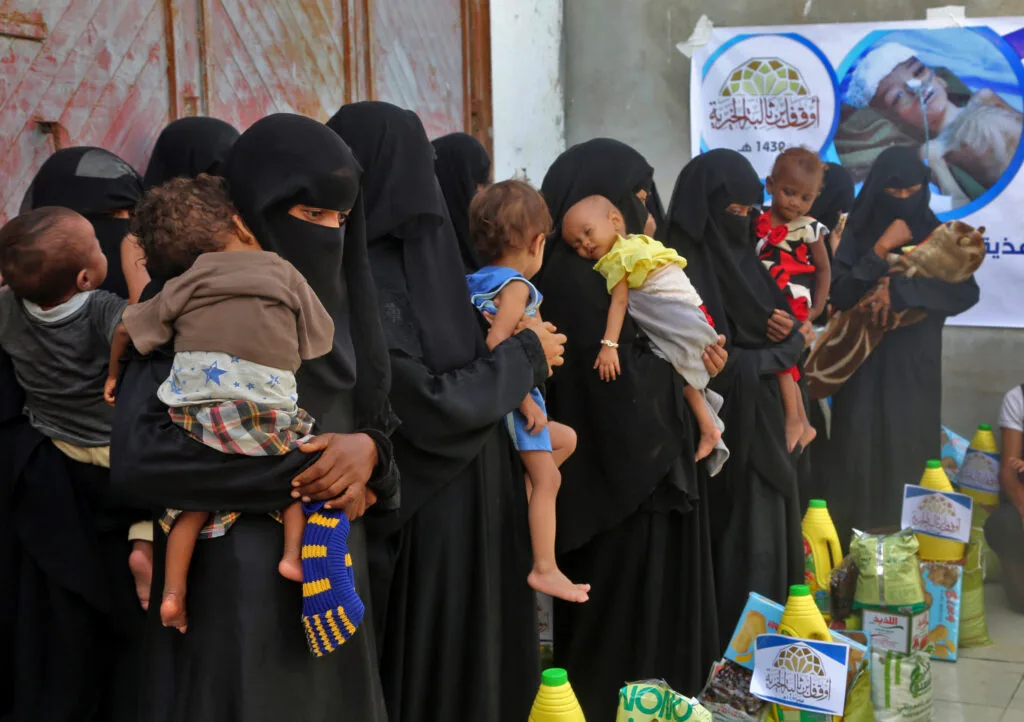
Yemen’s civil war has already led to what the United Nations described as the world’s worst humanitarian crisis — at least three million displaced by fighting, a cholera epidemic that is now the largest outbreak ever recorded, and eight million people on the brink of starvation.
Yemen has become a battleground for warring factions in the Middle East for the past several years. In Sept. 2014, a group of rebels, the Houthis, wrested control of the Yemeni government. By March 2015, a coalition led by Saudi Arabia, which views the Houthis as an Iranian proxy, had launched a military intervention. The resulting warfare has left the country in shambles, and Yemeni civilians have paid the highest price.
Today, June 13, the Saudi-led coalition launched an offensive that aid organizations warned will make the humanitarian catastrophe in Yemen even worse.
Saudi Arabia, the United Arab Emirates, and UAE-backed Yemeni forces launched an assault to retake Hodeidah, a Houthi-held port city through which 70 to 80 percent of commercial and humanitarian supplies enter Yemen. Saudi Arabia has accused Iran of smuggling missiles into the country using the port at Hodeidah, according to The Wall Street Journal — a charge that Iran denies.
A Saudi-owned network reported “intense and concentrated” strikes near the port, according to the BBC. Yemen’s government in exile said its forces and the Saudi-led coalition’s troops launched the assault after “exhausting all peaceful and political means.”
But aid groups said the port is a lifeline for millions of Yemenis, who depend on the port to import food and other commodities. “A military attack or siege on Hodeidah will impact hundreds of thousands of innocent civilians,” Lisa Grande, the U.N.’s humanitarian coordinator for Yemen, warned in a statement before the offensive began. “In a prolonged worst case, we fear that as many as 250,000 people may lose everything — even their lives.”
A year ago, FRONTLINE’s Martin Smith was able to enter Yemen to see the consequences of the war. At one hospital, he met staff tending to severely malnourished children. A nurse told him, “For sure, it’s a consequence of the war. The war is behind the malnourishment. And it is only getting worse. The cases have increased. There is a food shortage.”
The United States, which has been providing the Saudi-led coalition with military assistance including help with targeting and refueling since 2015, warned against the offensive as recently as last week, according to Foreign Policy.
On Monday, Secretary of State Mike Pompeo released a statement saying he had “made clear our desire to address [the Emirati leaders’] security concerns while preserving the free flow of humanitarian aid and life-saving commercial imports.”
But in a report on the offensive, the International Crisis Group warned that the battle was unlikely to be either quick or decisive. “The most likely outcome” it said, was “prolonged and destructive fighting.”
Earlier this week, Defense Secretary James Mattis told reporters that he was in touch with the U.N. special envoy to Yemen, Martin Griffiths, about how the U.S. might potentially support the international body’s humanitarian efforts, and try to “drive this to a negotiated… end of the fighting.”

Digital Editor, FRONTLINE
Support provided by:
Learn More
Related Documentaries


Latest Documentaries


Related Stories

Inside Yemen
Related Stories
Inside Yemen
Explore
Policies
Teacher Center

Jon and Jo Ann Hagler on behalf of the Jon L. Hagler Foundation
Corey David Sauer
Koo and Patricia Yuen
FRONTLINE is a registered trademark of WGBH Educational Foundation. Web Site Copyright ©1995-2025 WGBH Educational Foundation. PBS is a 501(c)(3) not-for-profit organization.
Funding for FRONTLINE is provided through the support of PBS viewers and by the Corporation for Public Broadcasting, with major support from Ford Foundation, and Fialkow Family Foundation. Additional funding is provided the Abrams Foundation, John D. and Catherine T. MacArthur Foundation, Park Foundation, Heising-Simons Foundation, and the FRONTLINE Trust, with major support from Jon and Jo Ann Hagler on behalf of the Jon L. Hagler Foundation, and Corey David Sauer, and additional support from Koo and Patricia Yuen. FRONTLINE is a registered trademark of WGBH Educational Foundation. Web Site Copyright ©1995-2026 WGBH Educational Foundation. PBS is a 501(c)(3) not-for-profit organization.