From the Archives: A Conversation With Julian Bond
August 17, 2015
Share
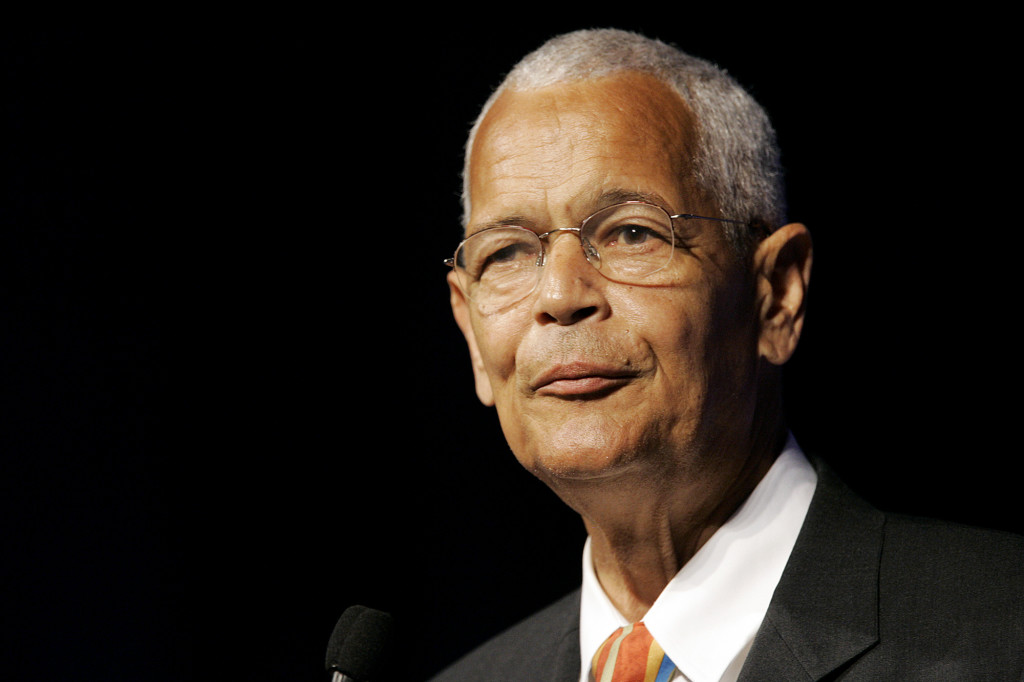
Julian Bond, the co-founder of the Southern Poverty Law Center and longtime chairman of the NAACP, died on Saturday at the age of 75.
For more than five decades, Bond was one of the leading figures of the nation’s civil rights movement. His activism dated back to the 1960s, when he founded the Student Nonviolent Coordinating Committee, leading student protests against segregation in Georgia. He would later go on to serve in the Georgia General Assembly for 20 years.
“Justice and equality was the mission that spanned his life,” President Barack Obama said in a statement on Sunday. “Julian Bond helped change this country for the better. And what better way to be remembered than that.”
Over the years, FRONTLINE interviewed Bond on at least two occasions for his perspective on some of the most pressing issues facing the nation’s African-American community. In 2011, he spoke with us about the scourge of AIDS in black America, calling the problem “a civil rights issue.”
In 1997 — ahead the 30th anniversary of Martin Luther King, Jr.’s death — Bond sat with Henry Louis Gates, Jr. for our film The Two Nations of Black America. The conversation focused on the struggle to address the divide between the poor and the middle-class within the African-American population. Nearly two decades later, his remarks still hold resonance.
“I look back over my life, which is longer than just the mid-60s, and I see change, improvement, progress,” Bond told Gates. “But in the immediate short-term you have to be pessimistic. … Nobody seems to want to spend money for this population at the bottom.”
Here is more from that conversation:
Did we win the civil rights revolution?
We won it in the sense that we eliminated legal segregation in America. That is no more; that is finished. If you look at the young people I teach and compare them with myself at that age, their lives are so much richer and fuller. Opportunity is so much greater they can do things that I couldn’t imagine doing. So in that sense sure, this was an enormous victory. We vanquished in the space of about five years a system that had been in place for almost 100 years. We confused discrimination and racism. We confused the poverty caused by discrimination with poverty caused by larger structural flaws in the economy. We have yet been able to come up with a strategy to deal with them. So we won, but we haven’t won.
How would the world be different if you had been successful?
I think you would see many more black people scattered throughout the economy. Not just at the top. Not just this bulging middle class we’ve got now. But in blue collar jobs you would see a much fairer distribution of black Americans up and down the economic ladder rather than being bunched in this big poverty group at the bottom and this big middle class in the middle and this tiny upper class at the top. Our position would more nearly mirror the position of the larger society, and had we been successful, the larger society would also have changed a bit.
Since the day Dr. King was assassinated in 1968, the black middle class has roughly tripled – doubling in the Reagan era alone. Nevertheless, 45 percent of all black children live at or beneath the poverty line– No model predicted that?
A couple of things happened. First, this middle class I think owes its existence to both affirmative action and the expansion of opportunity for people with skills and training. And so the number of not just doctors and lawyers and stockbrokers but black bank tellers, black policemen, black electricians just ballooned in this period particularly in the Reagan years. As doors opened and people with skills and training and drive walked in.
“We confused discrimination and racism. We confused the poverty caused by discrimination with poverty caused by larger structural flaws in the economy. We have yet been able to come up with a strategy to deal with them. So we won, but we haven’t won.”Secondly, the economy began to shift. As skills and energy became more of a demand, people who didn’t have skills just got left behind, got shuttled to the side. Education didn’t keep up with their promise. Education didn’t prepare them for this new world. Jobs went overseas. Organized labor, which had been an enormous boost for black workers or black union members make more money than blacks who are not in unions, began to weaken. Things just changed. The movement couldn’t develop a strategy to deal with it and couldn’t find allies of the larger society to help shape those strategies.
Why not? We were very clever in analyzing race and racism for a couple of centuries….
Because we had studied it for a couple of centuries. We had been confronted by it for a couple of centuries. We knew it for a couple of centuries, but we didn’t know this. For one reason or another just weren’t able to come to grips with it. But then I don’t think the American liberal community has been able to come to grips with it either.
Are we better off today than we were in 1967?
I’m not sure. I think so. I think there is probably greater racial tolerance nationwide now than in ’67. These disruptions we see over the Simpson verdict are simply telling us that these divisions still exist. Simpson doesn’t create these divisions. Those divisions are there and the fact that we know them now. That we see newspaper analysis of them. That we hear television commentators talking about them I think is a sign of progress not of regression. So in that sense sure, we are much better off, but we are not where we should have been if we followed the progress say from ’60 forward. From ’60 forward to the mid-60s we are doing well. Then we come to these bumps and slowness and almost frozen in place.
Is it fair to say that there are two nations within the African American community today? The have and the have nots?
Oh, yes, it is absolutely. When I was a kid, I grew up in the circumstance where my near neighbors were poverty stricken people and even when I was in my 20’s living in Atlanta, my near neighbors were people on welfare. That’s not true anymore. I don’t live in a neighborhood with anyone except people like me. People who are poor who are living on the edge of poverty or who are living under poverty are tucked away some place else. I don’t see them; they don’t see me; we don’t interact; we have no relation one to the other; no physical relation.
No, you have the symbolic cultural relation in that where you wear your kente cloth of a bow tie and cummerbund with your tuxedo and have your obligatory Coltrane poster on your wall and listen to black music or celebrate black culture. But that’s not the same as being a member of the community.
No, it’s not at all. We are the same here, but we are not the same in any other way. We are physically separated from each other in a way we never were before.
Yet we still vote when we vote. We tend to vote overwhelmingly for liberal left candidates –democratic presidential candidate, etc. It seems to me that it is very difficult to imagine how to connect these two strands of the black community together again.
It is difficult, and of course there are all kinds of ways in which it is being done. There are these mentoring programs, and the fall-out from Million Man March suggests that many, many more black man are engaging people in the poverty population. Mentorship boys programs, all those kinds of things. That’s all to the better but something beyond that is needed. You can’t just make these weekend visits to the ghetto and feel you have somehow closed the gap, which I think is getting wider and wider not closer and closer.
If you had the power, all the money in the world to solve the problem, how can we solve it? And define the problem….
The problem is the inability of the economy to absorb this large population at the bottom and that population’s distance from the economy because of lack of skill and training and any kind of job experience. So here are these two elements of our society that have no relation of one to the other. So you’ve got to do something to equip this group, train, skills, make sure that the kind of education they receive is the kind of education most other Americans receive, not all, but most other Americans receive.
Then also make sure that once they are able, that there is some place they can go. You know if you train people to be electricians, and they are locked in the inner city far away from almost all their electricity, what are they going to do? How are they going to practice their trade? How are they going to get to it? Are there openings for electricians? Is there a chance for these people to get some work so unless you connect these two things, you are not going to do anything.
But does that mean that we have to move people out of the inner city?
I think so. I don’t think these plans for development of enterprise zones or opportunity zones or whatever they are now called, I don’t think they hold any real promise. I think you have to put people where jobs are or you have got to make them able to go from home to job and most city black people and even most rural black people don’t live where jobs are. Jobs are in this ring around the city and unless you can get into that ring and bring with you some skill and some training or at least the aptitude for skill and training, forget it.
But many of our black politicians are only elected because of those concentrations of black people in the inner city so they tend to be against any kind of migration or relocation–the very same migration that brought people from the south as you well know starting at the turn of the century and particularly through World War I and the Great Depression.
Well, they have got to make some accommodation. They have got to either learn how to sell their program to an increasing number of white voters and hope they will be rewarded with an election victory or they’ve got to say I am just abandoning this little group I have pulled together to elect me to public office.
One of the sad things that happened after the ’65 Voting Rights Act in the election of all these black elected officials is a great many of them decided that the number of voters required is the number of voters required to elect me. Once I’ve got that number, forget about it. The attempts at building coalition, at spreading the message, widening the opportunity — political opportunity — just went by the board.
Why did affirmative action work so well in its early stages? You said earlier that the reason that we have so many black people in the middle class is because of entitlement programs such as affirmative action.
I think it was because it was not initially viewed as black advantage must equal white disadvantage. It was viewed initially as opportunity. Here is John Smith, capable, talented, skilled. All you need to do is change one of these qualifications that has nothing to do with his job but will allow him to compete for it. He can do it, and she can do it. But slowly over time–I think largely because of the growing power, strength and cleverness of the right wing movement almost since 1964 to turn the Republican Party into the white people’s party– the combination of these things began to create a victim class of white men to the point now where white men are the largest group of complainants before the equal opportunity employment committee.
No one anticipated that result.
No one anticipated that, and I think in almost every case with some exceptions, there is no validity. These claims that these white men are being shouldered aside by minorities and women. What’s happening is the economy has only so many positions. All of a sudden over the last 20 to 30 years, new people — women and racial minorities — are saying we want those jobs too. Not everybody can get one of these jobs and the people who are pushed aside are now claiming some grievance.
Are they justified?
In a minute fraction of the cases, I think they are justified. In the large number — you know if I ask my students don’t each of you know some white kid who should be here because his SAT scores were higher than that of John Robinson or Mary Smith, every single one of them will go up. Then I will say did all of you get in here because you had good SAT grades? Well, actually no, I am the president of the Chess Club or I played football or my dad went to school here, and that’s why I got in here.
These are white kids?
These are white kids. So there is this perception that racial minorities and women are shouldering white people aside. That’s not the reality. In 99 out of 100 case, it does not happen. But the perception is real, and the perception is felt.
Who within the black community benefitted the most from affirmative action?
First, I think it was college educated people. People who should have been getting decent jobs all along but couldn’t because of ordinary racism and affirmative action helped to mute that. These people moved into the kind of jobs that their training and skills suggested they should have had. Secondly, I think it was people just a step below that. High level blue collar jobs. People who again should have had the jobs but because of racism couldn’t get it. Now I think it is a larger and larger pool — not large enough — of people who come to the job market, come to the school and find that affirmative action has created a structure that allows them to compete. They are the beneficiaries of it. But we have not found a way, and I don’t think affirmative action is the way to effect that population down at the bottom. They need something more.
Right, well, the myth was that this was a neo version of up from slavery. ‘We are going to reach into the ghetto and drop off all of these kids at Harvard.’ That’s not really what happened.
It’s not what happened. It shouldn’t have been in retrospect expected to have happened. Affirmative action isn’t a poverty program. It shouldn’t be criticized for not having eliminated poverty in black America. Nobody beat Rodney King because he was poor. Right. People weren’t saying, “you poor guy. I am going to beat you up.”
They beat him because he was black. These people at the bottom face educational disability, skill disability, training disability. Their problems are not precisely those of the black college graduate who has got skill, who got ability, and who ought to have that job. So something new has got to be developed for them.
But how do we know where race starts and class stops or class starts and race stops?
I don’t think you can always tell. I think these things overlap so much in our society that it is hard to separate one from the other. So if you are talking about this large population at the bottom, you have got to have a two-track program. You have got to make sure that given skill and given training, given education that race doesn’t become an additional barrier. But you also if you don’t have the skill, education, and training, then nothing works.
Given this political climate, how likely is it that the noble goals that you set out for solving the problem, for changing what I think of as the bell curve of class can actually be achieved?
Well, I have to tell you I am an optimist. I look back over my life, which is longer than just the mid-60’s, and I see change. I see improvement; I see progress. So I’ve got to think I can see more in the next span of my life. So I am optimistic. But in the immediate short-term you have to be pessimistic about it. Nobody wants to pay anything for anything. Nobody wants to give more money to schools except perhaps the president and then only so kids who are already there can do better. Nobody seems to want to spend money for this population at the bottom which is going to be in desperate straights now that this welfare repeal has passed the congress and signed by the president. So in the short run you’ve got to be pessimistic about it.
Could you go back to the civil rights movement a bit and chart it out for me, doctor, because we tend to forget now every King day. Basically the whole country takes off, and we hear “I have a dream” a thousand times on the radio. The King family is marketing the King logo in very important ways sort of the kitchification of Dr. King. That’s important in terms of naturalizing a culture and one’s people’s achievements. But I remember when people would stand up — I was a teenager — but people would stand up and call Martin Luther King a handkerchief head. That his day was over. Am I misremembering?
No, you don’t misremember at all. I was on the student non-violent coordinating committee. We thought we were the bad boys and girls of the civil rights movements.
We were bad.
No one dared to go before. We used to in a kind of affectionate way call Dr. King “da lawd.” ‘Here come the Lord; here come the Lord; here come the Lord.’ We were critical of this notion that a man is going to come and save you. We pushed the notion that there is within each of us some leadership ability and that leaders spring up out of a movement. They don’t create movements. Movements throw them up and throw them out and put them on the podium and put them on the platform. So yeah, that’s true.
Then there came a point where we began to pull away from non violence, not just as a tactic but non violence period.
“We pushed the notion that there is within each of us some leadership ability and that leaders spring up out of a movement. They don’t create movements. Movements throw them up and throw them out and put them on the podium and put them on the platform.”Most of the people in my organization were wedded to non-violence as a tactic. Strongly so. You are on the picket lines and somebody hits you, don’t hit back. More and more we began to think that if I am walking down the street and somebody hits me, he better be ready because I am going to hit him back. Then more and more if I’m on the picket line and somebody hits me, I am not going to take it anymore. I think the nature of the work we did, the low pay we were getting, the negative experiences we had with government and that sort of orthodox liberalism in the United States just soured us on the chance of any progress being made using the techniques that we have made or the techniques that King suggested that we made.
What effect did the Panthers have?
Well, kind of two effects. One is sort of people who weren’t in Oakland looked at them from afar and most of the times cheered them on. Kind of irritated they had stolen from us that Panther symbol and attached it to…
Oh, the Black Panther party in Alabama?
Yes, the Black Panther party in Alabama and attached it to their party. But interested in their free breakfast programs, interested in their concern for the community, interested in their ability to work with the lease of our communities, which is what we had thought we were doing to. But then they, as you know, became involved in this enormous internal warfare with each other and fell victim to this romanticizing of them that took place throughout the right/left….. and they crashed.
And with a lot of help from J. Edgar Hoover.
Yes, an enormous amount of help from J. Edgar Hoover.
What happened to the black white coalition, particularly the coalition between liberal Jews and liberal blacks in the ’60s?
The black Jewish coalition, which has always been contentious. If you look back over 80 years, it has always been contentious, fell apart through a variety of reasons. First, Israel was seen as being more endangered, and many American Jews said I can’t worry these other things, I’ve got to focus on Israel. Secondly, the anti-war movement attracted many liberals including many Jews and took them away from the civil rights movement. Thirdly, and probably most importantly, there is a strain of anti-semitism in black America that also has got a long and pathetic history but it began to flourish and flower again in the middle 1960s. That too caused this alienation between blacks and Jews. You could see it play itself out in New York city. Because we are such a New York centric population in this country, we imagined that this narrow New York lesson an American lesson. Blacks and Jews fighting in New York; they must be fighting every place else. They weren’t. But we took this lesson. We applied it everywhere. This estrangement just drifted apart. It’s interesting, however, that in the Congress, black and Jewish congressman still vote together almost as a unit both on civil rights and on aide to Israel so the division while real is not as real as it seems to be.
Do you think that it would be a good idea to try to put the coalition back together, or is it possible to put it back together?
I think you have to put it back together because black Americans can’t make it by ourselves. We’ve got to have allies, and Jews are natural allies. Here are these two fellow victims of discrimination of different sorts and different kinds. But two fellow victims and they have a commonality and an interest in making sure this discrimination is rolled back. But you can’t build a coalition on the graves of Goodman, Schwarner, and Chaney. You have to renew this coalition almost everyday.
What about coalitions with poor Hispanic people?
Absolutely. With Hispanics, with organized labor. But you know it requires that black Americans realize that we are not competing with these people for pieces of the small pie. What we ought to do is join with them in trying to create a larger pie so there is something there for each of us.
When Dr. King was near the end of his life he appeared to be moving in a new direction toward an economic analysis of the problem for the Black person in this country, particularly through things like the poor people’s campaign. Help me to understand that.
Well, he had seen legal segregation struck down largely through efforts of the movement that he lead. He had seen Black people win the right to register to vote with the protection of the federal government and access to lunch counters and movie theaters and that kind of petty apartheid just swept away. But here are Black people still not part of the mainstream, still not economically integrated into the larger society, and he saw large numbers of whites and Hispanics and others equally excluded, perhaps not for the, all the same reasons, but equally excluded.
And so he put together this coalition of Appalachian whites, of Hispanics from the West Coast and from Texas, Black people from the rural south and urban north, and hoped that he would be building the poor people’s movement, movement of poor people to demand federal action that would help solve their common problems, having already solved at least a portion of the racial problem of what he hoped would be the main component of this coalition. His death, and other factors, killed the chance of that happening, but it needs to happen again.
Because The Talented Tenth, as Du Bois put it at the turn of century, was busy through affirmative action scrambling into the new broader American middle class.
The Talented Tenth was winning its own place in society, working hard, scuffling hard, and was being separated from this population at the bottom and had no relationship with this population at the bottom.
Do you think the leadership abilities within the talented tenth are stronger now than they were when you were a young buck going around fighting the revolution in the mid 60s?
I think the abilities are greater and the skill level is higher. I’m not sure if the commitment to the larger mass is as great. It seems to me that this physical separation has also caused an intellectual separation. When I was a college student we used to have all these great lights in Black American come and talk to us and these were largely men and some women who seemed to be, to me to be concerned about everybody. These were race men, race women, they weren’t nationalists, but they were race people. I’m not sure if, although we have a lot of race people today, if they have the same concern, or if they bring the same high level of commitment. And this could be just nostalgia for misspent youth, but somehow or another I just don’t feel that we have the same concern for everybody from the very top to the very bottom, and that we focus so much on entrepreneurship, on creating businesses, that we forget that most people in America, not most Black people, most people in America, don’t own businesses, they work, they get a paycheck, they own a salary and we need to concentrate on that large numbers of us who are not going to be entrepreneurs, who are going to go to jobs every day, and we need to find them jobs, we need to get them the skills, and we need to make sure they can succeed.
Who did you admire, among the leaders at the time in the 60s, who were your heroes?
Oh, just like a new one every week. At Morehouse they would bring these figures and they talked to us, I can remember Mordecai Johnson, the president of Howard University, spoke at my high school graduation for three hours! Didn’t use a note. General Benjamin O’Davis came to speak to me, spit and polish in a uniform. You think Colin Powell looks good? Shoot, this guy looked like a Black Cary Grant, I mean, he was just, he was a military man. Young Martin Luther King came to speak to my college, it was his college as well. Every figure of substance, Lester Grainger of the Urban League, Roy Wilkins of NAACP, came through Morehouse College and all these other sites in Black America, and held up an image of what a leadership figure ought to be, you didn’t have to agree with everything every one of them did, but here you saw dynamic, committed men who had made race their life’s work.
Do you think that we’re victims of nostalgia today, those of us in the postmodern talented tenth, you see books like Once Upon a Time We Were Colored, my own Colored People, August Wilson’s recent declaration that we need Black theaters in Black communities, throw all the white people out of the boards of our arts organizations in cities with a population that’s Black over 60 percent. Are we in danger of romanticizing the past? Would you go back to that world if you could?
No, I would never go back to that world, not in a minute. I think we over-romanticize the past. I think there was a lot about it that was attractive and nurturing and wholesome, but a lot about it was evil and awful and the people who lived in that world, even though I may have lived next door to the doctor and the doctor lived next door to the welfare recipient, there wasn’t always much communication between them. There was a rigid class division while we lived in the same neighborhood, while we lived on the same block. So no, I would never go back to that world. There’s a lot attractive there, a lot of nostalgia, the granny sitting on the porch, saying, I’m going to tell your mama when you come home. But no, I wouldn’t go back.
Would you say that we have a crisis of black leadership?
I think we have a crisis of leadership and followship, and it works both ways. I speak on these college campuses and these kids tell me, Mr. Bond, there was an awful racial incident here last week. I wish Jesse Jackson would come here! Well, he’s not coming, he’s someplace else. Why should he come? Why can’t you do it? Why do you have to wait for him? He’s too busy. And then I think there’s this leadership crisis which thinks things can’t happen without me. If I’m not there, it’s not a movement. And so these two groups which want each other and need each other so badly are almost at odds with each other, neither one able to move without the other, and it paralyzes the whole of us.
But is it possible, in a nation within a nation, as we are, 35 million people, and remember, there are only 27 million Canadians, is it possible for a King-like figure ever to emerge again?
I think maybe, but I don’t think we ought to wait for him or her. We need to move ahead with what we can do with our own resources, our own abilities. I can’t give an I Have a Dream speech, but I can talk! And some college student may not be able to reach the oratorical heights of Jesse Jackson, but he can organize, or she can pull her classmates together or can go down into the neighborhood near the school and help people there help kids with their schoolwork or help people form a buying coop or help them run a rent strike or get that traffic light at the school crossing, or do all of those things. We don’t have to wait for somebody to tell us to do those things, we can do those things ourselves.
Well, what are the responsibilities of those of us who are making it to those still trapped at the lower end of the bell curve?
I think they are numerous, they are first because we have the power of access public forums to articulate the pain and the suffering of those who don’t seem able to speak for themselves, and to reach back to those, and see if we can’t pull them up, go to them, work with them, do anything and everything we can to say, listen, you’re somebody. I don’t want to sound like Jesse Jackson, but you are somebody. You have worth, you have humanity, you can be what you want to if you get this, if you get this, if you get that, and some of that is within your own power to get.
Is their plight something that you worry about, that you think about actively?
I don’t want to say I’m consumed about race, because you can’t be, but you read in the newspapers of these attempts to roll back affirmative action and you see this growing hostility in the larger world to any initiative that assists, that aids Black people, and think of the work already done, and you wonder, gee will this ever end.
Yeah, do you feel guilty about it?
I feel as if I and others have never done enough, and we never be able to do enough.
When we were growing up, in the 50s, the blackest thing you could be was Thurgood Marshall or Dr. King–or one of those race men or women that you’ve described so well. But now, I read recently the results of a Gallup Poll survey–inner city kids here in Washington–and it said, list ‘things white.’ And on that list were the following: getting straight A’s in school, speaking standard English, visiting the Smithsonian. Now, if anybody had said anything like that in my neighborhood, first of all their mother would have beat their butt and then they would have checked them into a mental institution. What happened to us?
I do not understand this perversity that doing well is white. When I was a kid doing well was doing well, and you were held up as a standard to the others who, so they could achieve to do as well as you could. And the kid who got the best grades or got admitted to the college or won the oratorical contest or the essay contest, we applauded and cheered and revered these people.
And the spelling bees were big in Piedmont, West Virginia — beat that white boy in that spelling bee!
Oh yes, absolutely. You had not only to be as good as, you had to be better than. Jackie Robinson could hit the ball further, could catch the ball easier, could run faster, could do things better than white people could do. And why this has, reversal has occurred, at least on the level of academic achievement, is a mystery to me.
How can we change it Julian, we have to do something about it, otherwise there will always be two Black communities.
I’m not sure how you change it. I think in the schools you’ve got to raise up and celebrate those kids who do well. You’ve got to connect doing well there with doing well in life. You’ve got to point out that those Johnny and Sally who skipped out on the day of the test, their future is dim, their future is dark. The best they can hope for is McDonalds, and maybe not even that. But I have a feeling that teachers are doing that, are saying that now, and why that message is not getting through, maybe needs to come from more places, from more voices, maybe you got to talk to mom and dad, maybe we’ve got to make sure people come to the PTA, but that is a horrific, horrific thing for young people to believe.
What about the role of the church, more. I remember talking to Cornel West about whether or not anyone but Mr. Farrakhan could have called the Million Man March, and I said, no one could have called it. And he said, oh, there’s one group could have called it. And I said who, and he said the Black Baptists, he said there’re 14 million Black Baptists. What about the role of the church?
Well, the church has always been a bulwark of Black America, but it’s a mistake for us to think that during the heyday of the movement that every church was involved. In Birmingham in 63, for example, only a small circle of Black ministers supported Dr. King and supported the movement. The rest stood aside and preached that there was salvation, but it wasn’t here on earth, it was after you’ve passed, shuffled off this mortal coil.
And don’t rile up that white man.
Exactly. I get the impression that more and more Black churches are realizing they’ve got to engage in this community they’re in, that their membership, overwhelmingly female, doesn’t speak to the problems of young Black men who are out there in the streets, some of them selling drugs, some of them going nowhere, some of them with no futures at all. And I get the impression that more and more are reaching out, more and more are doing. But as I say, I don’t think any of us do enough, and Black churches have never and do not now do enough. They don’t use this enormous resource, the money, the physical facility, the leadership ability of the ministers, the leadership abilities that the members learn in running the deacon board, don’t use that to the fullest extent possible.
And they could, in addition to forming economic coalitions and becoming an economic base within the larger society, seems so me that they too could perpetuate Black culture to make Sunday school culture school, like Hebrew school, for example.
Oh, absolutely. When I was a kid, and I hate I feel like my dad, “when I was your age,” when I was a kid, it was in the church or at Spelman College where you heard …Marian Anderson sang in Black churches. Our artists, our writers, our intellectuals, found an audience in the Black church. I guess they find that audience on Black college campuses and on campuses that celebrate Black history month now, but I think you’re absolutely right. These places out not just be centers of spiritual uplift and instruction and training, but of moral training and of intellectual training and culture preservation. They did it and they can do it again.
Last question. How do we regenerate more values within the African-American community? I mean you hear so much political rhetoric about the man or about white racism but very few people are willing, in public, to say we have moral and ethical responsibilities to and of ourselves. How do we go about regenerating that spirit among our own people?
I think it comes down partially to leadership, and two people who consistently talk about this are Louis Farrakhan and Jesse Jackson. And when Jackson talks about it he’s accused of being reactionary. When Farrakhan talks about it people say it’s just a cover for your anti-Semitism.
But I think we need to listen to them when they speak about this and we need to have this message repeated over and over and over again by the minister in the pulpit, by the businessman on the job, by the schoolteacher in the classroom, by the PTA president, by this whole range of leadership that runs up and down through our community.
“I can’t give an I Have a Dream speech, but I can talk! And some college student may not be able to reach the oratorical heights of Jesse Jackson, but he can organize. …”And you’ve got to start telling our young people that listen, mom and dad are the best model for a family, mom and dad are the best model if you’re thinking about children and mom and dad ought to be married and dad ought to have the chance of a job, mom too as well, but you’ve got to just thunder this into people and even grab them by the shoulders and shake them, I think.
But you’ve got to get this message in children, you’ve got to get this message in high school kids, you’ve got to spread this message through society that being a decent person, living an honest just life, that’s the hallmark of being a good citizen. It’s not just voting, it’s not just being a member of the NAACP, it’s living a good life, a decent life and we can do it, I think.
One more question. I did an essay for Sports Illustrated in 1991. I had their research department count the number of black lawyers, black dentists, black doctors and black athletes and it turns out that there were 20,000 black lawyers and 1200 black professional athletes in all sports including the minor leagues. Now nobody believed that statistic. How did we get to the point where our people think it’s easier to be Michael Jordan than Vernon Jordan?
I think many of our people don’t know Vernon Jordan because he is such an insider, but Michael Jordan is just everywhere. We see him everywhere. So you’ve got a big fight there to expose the Vernon Jordans of this world and compare them with the Michael Jordans. For all we know Vernon may make more money than Michael as quiet as it’s kept. But I think Vernon has to go to schools and say look at me, I’ll tell you what I do, I advise the president of the United States, I help decide policy that affects every single American, black, white and otherwise, and other people like him to be held up, promoted as models.
These people were my models, the Vernon Jordans of my generation were my models and we’ve got to put these models out there. There’s got to be more — I mean Michael is a wonderful guy, I wish I could do that but it’s a dream for me and it’s a dream for these kids. We’ve got to say this is a dream, you can’t do it.
How much of this problem is black America’s problem, how much is America’s problem?
I don’t think you can quantify it and say 50-50 or 90-10 or anything like that. It’s obvious that racism, to me at any rate, is an overwhelming problem for black Americans and if it were to be removed today tomorrow the economic, social, political, educational condition of black Americans would just bloom. Wouldn’t be perfect but it would bloom because the previous racism from today back has caused so much disadvantage it’s going to take time to overcome that.
Having said that, there are many things we should be doing that have nothing to do with white people, nothing to do with racism, to help ameliorate the conditions we find ourselves living in. We ought to be in block clubs, we ought to be at the PTA, we ought to be doing this, we ought to be doing that, we ought to join — we ought to do the American thing and join organizations. We do this by the millions. I mean we’re in every kind of group you can name. You name a group, we’re in it. And you look in our neighborhoods for groups and we’re in them, and we’ve got to turn the energy of these groups towards civic uplift.
Not towards civil rights, towards civic uplift, toward picking up the trash in the street, toward helping the kids in school, toward doing this, toward doing that, toward doing this, nothing to do with white people. So I can’t say it’s 90% them and 10% us or 50-50 but it’s an equally shared responsibility andI don’t believe white people have picked up their share, I don’t believe black people have either.

Former Digital Editor
Support provided by:
Learn More
Latest Documentaries






Explore
Policies
Teacher Center

Jon and Jo Ann Hagler on behalf of the Jon L. Hagler Foundation
Corey David Sauer
Koo and Patricia Yuen
FRONTLINE is a registered trademark of WGBH Educational Foundation. Web Site Copyright ©1995-2025 WGBH Educational Foundation. PBS is a 501(c)(3) not-for-profit organization.
Funding for FRONTLINE is provided through the support of PBS viewers and by the Corporation for Public Broadcasting, with major support from Ford Foundation, and Fialkow Family Foundation. Additional funding is provided the Abrams Foundation, John D. and Catherine T. MacArthur Foundation, Park Foundation, Heising-Simons Foundation, and the FRONTLINE Trust, with major support from Jon and Jo Ann Hagler on behalf of the Jon L. Hagler Foundation, and Corey David Sauer, and additional support from Koo and Patricia Yuen. FRONTLINE is a registered trademark of WGBH Educational Foundation. Web Site Copyright ©1995-2026 WGBH Educational Foundation. PBS is a 501(c)(3) not-for-profit organization.