How One Texas High School “Dropout Factory” Tried to Transform
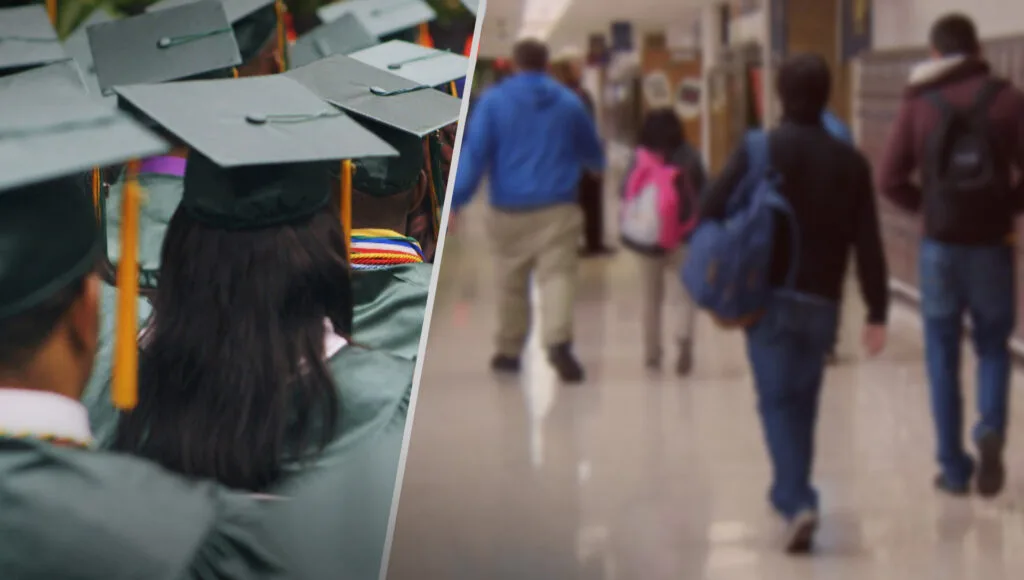
A 2012 FRONTLINE documentary investigated how one underperforming Houston high school sought to transform itself and the futures of its students.
May 20, 2026
Share
Over a decade ago, the U.S. was in the throes of a dropout crisis. Hundreds of thousands of high school students left school every year without graduating. Some estimates from that time were even higher. The issue prompted news headlines, investigations and studies. Obama administration officials talked about it in interviews and speeches, calling for reform.
Amid this backdrop, FRONTLINE spent a semester immersed in one school that had a reputation as a “dropout factory,” and had set out to transform itself and the futures of its students. A high-stakes experiment — an educational reform program called Apollo 20 — was underway at Houston’s Sharpstown High School to rescue students from the edge.
What resulted was an unforgettable look at the lives of four students and the educators waging a daily personal struggle to get them to graduation. Now, for the first time, Dropout Nation — produced by Frank Koughan with co-producer Lisa Kalikow — is available on YouTube as part of an ongoing effort to make FRONTLINE’s multi-decade film archive widely available for streaming.

The students featured in the documentary faced varied obstacles to succeeding in school: A lack of family support, stable housing, food, or money.
These were unfortunate and common circumstances for many students at Sharpstown, according to Rob Gasparello, then principal of Sharpstown High. “Our kids come from stuff that we don’t even want to think about. We can’t even begin, I don’t think, to grasp and understand,” he said. “What poverty does is, our kids come and go. They start academically a year or two behind. Somewhere along the way, they’ve gotten lost and they have to catch up. You see the signs — erratic behavior. Sometimes it’s isolation. Sometimes it’s just blatant acting out, excessive absences.”
At the time, Sharpstown had been identified as one of several Houston schools with a dropout rate that was too high. It was selected to participate in the Apollo 20 program alongside 19 other schools to close achievement gaps. The program set out to change the culture and methods of the participating schools with a few core tenets, including extra class time, tutoring, data-driven teaching, and high benchmarks for educators.
The documentary notes how dropping out can affect someone’s job prospects, and it’s also correlated with difficult life outcomes, and costs to the larger economy. Inversely, the more education one receives the higher their earnings and healthier their lives.
One of the students featured in the documentary, Marco, dropped out of school his junior year to financially support his family after his father was deported.
“I was 17 at the time, 16, and I was, like, working 40 hours or more a week, which I still do,” Marco said in the documentary. “I was never used to that life, you know, so I just had to suck it up.”
Marco worked at a deli counter but recalled how his mother wanted him to go back to school. “My mother, she cared. She used to tell me, ‘You’re going to go back to school one day, right?’ And I was, like, ‘Yes, Mom.’ I have to graduate from high school, no matter what. My brother didn’t do it, and I don’t want to be cutting grass like him,” he said.
In one scene, Marco admitted he had half the credits he needed to graduate. But, he said, he could finish the credits if he worked hard. “I know I can. Just Saturdays, just come in every Saturday, I think I can,” he said. “I just got to up my effort so I can graduate this year.”
Ebony Washington, a drop-out prevention case worker at Sharpstown, said she noticed Marco taking initiative and hoped he would graduate.
“Together we can,” Marco said.
“Whatever it takes,” Washington replied.
“No excuses,” Marco said.
Watch the Documentary
Dropout Nation
Journalism powered by your support — and accessible to all.
Watching our “Scammed” documentary revealing how the global scam industry operates? Exposing the truth is where accountability begins. Help keep reporting like this paywall-free for everyone with a gift of $5 or $10 today.
Tow Journalism Fellow, FRONTLINE/Newmark Journalism School Fellowship, FRONTLINE
Email:
leo_miranda@wgbh.orgSupport provided by:
Learn More
Related Documentaries






Latest Documentaries






Related Stories
Dropout Nation
Related Stories
Dropout Nation
Explore
Policies
Teacher Center

Jon and Jo Ann Hagler on behalf of the Jon L. Hagler Foundation
Corey David Sauer
Koo and Patricia Yuen
FRONTLINE is a registered trademark of WGBH Educational Foundation. Web Site Copyright ©1995-2025 WGBH Educational Foundation. PBS is a 501(c)(3) not-for-profit organization.
Funding for FRONTLINE is provided through the support of PBS viewers and by the Corporation for Public Broadcasting, with major support from Ford Foundation, and Fialkow Family Foundation. Additional funding is provided the Abrams Foundation, John D. and Catherine T. MacArthur Foundation, Park Foundation, Heising-Simons Foundation, and the FRONTLINE Trust, with major support from Jon and Jo Ann Hagler on behalf of the Jon L. Hagler Foundation, and Corey David Sauer, and additional support from Koo and Patricia Yuen. FRONTLINE is a registered trademark of WGBH Educational Foundation. Web Site Copyright ©1995-2026 WGBH Educational Foundation. PBS is a 501(c)(3) not-for-profit organization.