How Much Did the Financial Crisis Cost?
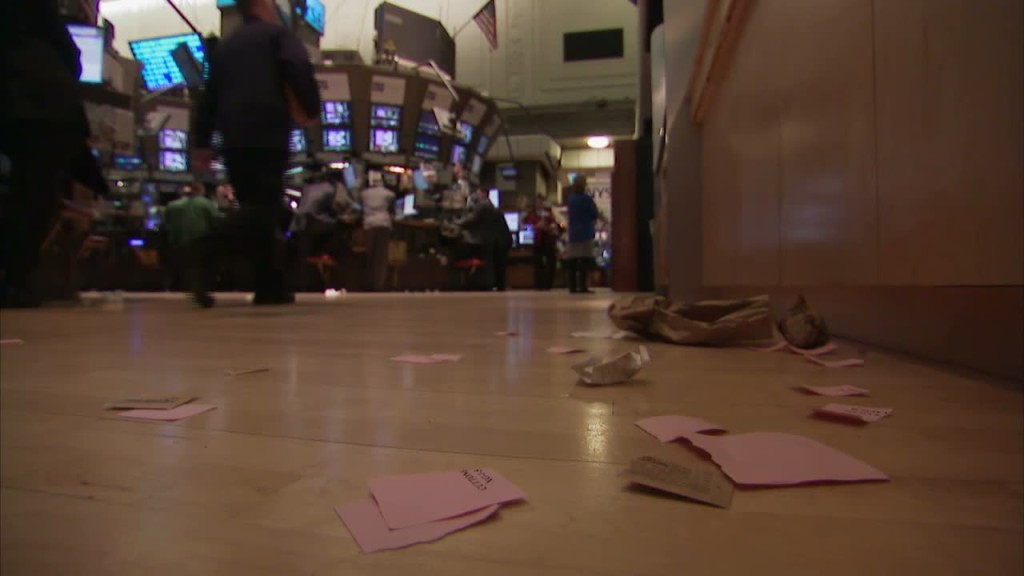
May 31, 2012
Share
There’s little in the way of comprehensive bean-counting when it comes to the financial crisis. That’s in part because it’s still unfolding.
But also because much of the human fallout can’t really be monetized. For example, the Treasury Department, in an April assessment [PDF], put the total lost household wealth at $19.2 trillion. But that doesn’t take into account long-term effects of homeowners who may be less socially mobile — and therefore contribute less to the economy over time.
Better Markets, a nonprofit watchdog for financial regulatory reform, recently attempted to analyze the full cost of the financial crisis, pulling together government data and outside studies. The group admits its own estimate [PDF] isn’t complete, either, but it lays out five major indicators to try to offer a more comprehensive accounting of the crisis:
- Gross Domestic Product: The report notes the massive difference between the actual and potential GDP — now estimated at about $2.6 trillion, according to a January Congressional Budget Office report.
- Unemployment: The rate peaked at 10.1 percent in October 2009, but it’s still at 8.1 percent today. That’s 12.5 million people who are out of work, not saving for retirement and not contributing to the GDP.
- Government bailouts: The government has poured about $23 trillion into a host of programs and bailouts.
- Lost household wealth: With home prices tanking, the report estimates a loss of $7 trillion in the real estate industry. The stock market decline has brought another $11 trillion in losses, and retirement accounts have lost $3.4 trillion.
- Human suffering: It’s hard to put a dollar value on this. But the report found plenty of grim data to offer some insight: The Census Bureau’s 2010 estimate of 46.2 million people in poverty is the “largest number in the 52 years for which poverty estimates have been published.”
You can read more detailed analysis of the factors in the full report [PDF]. And if you’re still wondering how it all went wrong, check out our four-part series, Money, Power and Wall Street.

Former Series Senior Editor, FRONTLINE
Support provided by:
Learn More
Related Documentaries

Latest Documentaries







Related Stories

Money, Power and Wall Street
Related Stories
Money, Power and Wall Street
Explore
Policies
Teacher Center

Jon and Jo Ann Hagler on behalf of the Jon L. Hagler Foundation
Corey David Sauer
Koo and Patricia Yuen
FRONTLINE is a registered trademark of WGBH Educational Foundation. Web Site Copyright ©1995-2025 WGBH Educational Foundation. PBS is a 501(c)(3) not-for-profit organization.
Funding for FRONTLINE is provided through the support of PBS viewers and by the Corporation for Public Broadcasting, with major support from Ford Foundation, and Fialkow Family Foundation. Additional funding is provided the Abrams Foundation, John D. and Catherine T. MacArthur Foundation, Park Foundation, Heising-Simons Foundation, and the FRONTLINE Trust, with major support from Jon and Jo Ann Hagler on behalf of the Jon L. Hagler Foundation, and Corey David Sauer, and additional support from Koo and Patricia Yuen. FRONTLINE is a registered trademark of WGBH Educational Foundation. Web Site Copyright ©1995-2026 WGBH Educational Foundation. PBS is a 501(c)(3) not-for-profit organization.