How the U.S. Has Responded to Allegations of China’s Human Rights Abuses
April 7, 2020
Share
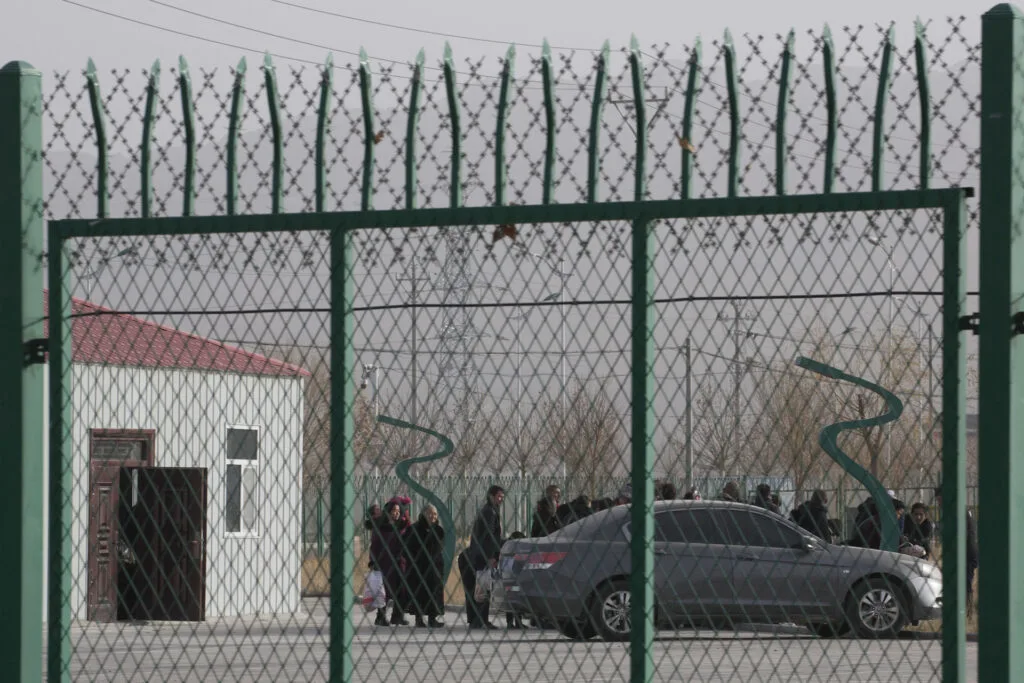
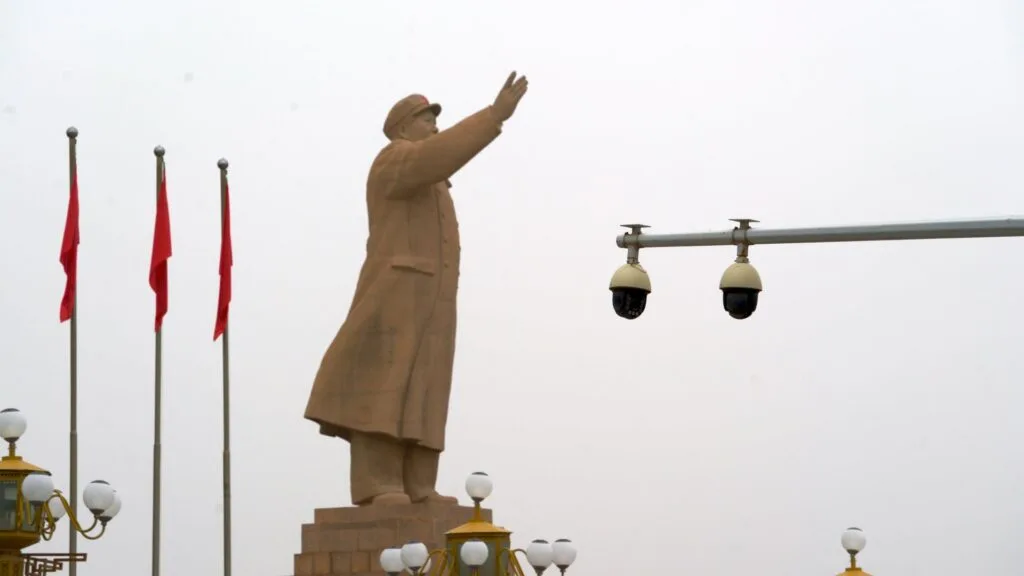
For years, the U.S. led other nations in condemning mass detentions and other abuses of Uyghurs and other Muslims in Xinjiang, China.
More recently, new and troubling reports began to emerge: some detainees were also being forced to work in factories, producing products for export.
One of those detainees was a woman named Gulzira, who told her story in FRONTLINE’s China Undercover. After a year in a “re-education” facility, Gulzira said she was sent to a “slave factory,” where she was made to sew gloves for nearly three months. For each pair of gloves she stitched, she told FRONTLINE, she was promised 0.1 yuan, or about one American cent, along with her eventual release.
“We sewed gloves and they said, ‘We will sell these gloves to America, Kazakhstan, England, Germany,’” she said. “When we got there, there were poor Uyghurs working there. They were told, ‘You will work at the factory, if you don’t work you will be taken [back] to be re-educated.’ So they had no choice.”
China has long denied the allegations that it is complicit in forced labor, saying that any programs connecting Uyghurs to factory jobs are a form of poverty relief.
Last year, a bipartisan group of lawmakers held hearings to examine China’s treatment of Uyghurs and whether American consumers were unwittingly buying products linked to forced labor.
“What you’re basically saying is that there isn’t a single American today that has not worn clothes or used a tech device that is not either funded or has been directly created by forced labor in China?” Sen. Marco Rubio, a Florida Republican, asked researcher Adrian Zenz during those hearings.
“This is the trend,” Zenz said.
U.S. law prohibits the import of any product made with forced labor. But the burden is on accusers to prove that abuses are happening along the supply chain. Last month, the Australian Strategic Policy Institute identified 83 companies that it says are “directly or indirectly benefiting from the use of Uyghur workers,” including several major American brands.
Most companies named in the report have denied any connection to forced labor, said Vicky Xu, a journalist-turned-researcher with the institute. But given the lack of transparency in Xinjiang, she said that can be difficult to prove either way.
“In the past two years there haven’t really been any audits that have happened in Xinjiang, just because it’s too dangerous,” she said. “Even the companies with goodwill, who want to correct this, have no idea what’s going on.”
In December, the Senate passed a bill sponsored by Rubio and Sen. Bob Menendez, (D-N.J.), that would direct President Donald Trump to impose sanctions and restrict potentially implicated imports from China over the treatment of the Uyghurs.
A few months later, in March, Rubio and Congressman Jim McGovern (D-Mass.) introduced a second piece of legislation: the Uyghur Forced Labor Prevention Act. If passed, it would require companies importing products from Xianjiang to prove that their supply chain is free of forced labor.
Then the global pandemic hit. Both bills are still pending, but human rights advocates worry that the broad support the bills once had may wane as lawmakers scramble to address the current crisis.
“There are some members of Congress that are very focused on this issue and have been unrelenting,” said Amy Lehr, director of the Human Rights Initiative at the Center for Strategic and International Studies. “Relatively speaking, the U.S. government has done more than some other governments. It’s just a hard issue to make progress on.”
Former Tow Journalism Fellow, FRONTLINE/Columbia Journalism Fellowship, FRONTLINE
Support provided by:
Learn More
Related Documentaries


Latest Documentaries


Related Stories
Related Stories
Explore
Policies
Teacher Center

Jon and Jo Ann Hagler on behalf of the Jon L. Hagler Foundation
Corey David Sauer
Koo and Patricia Yuen
FRONTLINE is a registered trademark of WGBH Educational Foundation. Web Site Copyright ©1995-2025 WGBH Educational Foundation. PBS is a 501(c)(3) not-for-profit organization.
Funding for FRONTLINE is provided through the support of PBS viewers and by the Corporation for Public Broadcasting, with major support from Ford Foundation, and Fialkow Family Foundation. Additional funding is provided the Abrams Foundation, John D. and Catherine T. MacArthur Foundation, Park Foundation, Heising-Simons Foundation, and the FRONTLINE Trust, with major support from Jon and Jo Ann Hagler on behalf of the Jon L. Hagler Foundation, and Corey David Sauer, and additional support from Koo and Patricia Yuen. FRONTLINE is a registered trademark of WGBH Educational Foundation. Web Site Copyright ©1995-2026 WGBH Educational Foundation. PBS is a 501(c)(3) not-for-profit organization.