Inside Jesse Jackson’s Historic 1988 Presidential Run
Following the civil rights icon’s death, the streaming premiere of an archival FRONTLINE documentary is bringing a key element of his legacy into focus. 'Running with Jesse' is available to watch now.
March 3, 2026
Share
Following the death of the Rev. Jesse Jackson, the streaming premiere of an archival FRONTLINE documentary on the civil rights icon is bringing his political legacy into focus.
Running with Jesse, an up-close chronicling of Jackson’s history-making 1988 presidential campaign, is now streaming online for the first time, after initially being broadcast on PBS in 1989. The documentary offers remarkable insights into the journey of the first Black American to become a serious contender for the presidency, the controversies that followed him, and his vision for the country.
“You have to have tough skin and a tender heart,” Jackson said in the documentary as he knew his campaign was winding to a close. “Don’t shout too much when you win, and don’t cry too much when you lose. You really have to be able to bounce back.”
Running with Jesse producers Orlando Bagwell and Jeanne Jordan followed Jackson and his campaign across six months during the 1988 primary season. Jackson had first run for president four years earlier, despite never being elected into a political office. At the start of his second run, the documentary reports, political analysts often dismissed him as a protest candidate who would appeal only to Black voters.
But roughly seven million people — more than two million of them white — voted for Jackson and his populist message in the 1988 primaries and caucuses. He won in 13 states, becoming the runner-up for the Democratic presidential nomination.
The film documents firsthand how Jackson’s emphasis on building coalitions, his calls to “keep hope alive,” and his magnetism resonated across divides. Susan Olesen, a Jackson volunteer in Greenfield, Iowa, described the candidate’s campaign-trail visit to her church: “We got lemonade for fifty people and hoped we wouldn’t be embarrassed, and the church was filled to overflowing,” she said in the film. “There was almost 1,000 people there. And he spoke to us that night and he talked about rural people joining forces with urban people.”
With close access to Jackson, his campaign staffers, his supporters and detractors, and the journalists covering him, Running with Jesse is a profound historical record of how his campaign fit into the larger political landscape in America, and how it played out.
"I was amazed that America did as well to understand Jesse as they did."
It was not a campaign without controversy, the documentary reports — from the lack of an endorsement from a number of Jackson’s civil rights movement contemporaries, to his fraught relationship with the Jewish community. Though Jackson never won a majority among white voters, the documentary traces how he still defied electoral expectations, connecting with everyone from farmers in Iowa to auto workers in Detroit as he worked to bring disenfranchised people together and into the political process.
“This is America, and America is a 90%-white country, and it not only is white in its skin color, it still thinks white,” civil rights leader Andrew Young said in the 1989 documentary. “I was amazed that America did as well to understand Jesse as they did. And I think it was a tremendous victory for lots of reasons.”
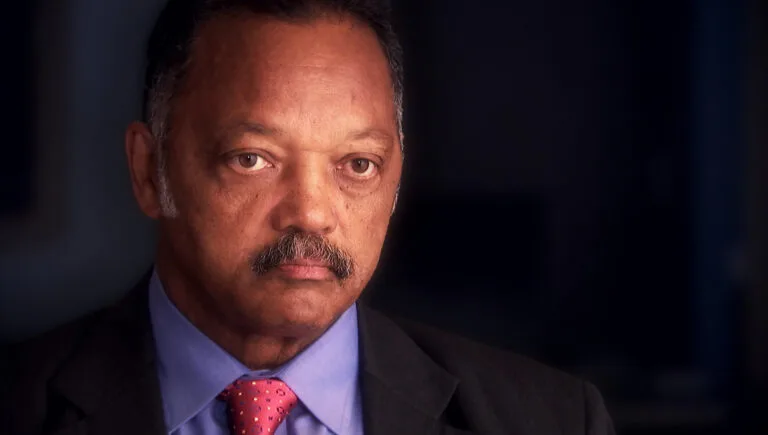
Running with Jesse offers powerful insights into what Jackson’s campaign signified for many.
Maxine Waters, who worked on Jackson’s campaign and went on to become a U.S. representative, said in the film, “If Jesse Jackson had not run, we really never would have known that there would have been so many people of all colors and all economic backgrounds that would have voted for him.”
“Somebody has to start it. And someone has to build upon it,” Waters said. “I don’t think things this big and this important get lost.”
Stream Running with Jesse on FRONTLINE’s YouTube channel.
Keep Our Journalism Strong. Donate Today.
Your support makes it possible for FRONTLINE to produce bold investigative documentaries on the issues that matter most. Donate today to help sustain this work through the months and years ahead.

Senior Digital Writer, FRONTLINE
Related Documentaries





Latest Documentaries





Related Stories
Running with Jesse
From the Archives: Jesse Jackson on the Rise of Barack Obama
Related Stories
Running with Jesse
From the Archives: Jesse Jackson on the Rise of Barack Obama
Explore
Policies
Teacher Center

Jon and Jo Ann Hagler on behalf of the Jon L. Hagler Foundation
Corey David Sauer
Koo and Patricia Yuen
FRONTLINE is a registered trademark of WGBH Educational Foundation. Web Site Copyright ©1995-2025 WGBH Educational Foundation. PBS is a 501(c)(3) not-for-profit organization.
Funding for FRONTLINE is provided through the support of PBS viewers and by the Corporation for Public Broadcasting, with major support from Ford Foundation, and The Fialkow Family Foundation, as part of the Plum Bush Foundation. Additional funding is provided the Abrams Foundation, Park Foundation, John D. and Catherine T. MacArthur Foundation, Heising-Simons Foundation, and the FRONTLINE Trust, with major support from Jon and Jo Ann Hagler on behalf of the Jon L. Hagler Foundation, and Corey David Sauer, and additional support from Koo and Patricia Yuen. FRONTLINE is a registered trademark of WGBH Educational Foundation. Web Site Copyright ©1995-2025 WGBH Educational Foundation. PBS is a 501(c)(3) not-for-profit organization.