Forever Chemicals, Carpet Companies and a ‘Crisis That’s Not Fully Understood’
PFAS chemicals once used in manufacturing popular stain-resistant carpets have contaminated the environment and water in parts of Georgia and Alabama. A new documentary investigates how it happened — and the ongoing health impacts.
February 3, 2026
Share
For decades, PFAS, a group of manmade forever chemicals prized for their water- and stain-resistance, have been ubiquitous in U.S. manufacturing, found in everything from nonstick pans and raincoats to shoes and carpets.
But these chemicals, which take decades or longer to degrade, are also being found elsewhere: in the environment, in drinking water — and in people. Researchers have linked high levels of some PFAS types in human blood to serious health problems.
It’s an issue that comes into sharp focus in northwest Georgia, home to some of the world’s largest carpet companies, which for decades used products containing PFAS to make carpets stain resistant.
Dana Barr of Emory University’s Rollins School of Public Health, an environmental scientist, tested PFAS levels in the blood of nearly 200 residents in the region: “We’ve compared them to the general U.S. population, and their values are much higher than the general U.S. population.”
A new documentary that’s part of a multiplatform joint investigation explores why.
Contaminated: The Carpet Industry’s Toxic Legacy examines how, in a region where carpet mills dominate the local economy, stain-resistant products became critical to the industry’s success.
“The PFAS was in these chemicals that provide stain resistance,” Jason Dearen of The Associated Press says in the above video drawn from the documentary. “So PFAS got into the water, because when that washes off the carpets, it ended up going into the drains to the local utility and ultimately ending up in the river water.”

The river system, which travels through the region and into Alabama, is contaminated with PFAS and supplies drinking water to more than 200,000 residents, the investigation found.
Produced as part of a local-national reporting collaboration among FRONTLINE, The Associated Press, The Atlanta Journal-Constitution, The Post and Courier and AL.com, Contaminated: The Carpet Industry’s Toxic Legacy premieres Feb. 3 on PBS and online. It examines how communities in the South became contaminated with PFAS from carpet mills, and the ongoing health impacts.
“It really is still a crisis that’s not fully understood,” Dylan Jackson of The Atlanta Journal-Constitution says in the above video drawn from the documentary.
Over much of the past year, a consortium of journalists from the partner news outlets — with support from FRONTLINE’s Local Journalism Initiative and AP’s Local Investigative Reporting Program — reviewed thousands of pages of documents and court depositions, and interviewed former regulators and industry insiders, as well as doctors, scientists and people who have the kinds of illnesses that researchers have linked to PFAS contamination.
“Can we figure out a solution to mitigate the damage that’s been done?” Stormy Bost, a 34-year-old mom with high levels of PFAS in her blood who is living with non-alcoholic fatty liver disease, asks in the documentary. Some types of PFAS have been linked to diseases of the liver.
As the above video reports, the carpet industry has long insisted it’s not to blame for PFAS getting into the environment, arguing that the chemical companies obscured the risks and assured the carpet industry the products they were supplying were safe. But recently reviewed records also show that executives from the two largest carpet companies in the U.S., Shaw Industries and Mohawk Industries, Inc., received warnings dating back decades about potential harms of some types of PFAS. And with little regulation until recently, the reporters found that for years both the carpet companies and their suppliers were able to legally switch among stain-resistant products that contained different PFAS compounds.
The carpet companies say they stopped using any kind of PFAS in U.S. manufacturing in 2019, and the industry also says that it has always complied with legal and regulatory standards and guidelines. Since PFAS are so persistent in the environment, communities and local governments say the contamination problem is too vast for them to fix alone. As Contaminated explores, there are now lawsuits against both carpet and chemical companies, and uncertainty and feelings of betrayal are boiling across the region.
“Every single part of the regulatory framework that should have addressed this compound essentially left somebody else to handle it. And in the end, no one has,” Jesse Demonbreun-Chapman, whose clean water advocacy group has sued the chemical and carpet companies over PFAS contamination, says in the documentary. “We’re left with drastic contamination in this region, and these aren’t the only communities that are facing this problem.”
For the full story, watch Contaminated: The Carpet Industry’s Toxic Legacy and explore related reporting from The Atlanta Journal-Constitution, The Post and Courier, AL.com and the AP. The documentary will be available to watch Feb. 3, 2026, at pbs.org/frontline and in the PBS App starting at 7/6c, and at 10/9c on FRONTLINE’s YouTube channel and PBS stations (check local listings). The documentary will also be available on PBS Documentaries on Prime Video. Contaminated: The Carpet Industry’s Toxic Legacy is a FRONTLINE production with Five O’Clock Films in association with the AP, The Atlanta Journal-Constitution, AL.com and The Post and Courier. The writer, director and producer is Jonathan Schienberg. The producers are Kate McCormick and Dana Miller Ervin. The reporters are Jason Dearen of the AP, Dylan Jackson and Justin Price of The Atlanta Journal-Constitution and Margaret Kates of AL.com. The editors of the AP’s Local Investigative Reporting Program are Ron Nixon and Justin Pritchard. The investigative editor of The Atlanta Journal-Constitution is Brad Schrade. The senior editor of FRONTLINE’s Local Journalism Initiative is Erin Texeira. The senior producer is Frank Koughan. The editor-in-chief and executive producer of FRONTLINE is Raney Aronson-Rath.

Senior Digital Writer, FRONTLINE
Related Documentaries









Latest Documentaries









Related Stories
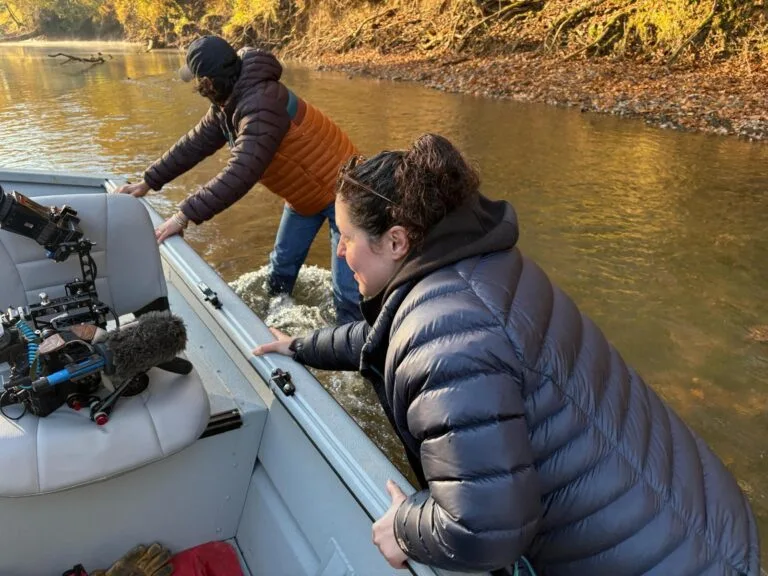
Following the Chemicals: Documenting PFAS Contamination in Southern Communities
Contaminated: The Carpet Industry’s Toxic Legacy
Related Stories
Following the Chemicals: Documenting PFAS Contamination in Southern Communities
Contaminated: The Carpet Industry’s Toxic Legacy
Explore
Policies
Teacher Center

Jon and Jo Ann Hagler on behalf of the Jon L. Hagler Foundation
Corey David Sauer
Koo and Patricia Yuen
FRONTLINE is a registered trademark of WGBH Educational Foundation. Web Site Copyright ©1995-2025 WGBH Educational Foundation. PBS is a 501(c)(3) not-for-profit organization.
Funding for FRONTLINE is provided through the support of PBS viewers and by the Corporation for Public Broadcasting, with major support from Ford Foundation, and Fialkow Family Foundation. Additional funding is provided the Abrams Foundation, Park Foundation, John D. and Catherine T. MacArthur Foundation, Heising-Simons Foundation, and the FRONTLINE Trust, with major support from Jon and Jo Ann Hagler on behalf of the Jon L. Hagler Foundation, and Corey David Sauer, and additional support from Koo and Patricia Yuen. FRONTLINE is a registered trademark of WGBH Educational Foundation. Web Site Copyright ©1995-2026 WGBH Educational Foundation. PBS is a 501(c)(3) not-for-profit organization.